SolveItClass 9 · NCERT

NCERT Solutions · Class 9 Social Science Democracy

29 questions · 29 still being checked

Questions and activities 6.1–6.12 (part 6 of 6)

  1. Exercise 6.1

    Read the passage and answer the questions that follow: A school cabinet was responsible for planning a Republic Day celebration, and members had different opinions on which activities to include. After a discussion, they decided to vote, and the activities supported by the majority were selected. a. Which democratic values are reflected in this situation? b. How does voting help resolve differences of opinion? c. Why is the majority decision important in a democracy? d. Mention responsibilities of elected representatives after a decision is made.

    The book prints no answer for this

    NCERT publishes no answers for this textbook, so there is nothing in the book to check this working against. It has also not yet been read through by hand.

    a. Which democratic values are reflected in this situation?NCERT_Solution_Class9_SocialScience_Ch6_QA_Q6-1
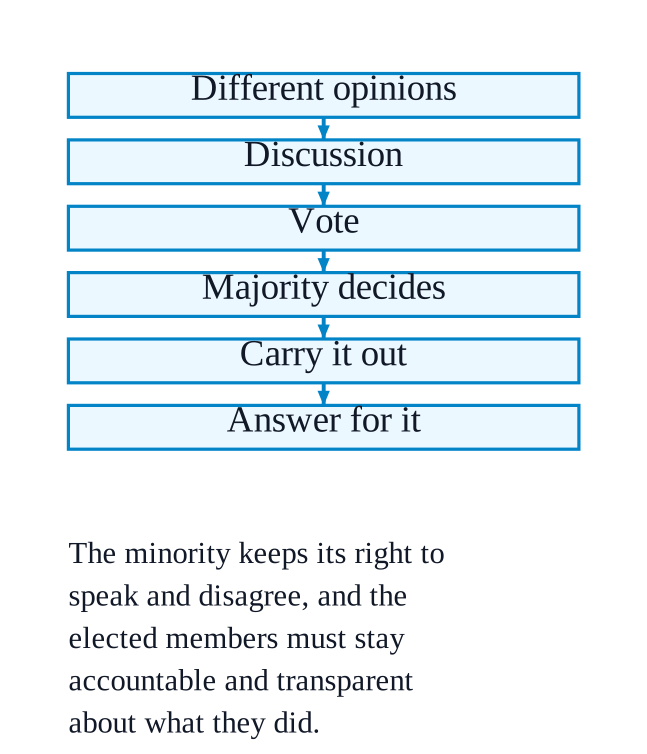
    Discussion and deliberation — the members talked before deciding, instead of one person announcing the plan.
    Respect for different opinions, including those that lost — dissent was allowed, which the chapter lists as a value of the legislative process.
    Equality and participation — every member's vote counted the same.
    Peaceful resolution of disagreement — the difference was settled by ballot, not by force or influence.
    b. How does voting help resolve differences of opinion?
    It gives every member an equal say and turns a disagreement into a countable result.
    It produces a clear decision so the group is not stuck arguing.
    Because the process is fair, even those who lose can accept the outcome as legitimate.
    It replaces pressure and personal influence with an open, agreed procedure.
    c. Why is the majority decision important in a democracy?
    It shows what most people actually want, so the decision has the widest support.
    It is the rule used in real government too: the chapter says the party or coalition that secures more than $\displaystyle 50$ per cent of the seats forms the government, while the largest opposing group becomes the opposition.
    It lets work go forward instead of ending in deadlock.
    But the majority must not silence the rest — the minority keeps its right to speak and disagree.
    d. Responsibilities of elected representatives after a decision is made
    Carry out the decision honestly and on time.
    Remain accountable to those who elected them, and answer questions about what they did.
    Keep the process transparent — share plans, spending and progress.
    Take along the members who disagreed, and protect their right to be heard.
    Work within the rules, and put the group's interest above their own.
  2. Exercise 6.2

    How would democracy be affected if citizens stopped following laws and civic responsibilities? Explain with an example.

    The book prints no answer for this

    NCERT publishes no answers for this textbook, so there is nothing in the book to check this working against. It has also not yet been read through by hand.

    Democracy would weaken badly, because it survives on citizens keeping the law as well as on the government obeying it.
    NCERT_Solution_Class9_SocialScience_Ch6_QA_Q6-2
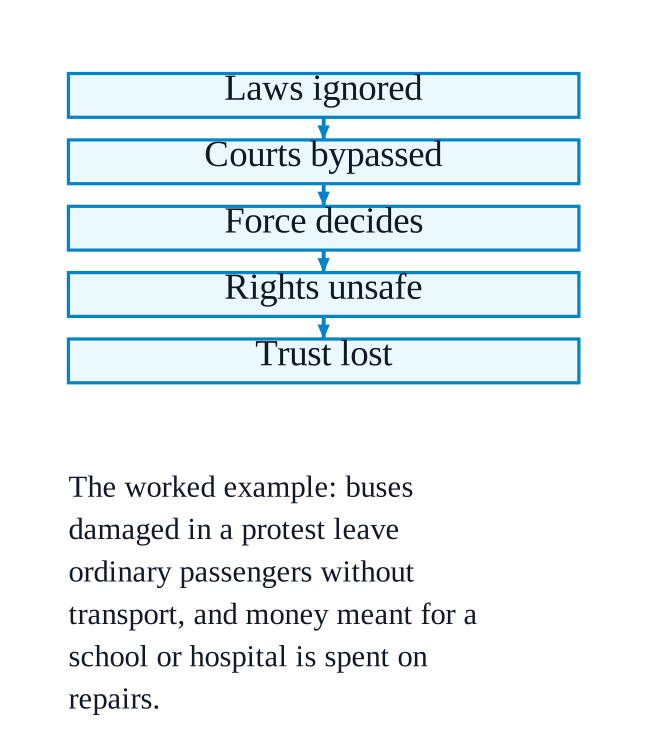
    The Rule of Law would collapse: if people ignore the law, disputes stop being settled in a court of law by procedure established by law, and start being settled by force or personal influence.
    Rights would become unsafe. Your Fundamental Rights are secure only while everyone else respects them; the chapter notes rights come with the expectation that citizens exercise them responsibly.
    Institutions would lose trust. The chapter says actions such as damaging public property, spreading misinformation or violating public rules weaken democratic values, and that indifference to public issues harms the health of a democracy.
    Example: during a protest, buses are damaged. The people who suffer are ordinary passengers who now have no transport, and the money meant for a new school or hospital is spent on repairs. Nobody's demand is met, and public property paid for by everyone's taxes is destroyed.
    A second example from the chapter: if citizens forward fake news without checking, public opinion is misled, confusion spreads, and it can sometimes even lead to conflict.
  3. Exercise 6.3

    Which situation best reflects the idea of popular sovereignty and why? a. A law is passed without public discussion b. Citizens vote to choose their representatives c. A court gives a final judgment d. A minister takes an independent decision

    The book prints no answer for this

    NCERT publishes no answers for this textbook, so there is nothing in the book to check this working against. It has also not yet been read through by hand.

    Answer: b. Citizens vote to choose their representatives.
    Popular sovereignty means the ultimate source of power lies with the people and the state derives its authority from them — which is exactly what happens when citizens elect their representatives through free and fair elections.
    Every citizen of $\displaystyle 18$ and above votes by secret ballot under the Universal Adult Franchise, so the authority handed to the government comes from the people themselves.
    Why the others are wrong
    a. A law passed without public discussion leaves the people out, which is the opposite of popular sovereignty.
    c. A court's final judgment is the Rule of Law at work, not popular sovereignty.
    d. A minister deciding alone is an individual act; it is not authority flowing from the people.
  4. Exercise 6.4

    The Rule of Law is violated when: a. Laws are applied equally to all b. Courts review government actions c. Powerful individuals are treated above the law d. Citizens challenge laws through legal means

    The book prints no answer for this

    NCERT publishes no answers for this textbook, so there is nothing in the book to check this working against. It has also not yet been read through by hand.

    Answer: c. Powerful individuals are treated above the law.
    The Rule of Law rests on equality before the law and equal protection of the law, and establishes that no one is above the law — so treating powerful people as an exception breaks it directly.
    The chapter defines equality before law as every individual, irrespective of status, identity or rank, being treated equally by the law.
    Why the others are wrong
    a. Laws applied equally to all is the Rule of Law being followed, not violated.
    b. Courts reviewing government actions is the judiciary doing its work under the separation of powers.
    d. Citizens challenging laws through legal means is exactly the peaceful, lawful route the Constitution provides, including remedies under Articles $\displaystyle 32$ and 226.
  5. Exercise 6.5

    Why is the Rule of Law essential for protecting democracy?

    The book prints no answer for this

    NCERT publishes no answers for this textbook, so there is nothing in the book to check this working against. It has also not yet been read through by hand.

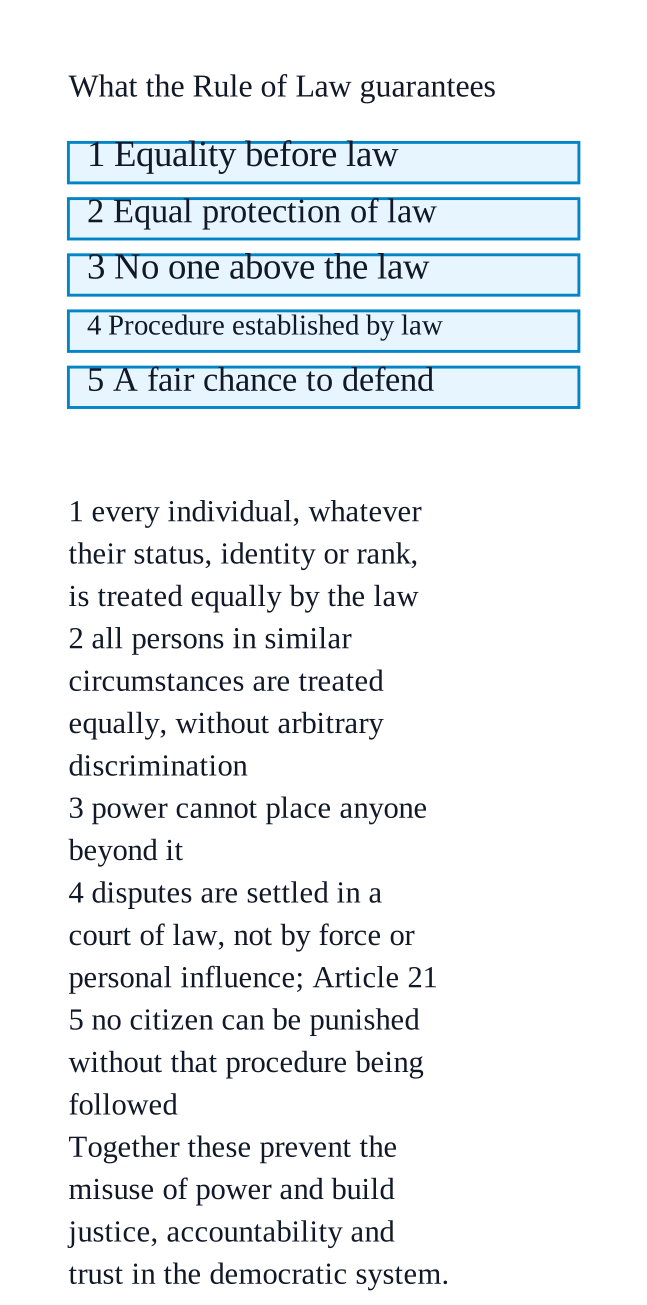
    Because it makes everyone equal before the law and stops power from being misused — without it, a democracy is only a name.
    NCERT_Solution_Class9_SocialScience_Ch6_QA_Q6-5
    It ensures equality before the law and equal protection of the law, and establishes that no one is above the law.
    When laws are violated, disputes are settled in a court of law through procedure established by law, not by force or personal influence.
    No citizen can be punished without that procedure being followed, and everyone gets a fair opportunity to defend their rights against arbitrary action — a principle enshrined in Article $\displaystyle 21$.
    It therefore prevents the misuse of power and protects people's rights, including the Fundamental Rights that are enforceable in court.
    Together this promotes justice, accountability and trust in the democratic system — and trust is what keeps citizens taking part.
  6. Exercise 6.6

    Is voting alone enough to make a country democratic? Support your answer with examples from the chapter.

    The book prints no answer for this

    NCERT publishes no answers for this textbook, so there is nothing in the book to check this working against. It has also not yet been read through by hand.

    No. Voting is essential, but it is not enough — the chapter says democracy is not limited to elections.
    NCERT_Solution_Class9_SocialScience_Ch6_QA_Q6-6Why voting alone falls short
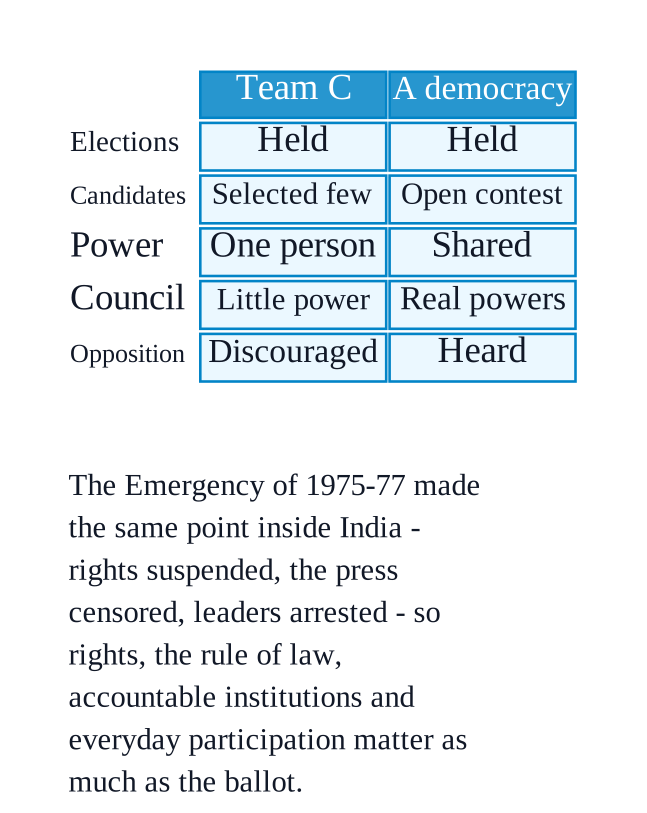
    Elections can exist without democracy. In Fig. $\displaystyle 6.5$, Team C holds elections, but only selected candidates may contest, the President holds most of the power, the Council has very limited authority and opposition voices are discouraged.
    The Emergency of $\displaystyle 1975$–$\displaystyle 77$ shows the same lesson inside India: most Fundamental Rights were suspended, the press was censored and political leaders and activists were arrested. Democracy needed rights and a free press, not only a ballot box.
    What else a democracy needs, from the chapter
    Rule of Law, so no one is above the law, and Fundamental Rights enforceable in court.
    Separation of powers among legislature, executive and judiciary, with judicial review.
    Accountability and transparency — the RTI Act, $\displaystyle 2005$, Question Hour, auditing of government accounts, and bodies such as the CAG, CIC, Lokpal and CVC.
    A genuine multi-party system, so voters have a real choice.
    Participation between elections — the chapter's grassroots case studies show it: Jethipura Gram Panchayat in Gujarat, with its Special Gram Sabhas, Mahila Sabhas and quorum ensured with SC, ST and women's participation, and South Manubankul Gram Panchayat in Tripura, recognised as a "women-friendly panchayat".
    Informed, responsible citizens — the chapter ends by saying the strength of a democracy depends not only on institutions and laws but on citizens who actively participate.
    In short: the vote opens the door; rights, the rule of law, accountable institutions and everyday participation are what keep the house standing.
  7. Exercise 6.7

    Social media allows people to express opinions freely. a. How can this strengthen democracy? b. How can it weaken democracy if used irresponsibly?

    The book prints no answer for this

    NCERT publishes no answers for this textbook, so there is nothing in the book to check this working against. It has also not yet been read through by hand.

    a. How can social media strengthen democracy?NCERT_Solution_Class9_SocialScience_Ch6_QA_Q6-7
    It carries the voice of the masses — the chapter groups social media platforms with newspapers and news channels as media that raise issues concerning the public and help get them resolved.
    It keeps people informed about developments around the country and the world, and being well-informed is a vital responsibility of a young citizen.
    It gives ordinary people a way to exercise freedom of expression and to question those in power, which supports accountability and transparency.
    It lowers the cost of taking part: a student can raise a local issue without owning a newspaper. This is why media is called the 'fourth pillar of democracy'.
    b. How can it weaken democracy if used irresponsibly?
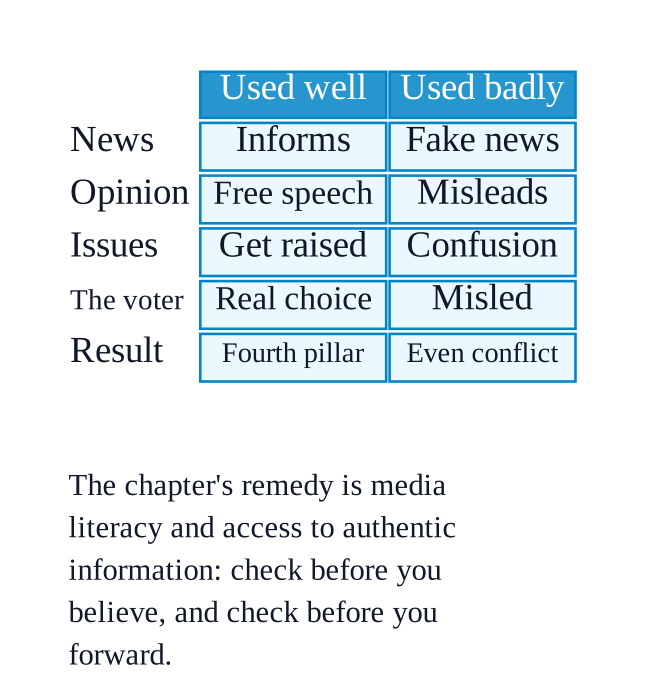
    The chapter names the spread of fake news through social media and other digital platforms as a major concern for Indian democracy today.
    Misinformation can influence public opinion, create confusion, and sometimes even lead to conflict.
    Voters misled by false information cannot make a real choice, so the value of the vote itself falls.
    It can be used to attack others' rights and dignity, whereas civic responsibility includes respecting others' rights and using social media responsibly.
    The remedy the chapter suggests is media literacy and access to authentic information — check before you believe, and check before you forward.
  8. Exercise 6.8

    Write a paragraph on what democracy means to you as a young citizen.

    The book prints no answer for this

    NCERT publishes no answers for this textbook, so there is nothing in the book to check this working against. It has also not yet been read through by hand.

    The task: write your own paragraph — this asks for your view, so no single answer is correct. Build it out of the chapter's ideas, in your own words.
    A worked example paragraph
    "Democracy, to me, means that the country belongs to its people and not to its rulers. My grandparents vote, my parents vote, and in a few years I will vote too, each of our ballots counting exactly the same — that is what popular sovereignty means. But I have learnt this year that democracy is much more than election day. It is the rule of law, which says that nobody is above the law. It is the right to speak, to question and to disagree. It is a Gram Sabha where villagers decide their own priorities, and an RTI application that makes a government office answer an ordinary citizen. As a young citizen I cannot vote yet, but I can already read the news carefully, refuse to forward what I have not checked, look after public property, and take part in my school council. Democracy is not something the Constitution finished in $\displaystyle 1950$; it is something my generation has to keep doing."
    What a good paragraph must contain
    One clear personal idea of what democracy means to you, stated at the start.
    At least two ideas from the chapter — for example popular sovereignty, rule of law, Fundamental Rights, participation beyond elections, or responsible use of media.
    At least one thing you can do now, at your age.
    Your own words, six to ten sentences, no memorised definition copied whole.
  9. Exercise 6.9

    Conduct a model parliament session or Gram Sabha in class on local issues—cleanliness, responsibilities towards public property, or school safety.

    The book prints no answer for this

    NCERT publishes no answers for this textbook, so there is nothing in the book to check this working against. It has also not yet been read through by hand.

    The task: actually run a mock session in class — a model parliament or a model Gram Sabha — on a local issue such as cleanliness, responsibility towards public property, or school safety.
    NCERT_Solution_Class9_SocialScience_Ch6_QA_Q6-9A worked example — a model Gram Sabha on school cleanliness
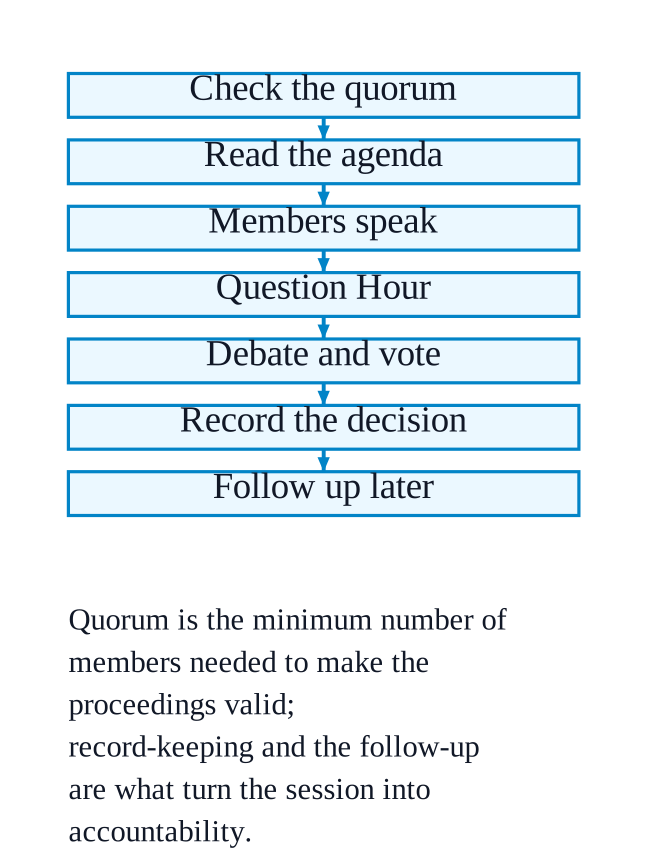
    Roles: a Sarpanch to chair, a Secretary to keep the record, and the rest of the class as Gram Sabha members. For a model parliament instead: a Speaker, a ruling side, an opposition, a minister to answer, and members to question.
    Check the quorum first — the chapter defines quorum as the minimum number of members needed to make the proceedings valid. Note the number present before starting.
    Step $\displaystyle 1$: the Secretary reads the agenda — one issue only.
    Step $\displaystyle 2$: members raise problems; nobody interrupts, and each speaker gets a fixed time.
    Step $\displaystyle 3$: a Question Hour — members question the office-bearers, as the chapter says happens in Parliament.
    Step $\displaystyle 4$: two or three proposals are put forward, discussed, and put to a vote; the proposal with the majority is adopted.
    Step $\displaystyle 5$: the Secretary records the decision, who will do what, and by when — record-keeping is one reason Jethipura Gram Panchayat was recognised.
    Step $\displaystyle 6$: at the next session, check what was actually done. That is accountability.
    What a good session must show
    Everyone gets a chance to speak, including those who disagree.
    The decision is taken by discussion and vote, not by the loudest voice.
    A written record and a follow-up.
    A short reflection afterwards: which democratic values did we actually practise?
  10. Exercise 6.10

    Choose any one democratic institution in India (such as Parliament, Election Commission, Judiciary, or Panchayat). Prepare a short note explaining: a. Its role in democracy b. How it ensures accountability and participation.

    The book prints no answer for this

    NCERT publishes no answers for this textbook, so there is nothing in the book to check this working against. It has also not yet been read through by hand.

    The task: choose one democratic institution and write a short note on (a) its role and (b) how it ensures accountability and participation.
    NCERT_Solution_Class9_SocialScience_Ch6_QA_Q6-10A worked example — the Election Commission of Indiaa. Its role in democracy
    It conducts the elections through which people choose their representatives, which is how popular sovereignty is exercised.
    The chapter's table places it against the electoral process, and the values it promotes as participation and equality.
    The scale it manages is enormous: the chapter records over $\displaystyle 96.8$ crore registered voters in $\displaystyle 2024$, more than one million polling stations including those in mountains, forests, deserts and islands — in some cases a polling station is created even for a single voter.
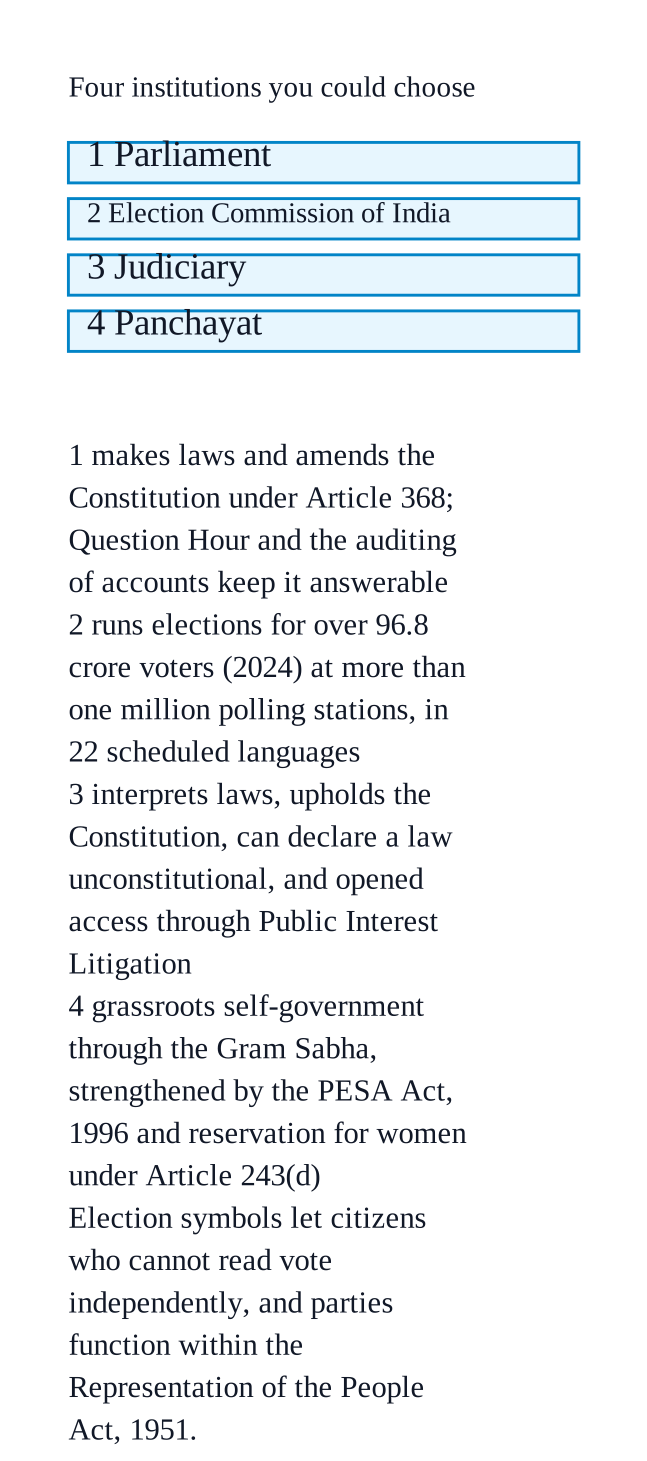
    It makes voting possible for everyone: elections are conducted in $\displaystyle 22$ scheduled languages along with several others, and election symbols are used so that citizens who cannot read can vote independently.
    India has over $\displaystyle 2,800$ registered political parties, and the Commission runs the contest among them peacefully.
    b. How it ensures accountability and participation
    Every citizen of $\displaystyle 18$ and above votes by secret ballot under the Universal Adult Franchise, so no one can be pressured over their choice.
    Because elections are periodic, a government must return to the people; the general elections held after the Emergency was lifted in $\displaystyle 1977$ let people express their will through the ballot, and the ruling government's defeat showed the strength of Indian democracy.
    Political parties function within the rules laid down by the Representation of the People Act, $\displaystyle 1951$.
    On average, a Member of Parliament represents about $\displaystyle 25$ lakh people ($\displaystyle 2019$) — the Commission is what turns that vast population into a countable, fair choice.
    If you choose a different institution, the note should cover
    Parliament — makes laws and amends the Constitution under Article $\displaystyle 368$; values of representation, deliberation and dissent; Question Hour and the auditing of government accounts.
    Judiciary — interprets laws, upholds the Constitution, can declare a law unconstitutional, and opened access to justice through Public Interest Litigation (PIL).
    Panchayat — grassroots self-government; the Gram Sabha as decision-making body, strengthened in tribal areas by the PESA Act, $\displaystyle 1996$, and reservation for women under Article $\displaystyle 243$(d).
    What a good note must contain
    One named institution, its role in three or four lines, and at least two specific ways it makes government answerable or brings citizens in.
  11. Exercise 6.11

    What role does the Constitution play in strengthening democracy in India?

    The book prints no answer for this

    NCERT publishes no answers for this textbook, so there is nothing in the book to check this working against. It has also not yet been read through by hand.

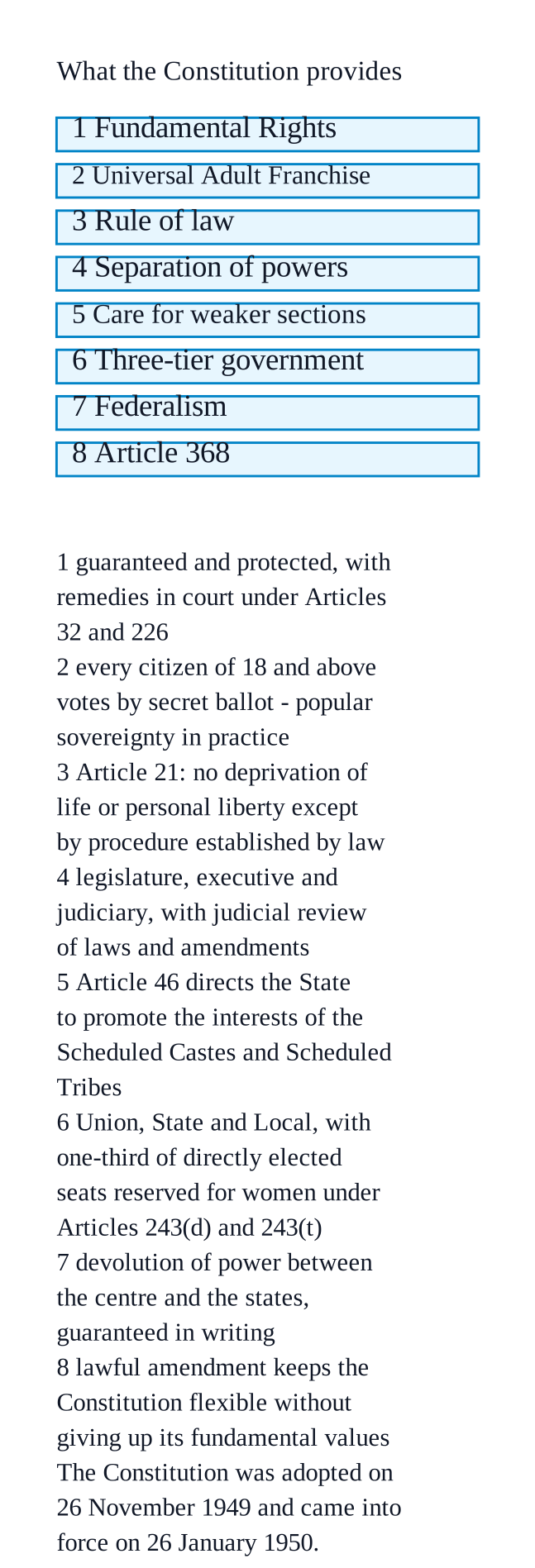
    The Constitution is the foundation of Indian democracy — it creates the institutions, guarantees the rights, and sets the limits within which power is used.
    NCERT_Solution_Class9_SocialScience_Ch6_QA_Q6-11
    It was adopted on $\displaystyle 26$ November $\displaystyle 1949$ and came into force on $\displaystyle 26$ January $\displaystyle 1950$, drafted by the Constituent Assembly over $\displaystyle 2$ years, $\displaystyle 11$ months and $\displaystyle 18$ days.
    It guarantees and protects Fundamental Rights, and ensures no citizen is discriminated against on the basis of religion, race, caste, sex or place of birth. Citizens can seek remedies in court under Articles $\displaystyle 32$ and $\displaystyle 226$.
    It establishes popular sovereignty through Universal Adult Franchise, giving every citizen of $\displaystyle 18$ and above the right to vote by secret ballot.
    It upholds the Rule of Law: Article $\displaystyle 21$ protects life and personal liberty except according to procedure established by law.
    It provides for the separation of powers among legislature, executive and judiciary, with checks and balances — the judiciary can review amendments and declare a law unconstitutional.
    It protects the vulnerable: Article $\displaystyle 46$ directs the State to promote with special care the educational and economic interests of the weaker sections, in particular the Scheduled Castes and Scheduled Tribes.
    It builds democracy at every level — a three-tier system of Union, State and Local government, with Article $\displaystyle 243$(d) and Article $\displaystyle 243$(t) reserving not less than one-third of directly elected seats for women in Panchayats and Municipalities, and Autonomous District Councils protecting tribal customs in specific north-eastern regions.
    It guarantees federalism, the devolution of power between the centre and the states, through a written constitution.
    Finally, it stays alive: Article $\displaystyle 368$ allows lawful amendment, so the Constitution remains flexible and responsive to changing socio-political needs without giving up its fundamental values.
  12. Exercise 6.12

    What challenges do you think democracy in India faces today?

    The book prints no answer for this

    NCERT publishes no answers for this textbook, so there is nothing in the book to check this working against. It has also not yet been read through by hand.

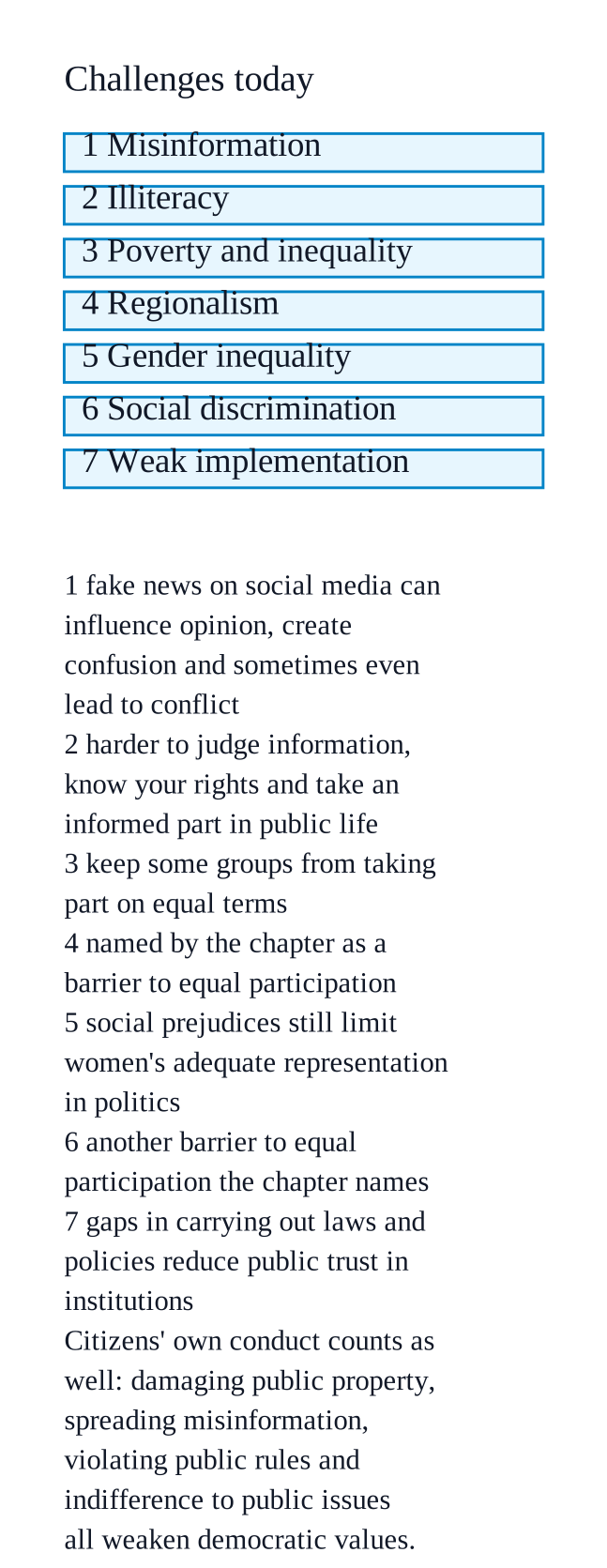
    The chapter names illiteracy, misinformation and inequality as India's main democratic challenges, alongside poverty, regionalism, gender inequality and social discrimination.
    NCERT_Solution_Class9_SocialScience_Ch6_QA_Q6-12
    Misinformation — the spread of fake news, especially through social media and other digital platforms, has emerged as a major concern; it can influence public opinion, create confusion, and sometimes even lead to conflict.
    Illiteracy — citizens who cannot read find it harder to judge information, know their rights, and take an informed part in public life.
    Barriers to equal participation — poverty, regionalism, gender inequality and social discrimination keep some groups from taking part on equal terms.
    Women's representation — Indian women got the vote without a prolonged struggle, but the chapter notes that social prejudices continue to act as barriers to their adequate representation in politics.
    Weak implementation — gaps in carrying out laws and policies effectively can reduce public trust in institutions.
    Citizens' own conduct — damaging public property, spreading misinformation, violating public rules, and indifference towards public issues all weaken democratic values.
    The historical warning — the Emergency of $\displaystyle 1975$–$\displaystyle 77$, when most Fundamental Rights were suspended, the press was censored and leaders were arrested, showed how quickly institutions can come under strain; the elections of $\displaystyle 1977$ showed they can also recover.