SolveItClass 9 · NCERT

NCERT Solutions · Class 9 Social Science Democracy

29 questions · 29 still being checked

The Big Questions 6.1–6.4 (part 1 of 6)

  1. Exercise 6.1

    How has the idea of democracy evolved over time and shaped our understanding of it today?

    The book prints no answer for this

    NCERT publishes no answers for this textbook, so there is nothing in the book to check this working against. It has also not yet been read through by hand.

    Democracy in India grew over a long historical process — it did not appear suddenly in 1947.
    NCERT_Solution_Class9_SocialScience_Ch6_BQ_Q6-1
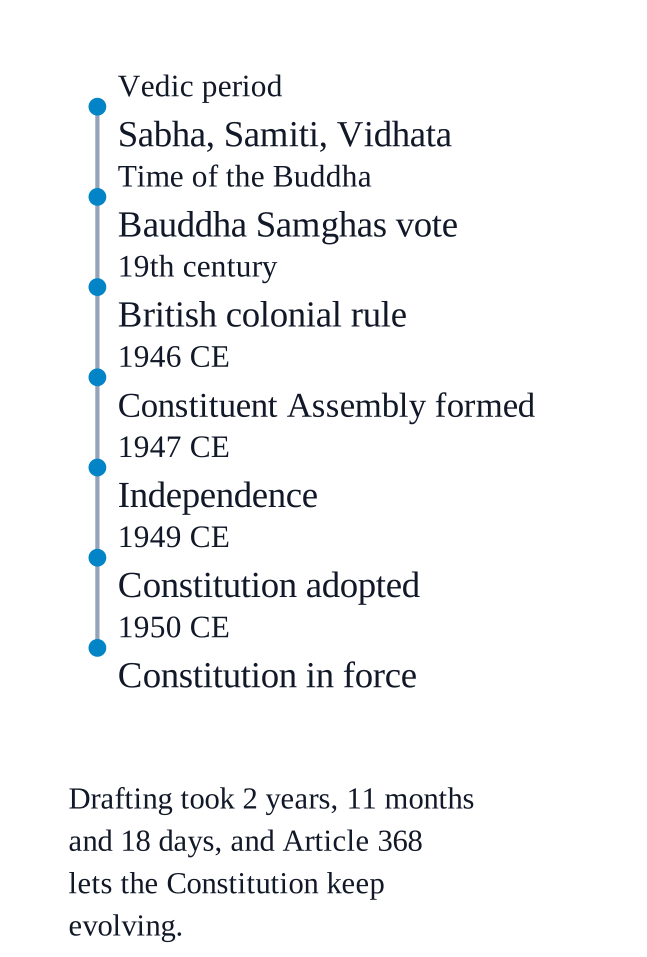
    From the earliest times the king was not an independent ruler: he worked in consultation with assemblies, ministers and officers. The Vedic assemblies Sabha, Samiti and Vidhata took decisions collectively, and the early republican states (gaṇas or saṁghas) worked the same way.
    A verse from the Aikyamatya Sūktam of the Ṛigveda praises common counsel, shared discussion and unity of purpose — so consultation and consensus have deep roots in India's traditions.
    The Bauddha Saṁghas, the monastic community established by Gautama Buddha, encouraged debate, let members choose their leader and took decisions by voting.
    Invasions and then British colonial rule altered political structures and limited people's participation, but the long freedom struggle revived and strengthened democratic ideas.
    The Constituent Assembly, formed in $\displaystyle 1946$, drew on these Indian traditions and on the global spread of democratic values, and took $\displaystyle 2$ years, $\displaystyle 11$ months and $\displaystyle 18$ days to draft the world's longest written Constitution.
    Because the Constitution can be amended under Article $\displaystyle 368$, our understanding of democracy keeps evolving with changing socio-political needs.
  2. Exercise 6.2

    What are the different forms of democracy, and how are they practised in India and other parts of the world?

    The book prints no answer for this

    NCERT publishes no answers for this textbook, so there is nothing in the book to check this working against. It has also not yet been read through by hand.

    There are two basic forms — direct democracy and representative (indirect) democracy — and representative democracy is itself of two kinds, parliamentary and presidential.
    NCERT_Solution_Class9_SocialScience_Ch6_BQ_Q6-2
    In a direct democracy citizens take part directly in most decision-making. It is difficult to follow in large countries. The chapter's example is Switzerland, where executive power lies with the Federal Council.
    In a representative democracy people elect their representatives, elections are periodic, and the government is accountable to the people. The chapter's example is India.
    In a parliamentary democracy members of the executive are also part of the legislature and the executive is accountable to the legislature — India and Canada. In India executive power lies with the council of ministers headed by the Prime Minister; the President is Head of State.
    In a presidential democracy the executive is independent of the legislature, the President is elected by the people and is accountable to them — the United States of America.
    The chapter's table also shows the United Kingdom as a parliamentary democracy with a Constitutional Monarchy and an unwritten constitution, where the Monarch is Head of State and the Prime Minister is Head of Government.
    So democracy offers no single model: countries differ in how power is shared and how citizens take part, but share common democratic values.
  3. Exercise 6.3

    What are the essential features of a democracy and how do they extend beyond government institutions?

    The book prints no answer for this

    NCERT publishes no answers for this textbook, so there is nothing in the book to check this working against. It has also not yet been read through by hand.

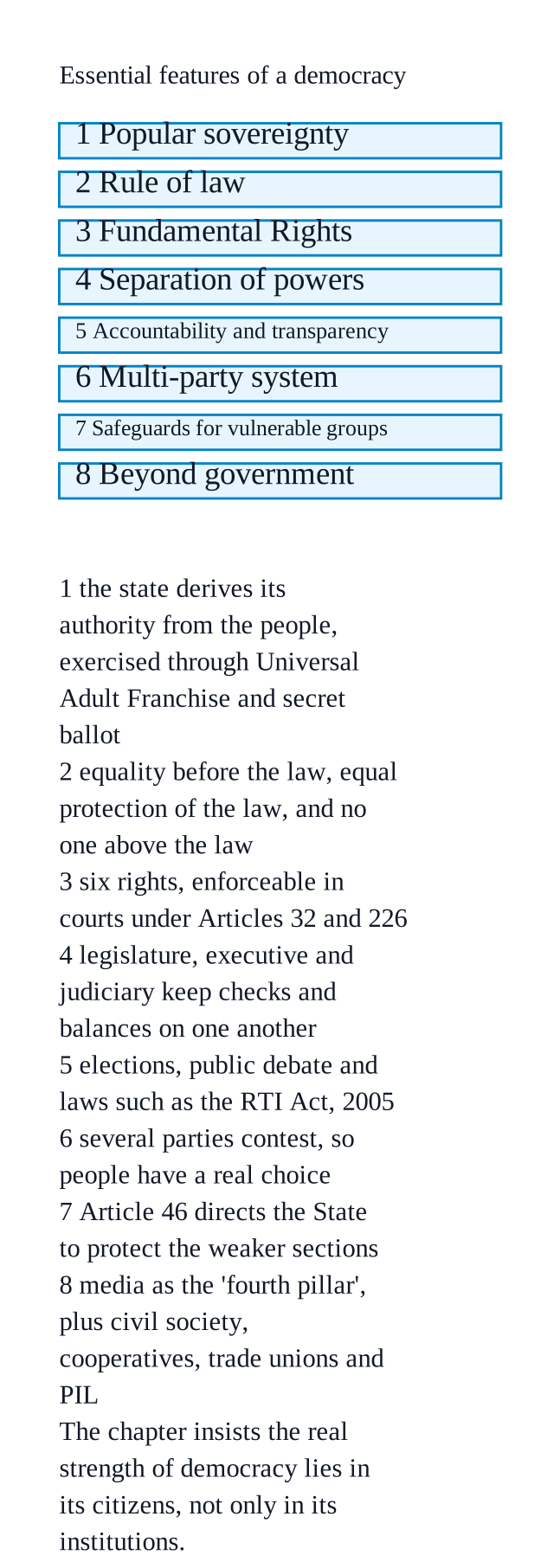
    The essential features are popular sovereignty, rule of law, Fundamental Rights, separation of powers, accountability and transparency, a multi-party system, and safeguards for vulnerable groups — and they live outside government too.
    NCERT_Solution_Class9_SocialScience_Ch6_BQ_Q6-3
    Popular sovereignty means the state gets its authority from the people, exercised through Universal Adult Franchise and secret ballot; the Rule of Law means equality before the law and that no one is above it.
    Fundamental Rights are enforceable in courts, and separation of powers among legislature, executive and judiciary keeps checks and balances.
    Beyond institutions, the media is called the 'fourth pillar of democracy' because it informs people and raises public issues.
    Civil society organisations, socio-religious and community institutions, cooperatives and trade unions also take decisions democratically; Public Interest Litigation (PIL) and campaigns make democracy more inclusive.
    Most of all, the chapter says the real strength of democracy lies in its citizens — their participation, awareness of rights and duties, and commitment to honesty and fairness.
  4. Exercise 6.4

    What are the challenges faced by Indian democracy?

    The book prints no answer for this

    NCERT publishes no answers for this textbook, so there is nothing in the book to check this working against. It has also not yet been read through by hand.

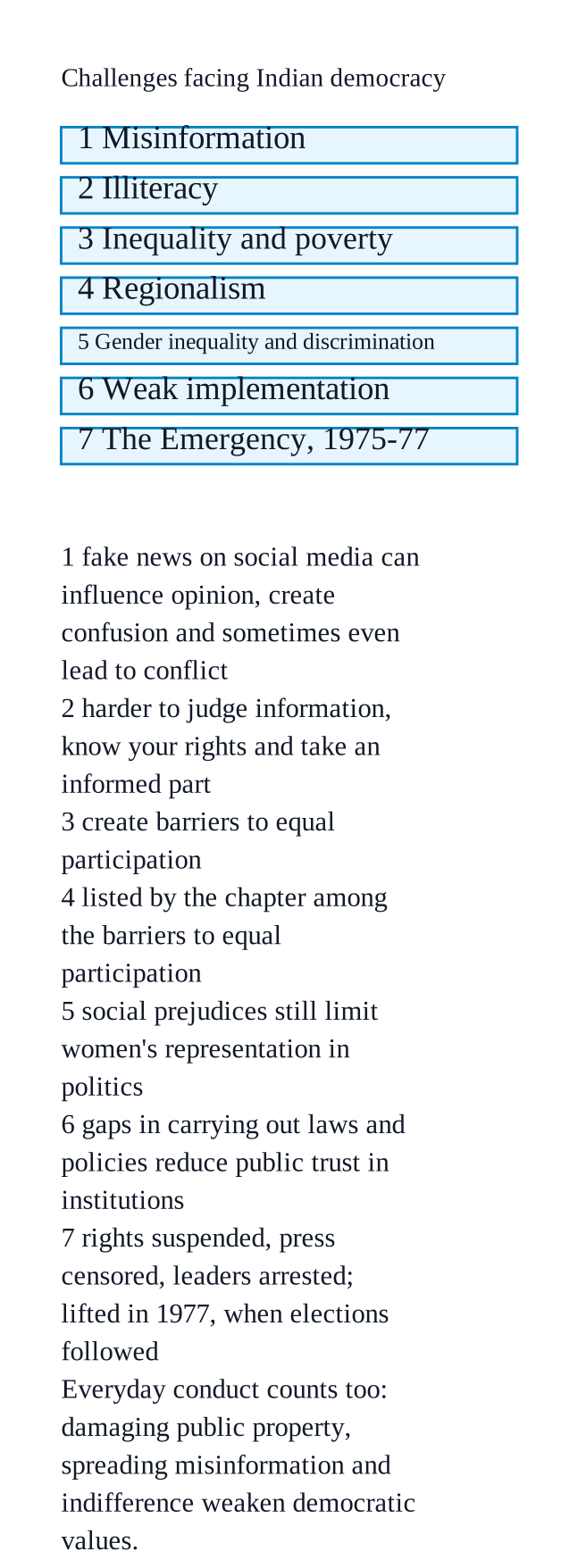
    India faces challenges of illiteracy, misinformation and inequality, along with poverty, regionalism, gender inequality and social discrimination.
    NCERT_Solution_Class9_SocialScience_Ch6_BQ_Q6-4
    The spread of fake news, especially through social media and other digital platforms, has become a major concern — it can influence public opinion, create confusion and sometimes even lead to conflict.
    Poverty, regionalism, gender inequality and social discrimination create barriers to equal participation.
    Gaps in the effective implementation of laws and policies can reduce public trust in institutions.
    Everyday behaviour matters too: damaging public property, spreading misinformation, violating public rules and indifference towards public issues weaken democratic values.
    The chapter's historical example is the Emergency of $\displaystyle 1975$–$\displaystyle 77$, when most Fundamental Rights were suspended, the press was censored and leaders were arrested — showing both the vulnerability and the resilience of democratic institutions.