SolveItClass 9 · NCERT

NCERT Solutions · Class 9 Social Science Democracy

29 questions · 29 still being checked

Let's Explore 6.1–6.8 (part 3 of 6)

  1. Exercise 6.1

    → The Constitution not only guarantees Fundamental Rights to citizens but also outlines their Fundamental Duties and the Directive Principles of State Policy. Discuss their significance and identify the differences among them. → The Right to Education (Article 21A) was added in 2009\displaystyle 2009, ensuring free and compulsory education for children aged 6\displaystyle 6 to 14. Discuss its significance.

    The book prints no answer for this

    NCERT publishes no answers for this textbook, so there is nothing in the book to check this working against. It has also not yet been read through by hand.

    → Fundamental Rights, Fundamental Duties and the Directive Principles of State Policy — significance and differencesNCERT_Solution_Class9_SocialScience_Ch6_LE_Q6-1
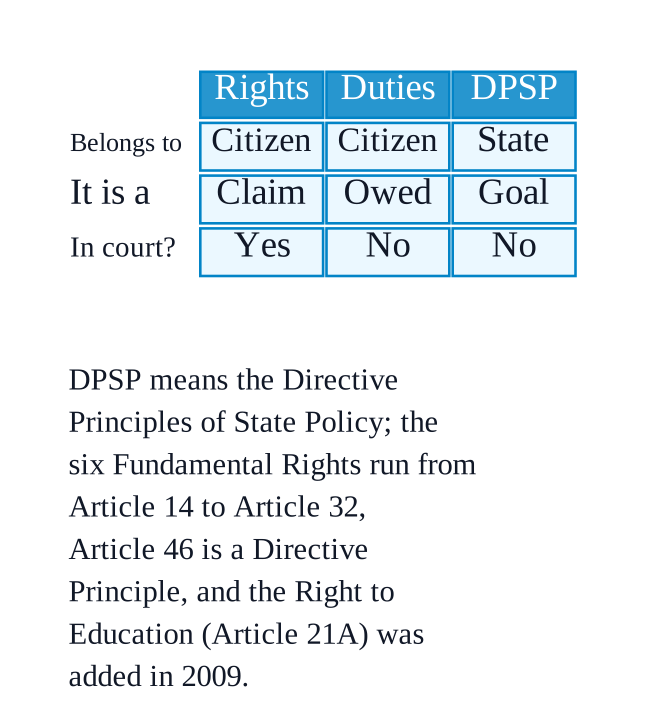
    All three are in the Constitution, but they point in different directions: Rights are what the citizen can claim, Duties are what the citizen owes, and the Directive Principles are goals set for the State.
    On Fundamental Rights the chapter is detailed: there are six — Right to Equality (Articles $\displaystyle 14$–$\displaystyle 18$), Right to Freedom (Articles $\displaystyle 19$–$\displaystyle 22$), Right Against Exploitation (Articles $\displaystyle 23$–$\displaystyle 24$), Right to Freedom of Religion (Articles $\displaystyle 25$–$\displaystyle 28$), Cultural and Educational Rights (Articles $\displaystyle 29$–$\displaystyle 30$) and the Right to Constitutional Remedies (Article $\displaystyle 32$).
    Their key mark is that they are enforceable in courts of law — a citizen can go to court under Articles $\displaystyle 32$ and $\displaystyle 226$. They are indivisible and inalienable, subject to reasonable restrictions in accordance with the procedure established by law.
    The chapter shows the flavour of a State goal when it quotes Article $\displaystyle 46$: "the State shall promote with special care the educational and economic interests of the weaker sections of the people" — a direction to the government rather than a right you sue for.
    The chapter also shows what duties look like in practice: civic responsibility includes respecting others' rights, using social media responsibly, abiding by laws and rules, appreciating the country's diversity and taking part in activities that strengthen unity.
    → The Right to Education (Article 21A), added in $\displaystyle 2009$
    It makes education free and compulsory for children aged $\displaystyle 6$ to $\displaystyle 14$, so schooling becomes a right and not a favour.
    It matters for democracy because the chapter lists illiteracy as one of India's continuing challenges.
    An educated citizen can read a ballot, judge misinformation, use the RTI Act, $\displaystyle 2005$ and form informed opinions — all things the chapter says a young citizen must be able to do.
    Because it is placed among the Fundamental Rights, a child denied a school place can seek a remedy in court.
  2. Exercise 6.2

    The first column of the table below lists some key features of democracy in India. Fill in the second column with suitable examples from your state, town, or village. One row has been completed for you. Parliamentary procedures such as Question Hour and the auditing of government accounts ensure accountability. Laws like the Right to Information provide transparency.

    The book prints no answer for this

    NCERT publishes no answers for this textbook, so there is nothing in the book to check this working against. It has also not yet been read through by hand.

    The task: fill the second column of the table with real examples of each feature from your own state, town or village — the completed row on Accountability and Transparency shows the pattern.
    A worked example of the shape (write your own local versions)
    Popular Sovereignty — for example, the voters of your constituency elect an MLA and an MP; in a village, the Gram Sabha members elect their panchayat representatives.
    Rule of Law — for example, a traffic fine is issued to anyone who breaks the rule, whatever their position; a land dispute in your area is settled in the local court and not by force.
    Separation of Powers — for example, your State Legislative Assembly makes a law, the district administration implements it, and the district court decides cases arising from it.
    Fundamental Rights — for example, a school in your town admits children of every caste and religion; people of different faiths worship freely in the same locality.
    Accountability and Transparency(given in the book) Question Hour and the auditing of government accounts; laws like the Right to Information. You could add an RTI application filed locally to ask what a road cost.
    Multi-Party System — for example, several parties putting up candidates in your ward, panchayat or assembly election.
    What a good answer must contain
    One example per row that is real and checkable in your own area, not a general statement.
    The name of the actual body, office or law involved.
    A one-line reason showing why that example matches that feature.
  3. Exercise 6.3

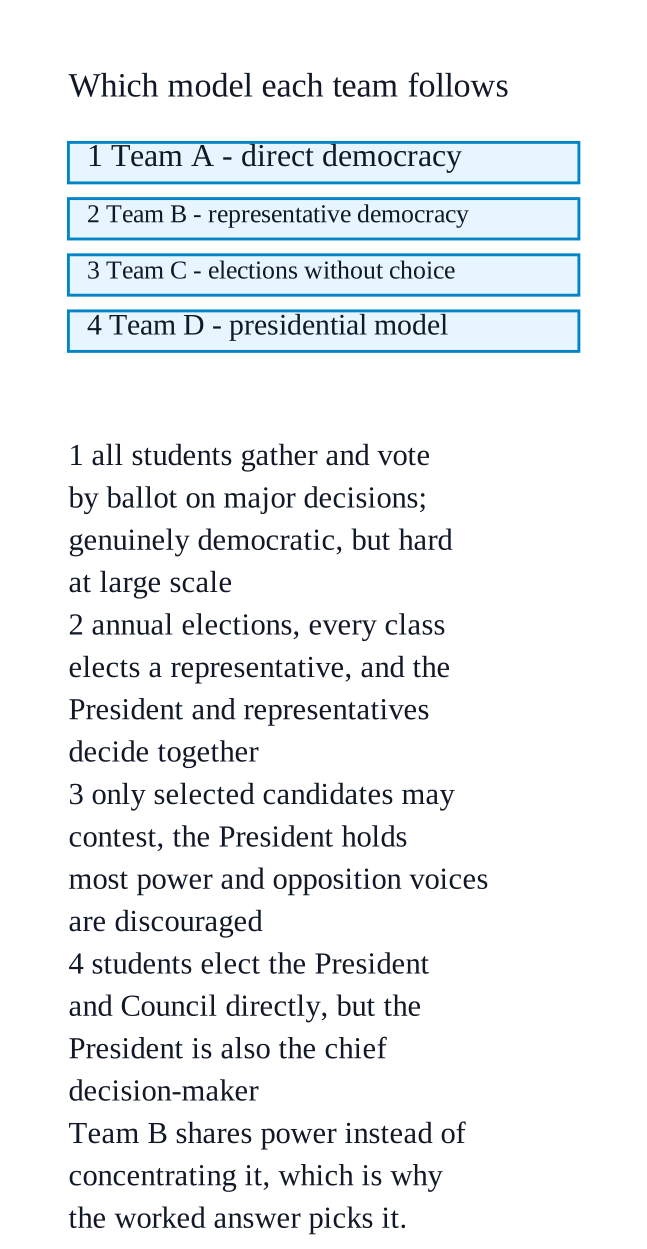
    Select your ideal team from Fig. 6.5\displaystyle 6.5 and give reasons for your selection.NCERT_Question_Class9_SocialScience_Ch6_LE_Q6-3

    The book prints no answer for this

    NCERT publishes no answers for this textbook, so there is nothing in the book to check this working against. It has also not yet been read through by hand.

    The task: pick one team from Fig. $\displaystyle 6.5$ and defend the choice with democratic reasons — the answer is your own, but the reasons must come from the chapter's features of democracy.
    NCERT_Solution_Class9_SocialScience_Ch6_LE_Q6-3A worked example — choosing Team B
    Team B is my ideal team, because it shares power instead of concentrating it.
    Periodic elections — the school holds elections every year, so no one holds office indefinitely.
    Representation for everyone — every class elects a representative, so no class is left out.
    Indirect (representative) democracy — the representatives then elect the Students' Council President, much as the chapter describes representative democracy in India.
    Shared decision-making — the President and the representatives decide together, so power does not sit with one student.
    Why the other teams are weaker
    Team A works like a direct democracy — all students gather and vote by ballot papers on major decisions. It is genuinely democratic, and the chapter's example of a direct democracy is Switzerland, but the chapter also notes direct democracy is difficult to follow at large scale.
    Team D resembles a presidential model — students directly elect both the President and the Council — but the President is both head of the Council and the chief decision-maker, so more power rests with one person.
    Team C should be rejected. Only selected candidates may contest, the President holds most of the power, the Council has very limited authority and opposition voices are discouraged. Elections happen, but free choice, a real multi-party contest and dissent do not.
    What a good answer must contain
    A named team, at least two democratic features from the chapter to support it, and one reason why a rejected team falls short.
  4. Exercise 6.4

    Work in pairs or small groups. Choose any two of India’s neighbouring countries (Afghanistan, Bangladesh, Bhutan, China, Maldives, Myanmar, Nepal, Pakistan, or Sri Lanka) and find out the following: → Does the country hold regular elections? → Who chooses the Head of the Government? → Is there more than one political party? → How much freedom do citizens have to express their opinions and criticise the government? How would you describe this system? Give reasons for your answer. → Democratic or Partially democratic or Non-democratic

    The book prints no answer for this

    NCERT publishes no answers for this textbook, so there is nothing in the book to check this working against. It has also not yet been read through by hand.

    The task: research two of India's neighbours on four points, then classify each system as Democratic, Partially democratic or Non-democratic, with reasons.
    NCERT_Solution_Class9_SocialScience_Ch6_LE_Q6-4The shape of the answer — build one table per country
    Column $\displaystyle 1$: Are elections held regularly? (are they held on time, and can all adults vote?)
    Column $\displaystyle 2$: Who chooses the Head of Government? (the people directly, an elected legislature, a monarch, or the armed forces?)
    Column $\displaystyle 3$: Is there more than one political party? (a real contest, or only one party allowed?)
    Column $\displaystyle 4$: How free are citizens to express opinions and criticise the government?
    A worked example using a country the chapter itself describes — the United Kingdom
    Type of democracy: Representative Democracy (Parliamentary Democracy with Constitutional Monarchy).
    Head of State and Head of Government: the Monarch is Head of State; the Prime Minister is Head of Government.
    Key features the chapter lists: an unwritten constitution, parliamentary sovereignty, and a multi-party system.
    Classification: Democratic — because representatives are elected, several parties compete, and power rests with an elected Prime Minister rather than one unelected ruler.
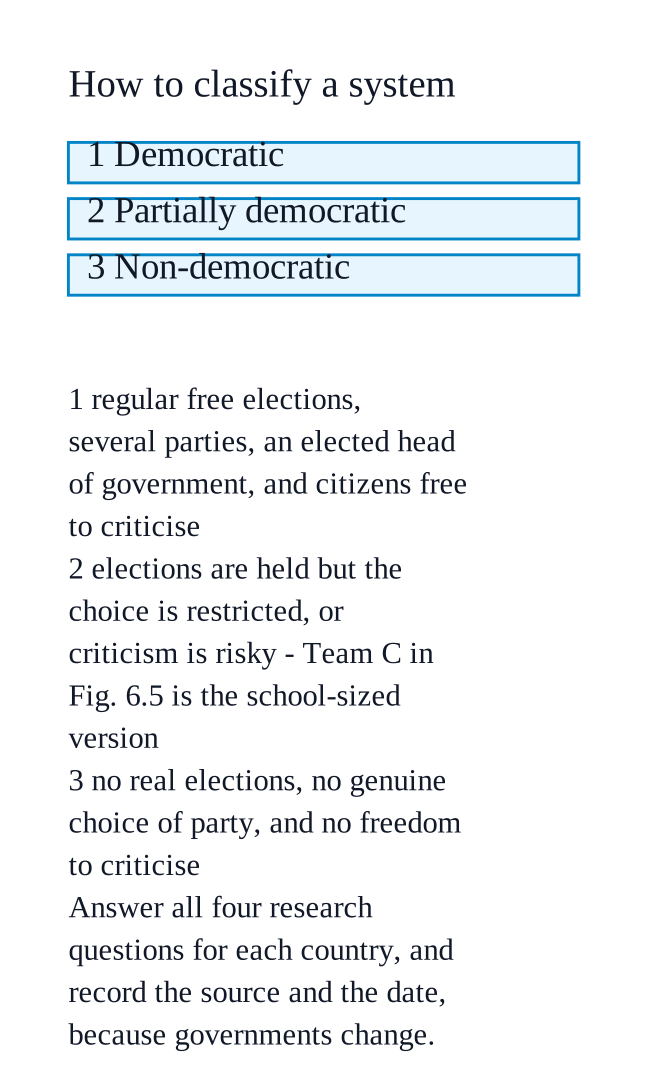
    How to classify
    Democratic — regular free elections, many parties, an elected head of government, citizens free to criticise.
    Partially democratic — elections are held but the choice is restricted, or criticism is risky. Team C in Fig. $\displaystyle 6.5$ is the school-sized version of this.
    Non-democratic — no real elections, no genuine choice of party, no freedom to criticise.
    What a good answer must contain
    Two named countries, all four questions answered for each, a stated classification, and at least two reasons per country.
    The source you used, and the date of the information — governments change, so an old fact can be wrong now.
  5. Exercise 6.5

    A democratic system seeks to promote participation, ensure fairness, limit the concentration of power, and resolve disagreements peacefully. Identify examples from the above case study that reflect these features.

    The book prints no answer for this

    NCERT publishes no answers for this textbook, so there is nothing in the book to check this working against. It has also not yet been read through by hand.

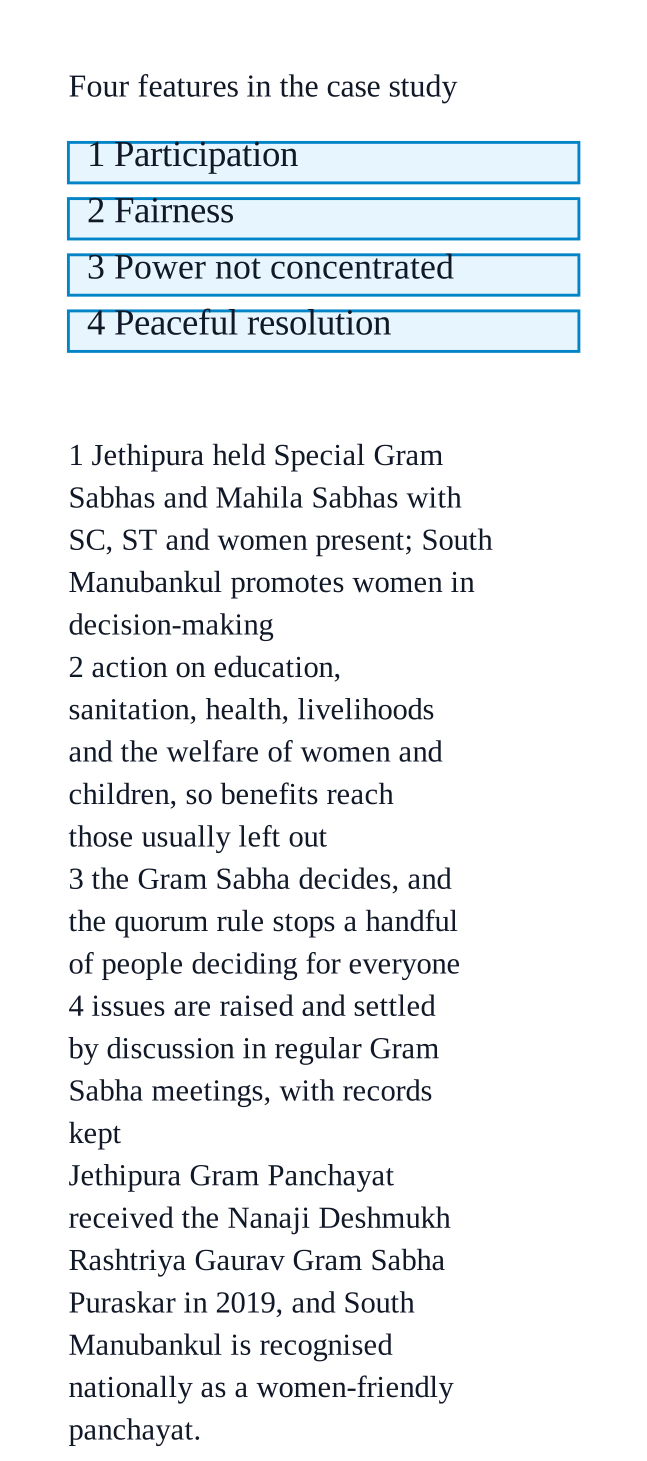
    ParticipationNCERT_Solution_Class9_SocialScience_Ch6_LE_Q6-5
    Jethipura Gram Panchayat ensured the effective conduct of Gram Sabhas and even organised Special Gram Sabhas and Mahila Sabhas.
    It ensured an adequate quorum, with active participation from marginalised sections — Scheduled Castes, Scheduled Tribes and women.
    South Manubankul Gram Panchayat promotes women's participation in decision-making and supports self-help groups and community programmes.
    Fairness
    Jethipura took timely action on education, sanitation and the welfare of women and children.
    South Manubankul provides facilities for health, sanitation and livelihoods and ensures the effective implementation of government schemes — so benefits reach those usually left out.
    Its focus on women's welfare and inclusive development earned it national recognition as a "women-friendly panchayat".
    Limiting the concentration of power
    Decisions are taken in the Gram Sabha, a meeting of the villagers, not by one official.
    The quorum rule means proceedings are valid only when a minimum number of members is present, so a handful of people cannot decide for everyone.
    Proper maintenance of records lets villagers check what was decided and what was done.
    Resolving disagreements peacefully
    The case study shows the forum rather than a quarrel: issues are raised and settled in regular Gram Sabha meetings through discussion, which is how a disagreement would be handled.
    Recognition through an award — Jethipura received the Nanaji Deshmukh Rashtriya Gaurav Gram Sabha Puraskar (NDRGGSP) in $\displaystyle 2019$ — rewards good process rather than force.
  6. Exercise 6.6

    India continues to work towards more inclusive institutions. Discuss in class about the advantages of increased representation of women in the legislature.

    The book prints no answer for this

    NCERT publishes no answers for this textbook, so there is nothing in the book to check this working against. It has also not yet been read through by hand.

    The task: discuss in class what the country gains when more women sit in its law-making bodies.
    NCERT_Solution_Class9_SocialScience_Ch6_LE_Q6-6Points a good discussion should raise
    Decision-making improves when half the population is present in the room — the chapter says empowerment of women starts with their active participation in institutions of decision-making.
    The vote alone has not been enough. Indian women received the vote without a prolonged struggle when Universal Adult Franchise came in with the Constitution in $\displaystyle 1950$, yet the chapter notes that social prejudices continue to act as barriers to women's adequate representation in politics. More seats attack that barrier directly.
    Local bodies show what changes. South Manubankul Gram Panchayat in Tripura, recognised nationally as a "women-friendly panchayat", promotes women's participation and works on health, sanitation, livelihoods and self-help groups. Jethipura ensured women's active participation in its Gram Sabhas and acted on the welfare of women and children.
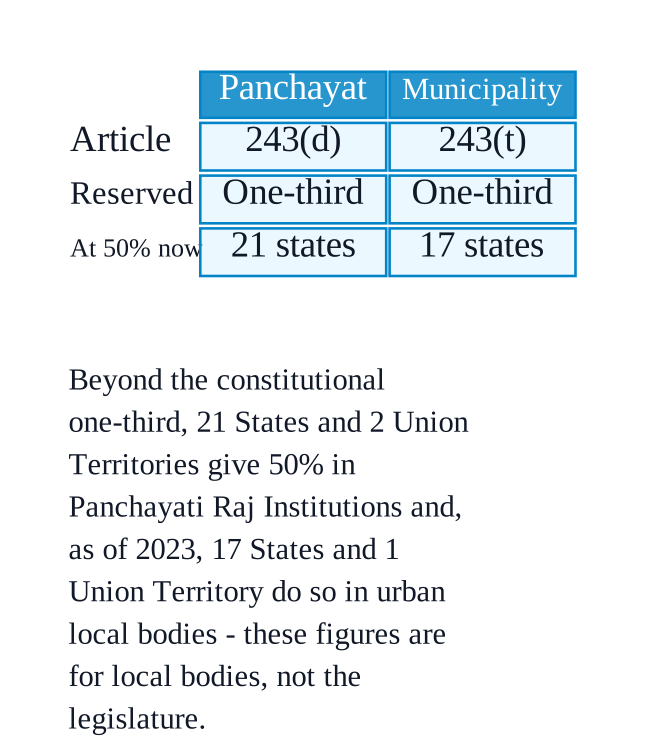
    The Constitution already treats this as necessary at the grassroots. Article $\displaystyle 243$(d) provides not less than one-third reservation for women in seats filled by direct election in every Panchayat, and Article $\displaystyle 243$(t) does the same for every Municipality. Beyond that, $\displaystyle 21$ States and $\displaystyle 2$ Union Territories have provided $\displaystyle 50$% reservation in Panchayati Raj Institutions, and as of $\displaystyle 2023$, $\displaystyle 17$ States and $\displaystyle 1$ Union Territory have done so in Urban Local Bodies.
    Representation makes democracy more inclusive — more voices, more kinds of experience, and role models that encourage other women to stand.
    What a good answer must contain
    At least three advantages, each with a reason.
    One example drawn from the chapter, and an honest note that reservation figures quoted here are for local bodies.
  7. Exercise 6.7

    In small groups, identify two or three examples of information shared on social media that you believe may be misleading or false. Discuss what made you question their reliability and how such information can influence people’s opinions. Reflect on why access to accurate and authentic information is important in a democracy.

    The book prints no answer for this

    NCERT publishes no answers for this textbook, so there is nothing in the book to check this working against. It has also not yet been read through by hand.

    The task: find two or three real posts or forwards that look false, say what made you doubt them, and connect this to why authentic information matters in a democracy.
    NCERT_Solution_Class9_SocialScience_Ch6_LE_Q6-7Worked examples of the kinds of thing to look for (illustrations, not real cases)
    A forwarded message saying a government scheme will pay money to anyone who fills a form at a link.
    A dramatic flood photograph shared as though it happened in your town this week.
    A screenshot styled like a news headline, with no channel name, no reporter and no date.
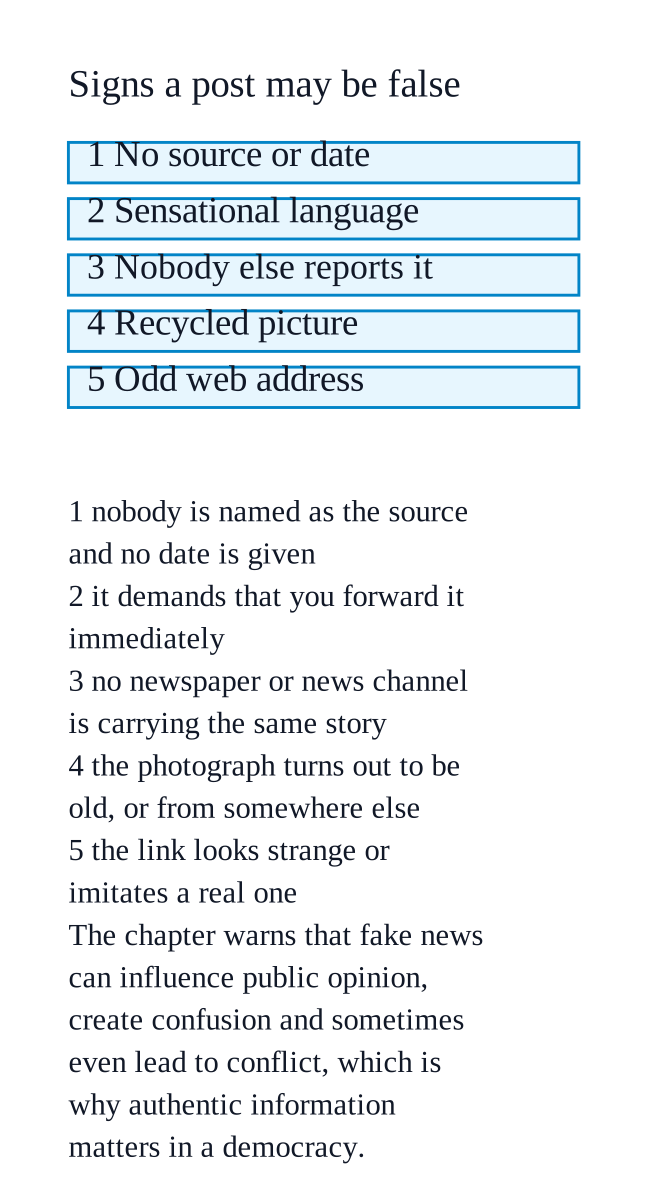
    What should make you doubt a post
    No source is named, and no date is given.
    The language is sensational and demands that you forward it immediately.
    No newspaper or news channel is carrying the same story.
    The picture turns out to be old, or from somewhere else.
    The web address looks odd or imitates a real one.
    How such information influences people
    The chapter says the spread of fake news, especially through social media and digital platforms, is a major concern: it can influence public opinion, create confusion, and sometimes even lead to conflict.
    Why access to accurate information matters in a democracy
    Being well-informed is one of the vital responsibilities of a young citizen; authentic information lets us form informed opinions on public issues.
    Voters who are misled cannot really choose, so misinformation attacks the vote itself.
    The media is the 'fourth pillar of democracy' only while what it carries is true.
    Using the internet and social media responsibly is part of civic responsibility, and media literacy is one of the ways Fig. $\displaystyle 6.9$ lists for youth to take part in democracy.
    What a good answer must contain
    Two or three actual examples the group has seen, with the reason each was doubted.
    One clear statement of the harm caused, and one of why authentic information is needed.
    No claim that an unverified example is true — say plainly that it was suspected to be false.
  8. Exercise 6.8

    Observe Fig 6.9\displaystyle 6.9 and explore the various other digital and non-digital ways through which you can participate in a democracy.NCERT_Question_Class9_SocialScience_Ch6_LE_Q6-8

    The book prints no answer for this

    NCERT publishes no answers for this textbook, so there is nothing in the book to check this working against. It has also not yet been read through by hand.

    The task: read the five ways Fig. $\displaystyle 6.9$ shows youth taking part in democracy, then add other ways of your own, digital and non-digital.
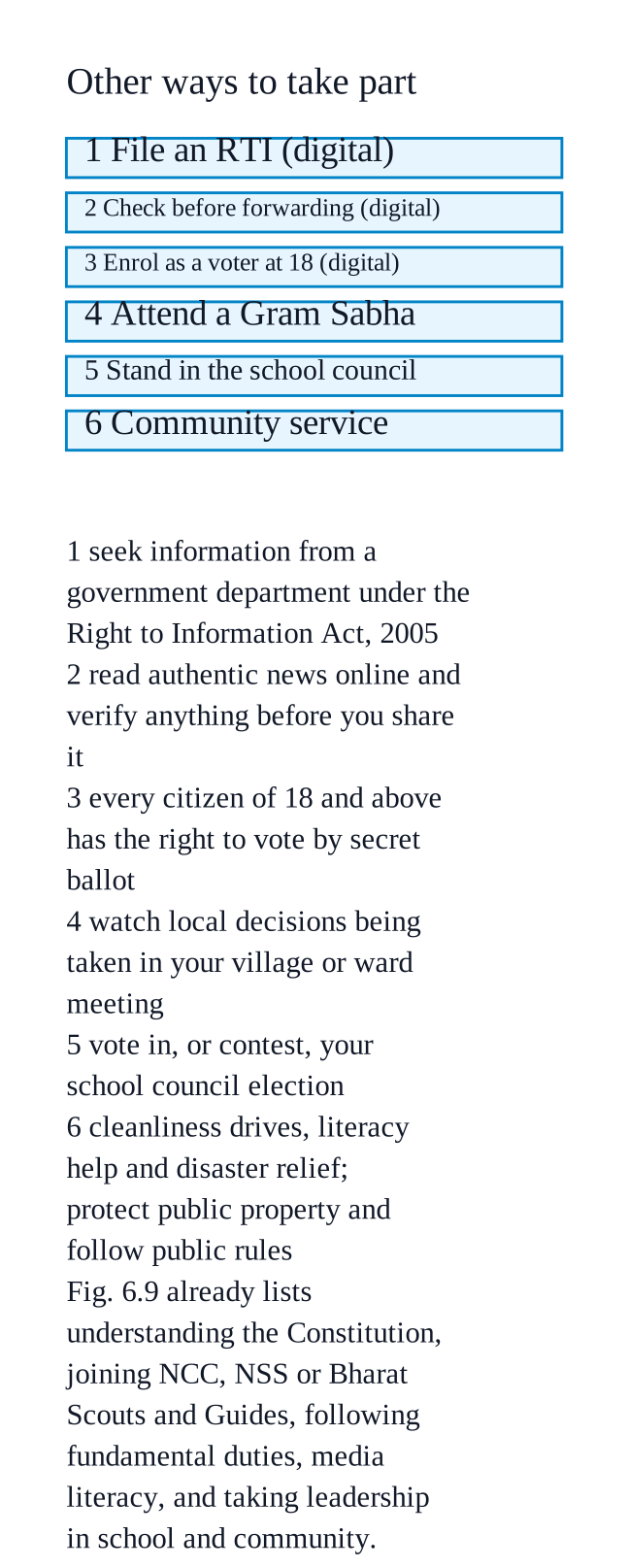
    NCERT_Solution_Class9_SocialScience_Ch6_LE_Q6-8What Fig. $\displaystyle 6.9$ already lists
    Understand the Constitution.
    Participate in nation-building activities (NCC, NSS, Bharat Scouts & Guides).
    Follow fundamental duties.
    Be media literate.
    Take leadership in school and community.
    Other digital ways (worked examples)
    Seek information from a government department under the Right to Information (RTI) Act, $\displaystyle 2005$.
    Read authentic news online and check before forwarding anything.
    Use social media to raise a genuine public issue — the chapter says social media platforms raise issues concerning the public and help get them resolved.
    Get your name on the electoral roll when you turn $\displaystyle 18$, since every citizen of $\displaystyle 18$ and above has the right to vote.
    Other non-digital ways (worked examples)
    Attend or observe a Gram Sabha or ward meeting and see local decisions being taken.
    Stand for, or vote in, your school council election.
    Do community service — cleanliness drives, literacy help, disaster relief.
    Protect public property and follow public rules, which the chapter treats as democratic behaviour.
    Read newspapers and watch news programmes to stay aware of national and international events.
    What a good answer must contain
    At least two digital and two non-digital ways beyond the figure.
    One line for each saying how it strengthens democracy, not just what it is.