SolveItClass 9 · NCERT

NCERT Solutions · Class 9 Science Work, Energy, and Simple Machines

28 questions · 20 still being checked

Revise, Reflect, Refine 7.6–7.7 (part 11 of 21)

  1. Exercise 7.6

    A crane lifts a mass m to the 10th floor of a building in a certain time. It then raises the same mass to the 20th floor of the same building in double the time. How much more energy and power are required? Assume that the height of all floors is equal.

    Not cross-checked

    NCERT prints no numerical answer for this exercise, so this working has not been cross-checked against the book.

    NCERT’s answer
    Energy twice of initial energy; power same as initial power
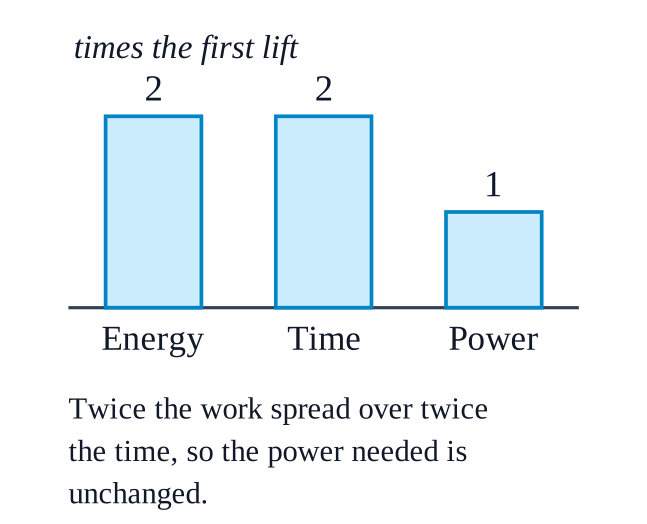
    Twice the energy is needed, but the same power — no extra power at all.
    NCERT_Solution_Class9_Science_Ch7_RRR_Q7-6
    Let the height of each floor be \(\displaystyle x \), so the 10th floor is at \(\displaystyle 10x \) and the 20th floor at \(\displaystyle 20x \).
    Energy for the first lift: \(\displaystyle E_{1} = mg \times 10x \)
    Energy for the second lift: \(\displaystyle E_{2} = mg \times 20x = 2 \times (mg \times 10x) = 2E_{1} \)
    So the crane needs an extra \(\displaystyle mg \times 10x \), i.e. the energy is doubled.
    Power for the first lift: \(\displaystyle P_{1} = \dfrac{E_{1}}{t} \)
    Power for the second lift: \(\displaystyle P_{2} = \dfrac{2E_{1}}{2t} = \dfrac{E_{1}}{t} = P_{1} \)
    Twice the work spread over twice the time gives the same rate of doing work, so the power required is unchanged.
  2. Exercise 7.7

    Which factors determine the energy required to raise a flag from the ground to the top of a tall flagpole using a pulley? Does raising the flag slowly or quickly change the amount of work done? If the speed at which the flag is raised is doubled, how does the power requirement change? Explain your answers.

    Not cross-checked

    NCERT prints no numerical answer for this exercise, so this working has not been cross-checked against the book.

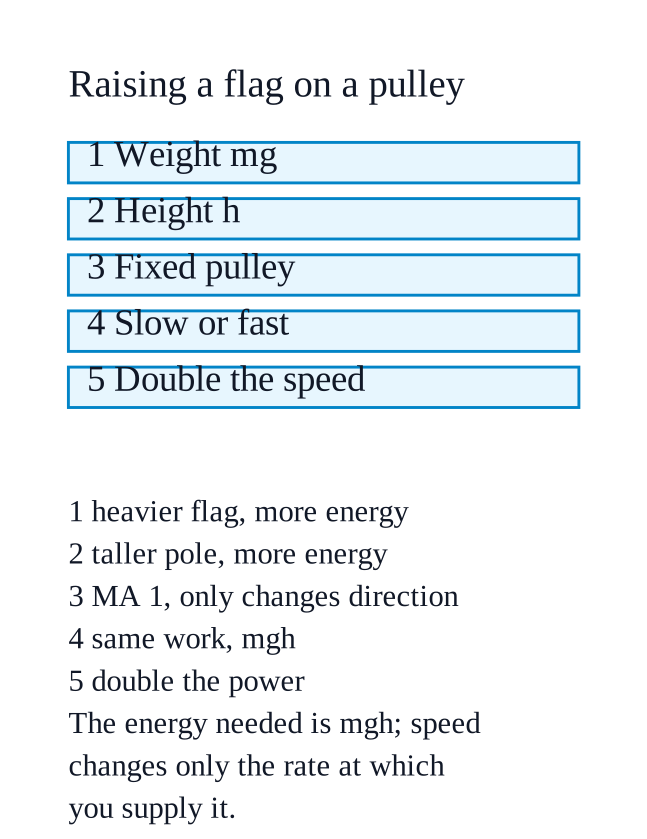
    The energy needed depends on just two things — the weight of the flag \(\displaystyle mg \) and the height of the flagpole \(\displaystyle h \): energy \(\displaystyle = mgh \).
    NCERT_Solution_Class9_Science_Ch7_RRR_Q7-7
    The pulley at the top is a fixed pulley, so its mechanical advantage is $\displaystyle 1$ — it only changes the direction of your effort so you can pull down instead of lifting up. Ignoring friction, it does not change the energy needed.
    Slowly or quickly makes no difference to the work done. \(\displaystyle W = mgh \) contains no time at all, so the same work is done either way.
    Doubling the speed doubles the power. The same work \(\displaystyle W \) is now done in half the time:
    \(\displaystyle P_{1} = \dfrac{W}{t} \) and \(\displaystyle P_{2} = \dfrac{W}{t/2} = \dfrac{2W}{t} = 2P_{1} \)
    So you must work at twice the rate, even though you do exactly the same amount of work.