SolveItClass 9 · NCERT

NCERT Solutions · Class 9 Science Work, Energy, and Simple Machines

28 questions · 20 still being checked

Revise, Reflect, Refine 7.14–7.15 (part 21 of 21)

  1. Exercise 7.14

    The potential energy-displacement graph of a 0.5\displaystyle 0.5 kg ball moving along a frictionless track is shown in Fig. 7.39. At O, the velocity of the ball is 0\displaystyle 0 m s1\displaystyle s^{-1} and potential energy is 30\displaystyle 30 J. Calculate the velocity of the ball at P, Q and R.NCERT_Question_Class9_Science_Ch7_RRR_Q7-14
    NCERT’s answer
    $\displaystyle 2$√$\displaystyle 10$ m \(\displaystyle s^{- 1}\); $\displaystyle 0$ m \(\displaystyle s^{- 1}\); The ball cannot reach position R
    \(\displaystyle v_{P} = 2\sqrt{10} \approx 6.3\ \text{m s}^{-1} \); \(\displaystyle v_{Q} = 0\ \text{m s}^{-1} \); the ball never reaches R.
    The track is frictionless, so the mechanical energy is conserved at the value it has at O:
    At O: \(\displaystyle K = 0\ \text{J} \) (velocity is zero) and \(\displaystyle U = 30\ \text{J} \), so total energy \(\displaystyle = 30\ \text{J} \) everywhere.
    At any point, \(\displaystyle K = 30\ \text{J} - U \), and \(\displaystyle K = \frac{1}{2} \times 0.5\ \text{kg} \times v^{2} = 0.25\,v^{2} \).
    At P, the graph reads \(\displaystyle U = 20\ \text{J} \):
    \(\displaystyle K = 30 - 20 = 10\ \text{J} \)
    \(\displaystyle 0.25\,v^{2} = 10 \Rightarrow v^{2} = 40\ \text{m}^{2}\,\text{s}^{-2} \)
    \(\displaystyle v_{P} = \sqrt{40} = 2\sqrt{10} \approx 6.3\ \text{m s}^{-1} \)
    At Q, the graph reads \(\displaystyle U = 30\ \text{J} \):
    \(\displaystyle K = 30 - 30 = 0\ \text{J} \), so \(\displaystyle v_{Q} = 0\ \text{m s}^{-1} \) — the ball just barely arrives at Q and stops there.
    At R, the graph reads \(\displaystyle U = 40\ \text{J} \), which is more than the $\displaystyle 30$ J the ball has altogether:
    That would need \(\displaystyle K = 30 - 40 = -10\ \text{J} \), and kinetic energy can never be negative.
    So the ball cannot reach R. It comes to rest at Q and rolls back.
  2. Exercise 7.15

    A coconut of mass 1.5\displaystyle 1.5 kg falls from the top of a coconut tree onto the wet sand on a beach. The height of the tree is 10\displaystyle 10 m. On impact, the coconut comes to rest by making a depression in the sand. the coconut’s energy is used to create the depression in the sand. Calculate the depth of the depression the coconut makes in the sand. Assume g = 10\displaystyle 10 m s2\displaystyle s^{-2}.
    NCERT’s answer
    (i)
    $\displaystyle 10$√$\displaystyle 2$ m \(\displaystyle s^{- 1}\) in the direction of motion (ii) $\displaystyle 0.05$ m
    (i) Velocity just before impact = \(\displaystyle 10\sqrt{2} \approx 14.1\ \text{m s}^{-1} \), directed downwards.
    NCERT_Solution_Class9_Science_Ch7_RRR_Q7-15
    All the potential energy at the top becomes kinetic energy at the bottom: \(\displaystyle \frac{1}{2}mv^{2} = mgh \)
    \(\displaystyle v = \sqrt{2gh} = \sqrt{2 \times 10\ \text{m s}^{-2} \times 10\ \text{m}} = \sqrt{200} = 10\sqrt{2} \approx 14.1\ \text{m s}^{-1} \)
    The mass cancels — a heavier coconut would land just as fast.
    (ii) Depth of the depression = $\displaystyle 0.05$ m ($\displaystyle 5$ cm).
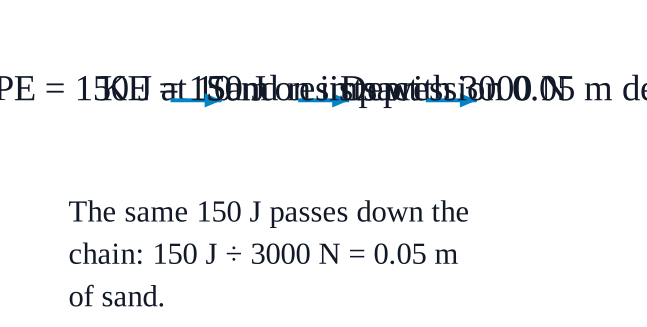
    Energy the coconut brings to the sand \(\displaystyle = mgh = 1.5\ \text{kg} \times 10\ \text{m s}^{-2} \times 10\ \text{m} = 150\ \text{J} \)
    The sand's resistive force does negative work over the depth \(\displaystyle d \) and takes away all of it: \(\displaystyle F \times d = 150\ \text{J} \)
    \(\displaystyle 3000\ \text{N} \times d = 150\ \text{J} \)
    \(\displaystyle d = \dfrac{150\ \text{J}}{3000\ \text{N}} = 0.05\ \text{m} = 5\ \text{cm} \)