Exercise 7.13
Throughout history, many designs of perpetual machines (using wheels, weights or magnets) have been proposed but none actually work. Why do all real machines eventually slow down and stop? Explain in terms of work and energy.
Not cross-checked
NCERT prints no numerical answer for this exercise, so this working has not been cross-checked against the book.
Because friction and air resistance do negative work all the time, and a machine can never create the energy to make up for it.
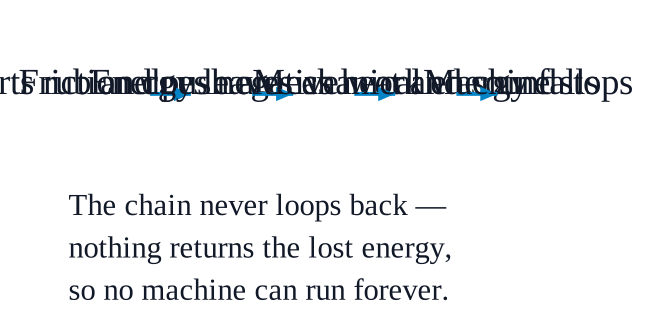
Every moving part rubs against another and against the air; these forces act opposite to the displacement, so they continuously take energy out of the machine.
Work done against friction is not stored as potential energy — it leaves as thermal energy and sound, and cannot be fed back into the motion.
So the mechanical energy of the machine falls step by step. Unless fuel, electricity or some other supply keeps replacing it, there is nothing to replenish it.
When the mechanical energy is used up, the machine stops. A perpetual machine would have to deliver useful work forever out of nothing; machines do not create energy, they only help us use it more effectively.