SolveItClass 9 · NCERT

NCERT Solutions · Class 9 Science Work, Energy, and Simple Machines

28 questions · 20 still being checked

Pause and Ponder 7.7–7.8 (part 12 of 21)

  1. Exercise 7.7

    For the situation depicted in Fig. 7.19\displaystyle 7.19, calculate the mechanical energy of the ball just before it hits the ground and show that even at this position, it is mgh .NCERT_Question_Class9_Science_Ch7_PP_Q7-7

    Not cross-checked

    NCERT prints no numerical answer for this exercise, so this working has not been cross-checked against the book.

    Mechanical energy just before the ball hits the ground = \(\displaystyle mgh \) — exactly what it was at A.
    Potential energy at C: the height there is zero, so \(\displaystyle U = mg \times 0 = 0 \).
    Speed at C: the ball has fallen the full height \(\displaystyle h \) from rest, so \(\displaystyle v^{2} = u^{2} + 2gh = 0 + 2gh \), giving \(\displaystyle v = \sqrt{2gh} \).
    Kinetic energy at C: \(\displaystyle K = \frac{1}{2}mv^{2} = \frac{1}{2}m(2gh) = mgh \).
    Mechanical energy at C: \(\displaystyle K + U = mgh + 0 = mgh \).
    All of the potential energy the ball had at A has turned into kinetic energy, and the sum is unchanged — this is the conservation of mechanical energy.
  2. Exercise 7.8

    You may have seen an exhibit like that in released from the highest point. Describe how the kinetic energy and potential energy change at points A, B and C. Why do subsequent points, such as C, D and E, usually have lower heights compared to the previous ones? Could it have anything to do with the energy lost due to friction? Power is defined as the rate at which work is done. Mathematically, the To do more work in the same time interval, requires more power. To Thus, the power required will be 1500\displaystyle 1500 J = 300\displaystyle 300 W while initial velocity u = 0\displaystyle 0 m s1\displaystyle s^{-1}

    Not cross-checked

    NCERT prints no numerical answer for this exercise, so this working has not been cross-checked against the book.

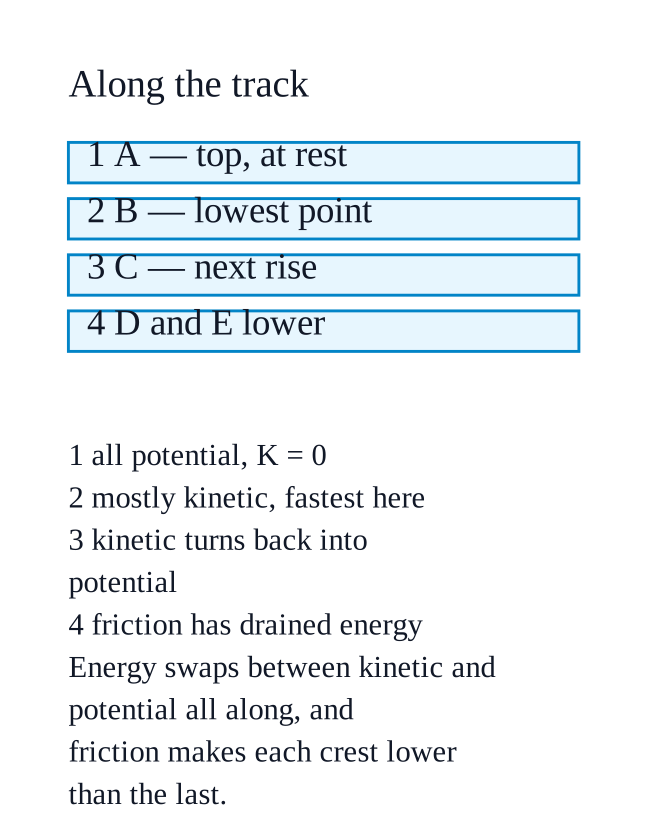
    At A the energy is all potential; lower down at B most of it has become kinetic; at C the ball climbs again and turns kinetic energy back into potential — and each later crest is lower because friction and air resistance drain mechanical energy away.
    NCERT_Solution_Class9_Science_Ch7_PP_Q7-8
    A (release point, the highest point): the ball starts at rest, so \(\displaystyle K = 0 \) and \(\displaystyle U = mgh_{A} \) is at its maximum. Mechanical energy \(\displaystyle = mgh_{A} \).
    B (lower down the track): the height has dropped, so \(\displaystyle U \) has dropped; the potential energy lost reappears as kinetic energy, \(\displaystyle K = mg(h_{A} - h_{B}) \). The ball is fastest where the track is lowest.
    C (the next rise): the ball is now climbing, so \(\displaystyle K \) falls and \(\displaystyle U \) rises again. It can only rise until \(\displaystyle mgh \) equals the mechanical energy it still has.
    Why C, D, E are lower: yes, this is friction. The ball rubs on the track and pushes through air, and both forces act opposite to its displacement, so they do negative work at every stage. That energy leaves as thermal energy and sound and is not stored — the chapter notes that work done against friction does not lead to storage of energy.
    With less mechanical energy left after each stretch, the ball can only climb to a smaller height, so the crests get steadily lower. This is the same reason the pendulum of Activity $\displaystyle 7.2$ does not quite return to its starting line.