Exercise 7.3
When a ball thrown upwards reaches its highest point, tick which of the following statement(s) are correct? (i) The force acting on the ball is zero. (ii) The acceleration of the ball is zero. (iii) Its kinetic energy is zero. (iv) Its potential energy is maximum.
Not cross-checked
NCERT prints no numerical answer for this exercise, so this working has not been cross-checked against the book.
NCERT’s answer
(iii)
; (iv)
Correct statements: (iii) and (iv).
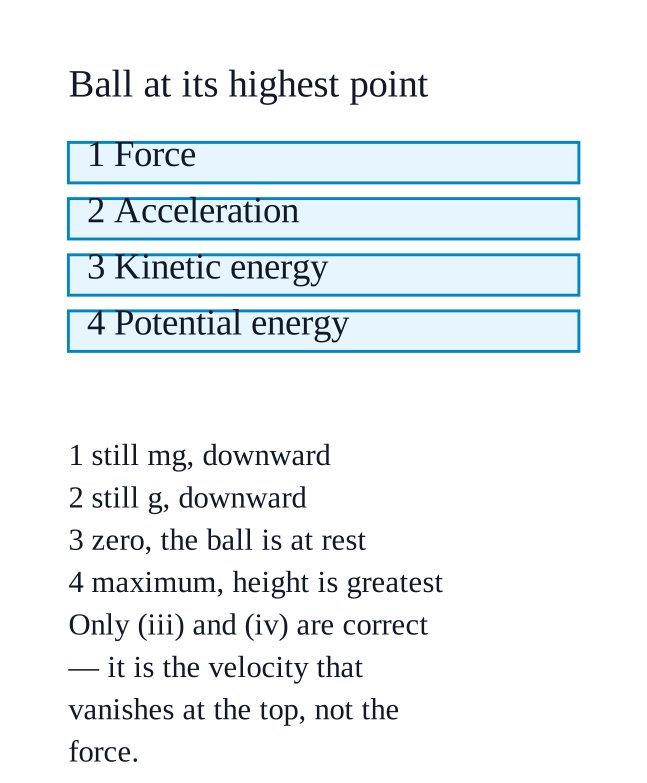
(i) Wrong — gravity still pulls on the ball at the top, with force \(\displaystyle mg \) downward. Nothing switches it off.
(ii) Wrong — since the force \(\displaystyle mg \) still acts, the acceleration is still \(\displaystyle g \) downward (about \(\displaystyle 10\ \text{m s}^{-2} \)). It is the velocity, not the acceleration, that is zero.
(iii) Correct — at the highest point the ball is momentarily at rest, \(\displaystyle v = 0 \), so \(\displaystyle K = \frac{1}{2}mv^{2} = 0 \).
(iv) Correct — the height \(\displaystyle h \) is largest there, so \(\displaystyle U = mgh \) is maximum. All the kinetic energy the ball started with has been converted into potential energy.