Exercise 7.3
When you pedal a bicycle on a flat road, your muscles supply energy. In what forms does this muscular energy appear as you ride? into light energy in a bulb, and into thermal energy of the water in an electric water heater. The chemical energy in the food we eat powers our muscles and gets converted into mechanical energy. Similarly, a ringing bell converts mechanical energy into sound energy. Among these, we will now look more closely at mechanical How much is the energy possessed by an object by virtue of Initial velocity = Initial Kinetic energy = F Let us find a mathematical expression for the kinetic energy. For that,
Not cross-checked
NCERT prints no numerical answer for this exercise, so this working has not been cross-checked against the book.
The chemical energy of your muscles appears mainly as kinetic energy of you and the cycle, and the rest as thermal energy and a little sound energy.
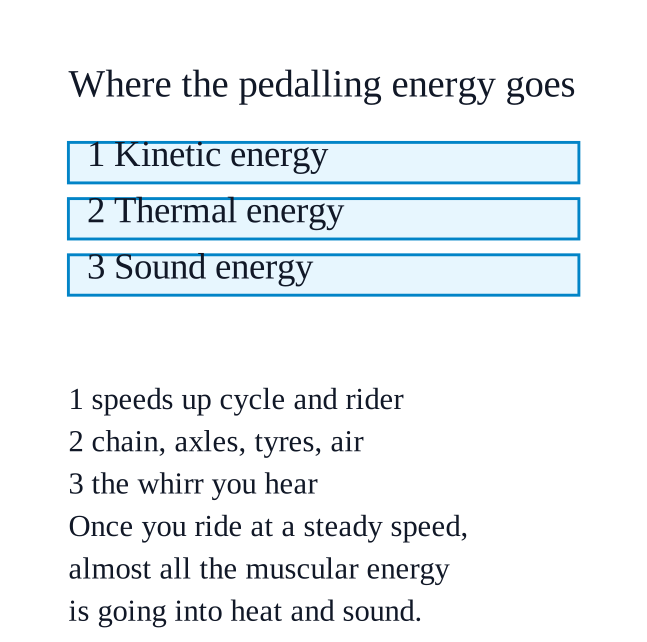
Kinetic energy: while you speed up, the positive work you do raises \(\displaystyle K = \frac{1}{2}mv^{2} \) of the cycle-plus-rider.
Thermal energy: friction at the chain, axles and tyres, and air resistance, do negative work all the time. Work done against friction is not stored — it warms the parts, the road and the air.
Sound energy: the whirr of the chain and tyres carries away a small share.
Once you ride at a steady speed on a flat road, \(\displaystyle K \) stops changing and the height \(\displaystyle h \) is fixed, so \(\displaystyle U = mgh \) is fixed too — from then on essentially all the muscular energy goes into overcoming friction and air resistance, i.e. into thermal and sound energy.