SolveItClass 9 · NCERT

NCERT Solutions · Class 9 Science Work, Energy, and Simple Machines

28 questions · 20 still being checked

Revise, Reflect, Refine 7.11–7.15 (part 3 of 3)

  1. Exercise 7.11

    A 10.0\displaystyle 10.0 kg block is moving on horizontal floor with negligible friction. As shown in the Fig. 7.37\displaystyle 7.37, a variable force is applied on the block in its direction of motion from its position at 0\displaystyle 0 m till 4\displaystyle 4 m. If the block had a kinetic energy of 180\displaystyle 180 J when it was at 0\displaystyle 0 m, find the block’s speed (i) at 0\displaystyle 0 m, and (ii) at 4\displaystyle 4 m. Does the block have negative acceleration in any portion of its motion?NCERT_Question_Class9_Science_Ch7_RRR_Q7-11
    NCERT’s answer
    $\displaystyle 6$ m \(\displaystyle s^{- 1}\); √$\displaystyle 66$ m \(\displaystyle s^{- 1}\); No
    (i) Speed at $\displaystyle 0$ m = \(\displaystyle 6\ \text{m s}^{-1} \); (ii) speed at $\displaystyle 4$ m = \(\displaystyle \sqrt{66} \approx 8.1\ \text{m s}^{-1} \); and no, the block never has negative acceleration.
    (i) Speed at $\displaystyle 0$ m — from \(\displaystyle K = \frac{1}{2}mv^{2} \):
    \(\displaystyle 180\ \text{J} = \frac{1}{2} \times 10.0\ \text{kg} \times v^{2} \)
    \(\displaystyle v^{2} = 36\ \text{m}^{2}\,\text{s}^{-2} \), so \(\displaystyle v = 6\ \text{m s}^{-1} \)
    (ii) Speed at $\displaystyle 4$ m — the work done by a varying force is the area under the force-displacement graph (Fig. $\displaystyle 7.37$). The graph is a trapezium: the force climbs to $\displaystyle 50$ N by $\displaystyle 1$ m, stays at $\displaystyle 50$ N up to $\displaystyle 3$ m, then falls back to $\displaystyle 0$ at $\displaystyle 4$ m.
    Area \(\displaystyle = \frac{1}{2} \times (4\ \text{m} + 2\ \text{m}) \times 50\ \text{N} = 150\ \text{J} \)
    By the work-energy theorem, \(\displaystyle K_{\text{final}} = 180\ \text{J} + 150\ \text{J} = 330\ \text{J} \)
    \(\displaystyle 330\ \text{J} = \frac{1}{2} \times 10.0\ \text{kg} \times v^{2} \Rightarrow v^{2} = 66\ \text{m}^{2}\,\text{s}^{-2} \)
    \(\displaystyle v = \sqrt{66} \approx 8.1\ \text{m s}^{-1} \)
    Negative acceleration? No. The applied force stays in the direction of motion everywhere between $\displaystyle 0$ m and $\displaystyle 4$ m — it never becomes negative — and friction is negligible.
    Between $\displaystyle 3$ m and $\displaystyle 4$ m the force gets smaller, so the block gains speed more slowly, but it is still speeding up. A smaller forward force is not a backward force.

  2. Exercise 7.12

    The gravitational attraction on the surface of the Moon (lunar surface) is about 1\displaystyle 1 th An astronaut can throw a ball up to a height of 8\displaystyle 8 m from the surface of the Earth. How far up will the ball thrown with the same upward velocity travel from the surface of the Moon?
    NCERT’s answer
    $\displaystyle 48$ m
    The ball rises $\displaystyle 48$ m on the Moon — six times as high.
    NCERT_Solution_Class9_Science_Ch7_RRR_Q7-12
    At the highest point all the kinetic energy has become potential energy:
    \(\displaystyle \frac{1}{2}mv^{2} = mgh \), so \(\displaystyle h = \dfrac{v^{2}}{2g} \)
    The astronaut throws with the same upward velocity \(\displaystyle v \), so \(\displaystyle h \) is inversely proportional to \(\displaystyle g \):
    \(\displaystyle \dfrac{h_{\text{Moon}}}{h_{\text{Earth}}} = \dfrac{g_{\text{Earth}}}{g_{\text{Moon}}} = 6 \) (since \(\displaystyle g_{\text{Moon}} = \frac{1}{6} g_{\text{Earth}} \))
    Therefore \(\displaystyle h_{\text{Moon}} = 6 \times 8\ \text{m} = 48\ \text{m} \).
    The mass of the ball cancels out, so the answer does not depend on how heavy the ball is.
  3. Exercise 7.13

    A 1000\displaystyle 1000 kg car is moving along a road at a constant speed. Suddenly, the driver notices some obstruction ahead and applies the brakes to come to a complete stop. The graphical representation of motion of the car starting from the instant the driver spots the traffic ahead is shown in Fig. 7.38. (i) Describe how the car moves between positions A and B. (ii) Calculate the kinetic energy of the car at A. (iii) State the work done by the brakes in bringing the car to a halt between B and C. (iv) What does the kinetic energy of the car transform into?NCERT_Question_Class9_Science_Ch7_RRR_Q7-13

    Check this one against your book

    NCERT’s printed answer for this exercise does not match its own question. This working follows the question as printed.

    (i) Between A and B the car moves at constant speed, \(\displaystyle 35\ \text{m s}^{-1} \).
    The speed-time graph is a horizontal line from A to B, so the speed does not change and the acceleration is zero.
    This is the driver's reaction time — the obstruction has been spotted but the brakes have not been applied yet.
    (ii) Kinetic energy at A = $\displaystyle 612500$ J.
    \(\displaystyle K = \frac{1}{2}mv^{2} = \frac{1}{2} \times 1000\ \text{kg} \times (35\ \text{m s}^{-1})^{2} \)
    \(\displaystyle K = 500 \times 1225 = 612500\ \text{J} \)
    (iii) Work done by the brakes between B and C = \(\displaystyle -612500\ \text{J} \).
    By the work-energy theorem, work done = change in kinetic energy \(\displaystyle = 0\ \text{J} - 612500\ \text{J} = -612500\ \text{J} \)
    It is negative because the braking force acts opposite to the car's displacement.
    (iv) The kinetic energy is converted mainly into thermal energy in the brake pads, tyres and road, with a small part leaving as sound.
    Braking is friction, and the chapter states plainly that work done against friction does not lead to any storage of energy — so none of this energy is stored as potential energy.
    The car runs on a level road, so its height never changes and \(\displaystyle U = mgh \) stays fixed at its ground-level value; there is no rise for gravitational potential energy to be gained through.
    Thermal energy is one of the forms of energy listed in the chapter, and the chapter records that mechanical energy and thermal energy can be converted into one another, and that energy can be transferred as heat.
    This is the same reason the chapter gives for a real pendulum slowing and stopping, and for the roller-coaster ball reaching lower and lower heights: the energy is carried away by friction and air resistance, not banked as potential energy.
  4. Exercise 7.14

    The potential energy-displacement graph of a 0.5\displaystyle 0.5 kg ball moving along a frictionless track is shown in Fig. 7.39. At O, the velocity of the ball is 0\displaystyle 0 m s1\displaystyle s^{-1} and potential energy is 30\displaystyle 30 J. Calculate the velocity of the ball at P, Q and R.NCERT_Question_Class9_Science_Ch7_RRR_Q7-14
    NCERT’s answer
    $\displaystyle 2$√$\displaystyle 10$ m \(\displaystyle s^{- 1}\); $\displaystyle 0$ m \(\displaystyle s^{- 1}\); The ball cannot reach position R
    \(\displaystyle v_{P} = 2\sqrt{10} \approx 6.3\ \text{m s}^{-1} \); \(\displaystyle v_{Q} = 0\ \text{m s}^{-1} \); the ball never reaches R.
    The track is frictionless, so the mechanical energy is conserved at the value it has at O:
    At O: \(\displaystyle K = 0\ \text{J} \) (velocity is zero) and \(\displaystyle U = 30\ \text{J} \), so total energy \(\displaystyle = 30\ \text{J} \) everywhere.
    At any point, \(\displaystyle K = 30\ \text{J} - U \), and \(\displaystyle K = \frac{1}{2} \times 0.5\ \text{kg} \times v^{2} = 0.25\,v^{2} \).
    At P, the graph reads \(\displaystyle U = 20\ \text{J} \):
    \(\displaystyle K = 30 - 20 = 10\ \text{J} \)
    \(\displaystyle 0.25\,v^{2} = 10 \Rightarrow v^{2} = 40\ \text{m}^{2}\,\text{s}^{-2} \)
    \(\displaystyle v_{P} = \sqrt{40} = 2\sqrt{10} \approx 6.3\ \text{m s}^{-1} \)
    At Q, the graph reads \(\displaystyle U = 30\ \text{J} \):
    \(\displaystyle K = 30 - 30 = 0\ \text{J} \), so \(\displaystyle v_{Q} = 0\ \text{m s}^{-1} \) — the ball just barely arrives at Q and stops there.
    At R, the graph reads \(\displaystyle U = 40\ \text{J} \), which is more than the $\displaystyle 30$ J the ball has altogether:
    That would need \(\displaystyle K = 30 - 40 = -10\ \text{J} \), and kinetic energy can never be negative.
    So the ball cannot reach R. It comes to rest at Q and rolls back.
  5. Exercise 7.15

    A coconut of mass 1.5\displaystyle 1.5 kg falls from the top of a coconut tree onto the wet sand on a beach. The height of the tree is 10\displaystyle 10 m. On impact, the coconut comes to rest by making a depression in the sand. the coconut’s energy is used to create the depression in the sand. Calculate the depth of the depression the coconut makes in the sand. Assume g = 10\displaystyle 10 m s2\displaystyle s^{-2}.
    NCERT’s answer
    (i)
    $\displaystyle 10$√$\displaystyle 2$ m \(\displaystyle s^{- 1}\) in the direction of motion (ii) $\displaystyle 0.05$ m
    (i) Velocity just before impact = \(\displaystyle 10\sqrt{2} \approx 14.1\ \text{m s}^{-1} \), directed downwards.
    NCERT_Solution_Class9_Science_Ch7_RRR_Q7-15
    All the potential energy at the top becomes kinetic energy at the bottom: \(\displaystyle \frac{1}{2}mv^{2} = mgh \)
    \(\displaystyle v = \sqrt{2gh} = \sqrt{2 \times 10\ \text{m s}^{-2} \times 10\ \text{m}} = \sqrt{200} = 10\sqrt{2} \approx 14.1\ \text{m s}^{-1} \)
    The mass cancels — a heavier coconut would land just as fast.
    (ii) Depth of the depression = $\displaystyle 0.05$ m ($\displaystyle 5$ cm).
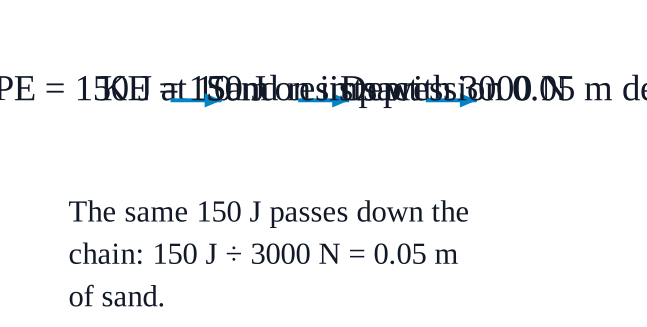
    Energy the coconut brings to the sand \(\displaystyle = mgh = 1.5\ \text{kg} \times 10\ \text{m s}^{-2} \times 10\ \text{m} = 150\ \text{J} \)
    The sand's resistive force does negative work over the depth \(\displaystyle d \) and takes away all of it: \(\displaystyle F \times d = 150\ \text{J} \)
    \(\displaystyle 3000\ \text{N} \times d = 150\ \text{J} \)
    \(\displaystyle d = \dfrac{150\ \text{J}}{3000\ \text{N}} = 0.05\ \text{m} = 5\ \text{cm} \)