SolveItClass 9 · NCERT

NCERT Solutions · Class 9 Science Work, Energy, and Simple Machines

28 questions · 20 still being checked

Pause and Ponder 7.1–7.13 (part 1 of 3)

  1. Exercise 7.1

    In the previous chapter, a weightlifter is shown holding a barbell steady in her hands (Fig. 6.8\displaystyle 6.8). Is she doing any work on the barbell while holding it steady?

    Not cross-checked

    NCERT prints no numerical answer for this exercise, so this working has not been cross-checked against the book.

    NCERT’s answer
    No
    No — she does no work on the barbell while holding it steady.
    Work needs displacement: \(\displaystyle W = F \times s \). Here the barbell does not move, so \(\displaystyle s = 0 \) and \(\displaystyle W = 0 \), however large the force she applies.
    She still feels tired because her muscles keep contracting and expanding and use up the internal energy of her body — but that is not work done on the barbell.
  2. Exercise 7.2

    Is the work done by friction on the stack of coins that travels on a rough surface (Fig. 6.13c) — positive, negative or zero?

    Not cross-checked

    NCERT prints no numerical answer for this exercise, so this working has not been cross-checked against the book.

    NCERT’s answer
    Negative
    Negative.
    Friction on the sliding stack of coins acts opposite to the direction of its displacement.
    When the force and the displacement point in opposite directions, the work done by that force is negative.
    That is why the coins lose energy, slow down and finally stop on the rough surface.
  3. Exercise 7.3

    When you pedal a bicycle on a flat road, your muscles supply energy. In what forms does this muscular energy appear as you ride? into light energy in a bulb, and into thermal energy of the water in an electric water heater. The chemical energy in the food we eat powers our muscles and gets converted into mechanical energy. Similarly, a ringing bell converts mechanical energy into sound energy. Among these, we will now look more closely at mechanical How much is the energy possessed by an object by virtue of Initial velocity = 0\displaystyle 0 Initial Kinetic energy = 0\displaystyle 0 F Let us find a mathematical expression for the kinetic energy. For that,

    Not cross-checked

    NCERT prints no numerical answer for this exercise, so this working has not been cross-checked against the book.

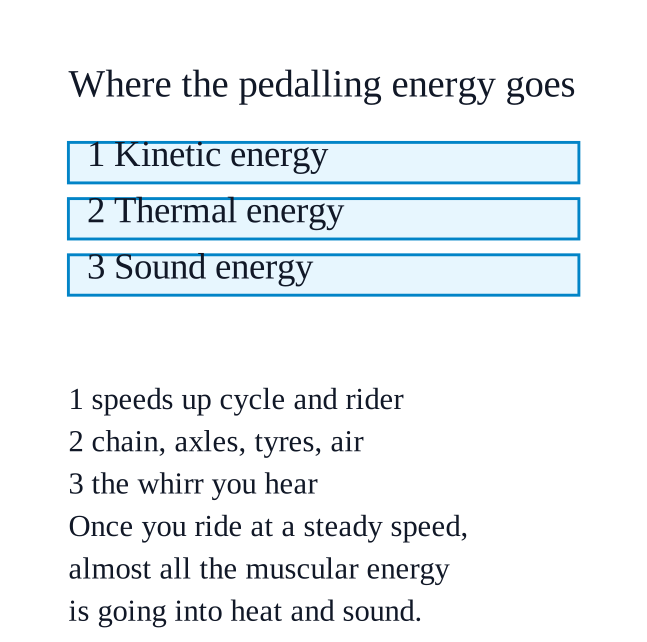
    The chemical energy of your muscles appears mainly as kinetic energy of you and the cycle, and the rest as thermal energy and a little sound energy.
    NCERT_Solution_Class9_Science_Ch7_PP_Q7-3
    Kinetic energy: while you speed up, the positive work you do raises \(\displaystyle K = \frac{1}{2}mv^{2} \) of the cycle-plus-rider.
    Thermal energy: friction at the chain, axles and tyres, and air resistance, do negative work all the time. Work done against friction is not stored — it warms the parts, the road and the air.
    Sound energy: the whirr of the chain and tyres carries away a small share.
    Once you ride at a steady speed on a flat road, \(\displaystyle K \) stops changing and the height \(\displaystyle h \) is fixed, so \(\displaystyle U = mgh \) is fixed too — from then on essentially all the muscular energy goes into overcoming friction and air resistance, i.e. into thermal and sound energy.
  4. Exercise 7.4

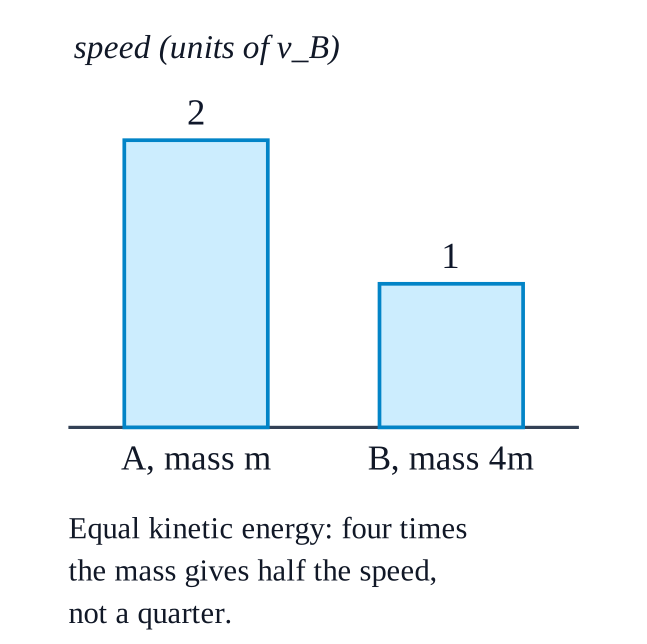
    Two objects A and B of mass m and 4\displaystyle 4 m have the same kinetic energy. What is the ratio of the magnitude of velocities of A and B?
    NCERT’s answer
    $\displaystyle 2$:$\displaystyle 1$
    \(\displaystyle v_{A} : v_{B} = 2 : 1 \) — the lighter object moves twice as fast.
    NCERT_Solution_Class9_Science_Ch7_PP_Q7-4
    Equal kinetic energies: \(\displaystyle \frac{1}{2}m\,v_{A}^{2} = \frac{1}{2}(4m)\,v_{B}^{2} \)
    Cancelling \(\displaystyle \frac{1}{2}m \): \(\displaystyle v_{A}^{2} = 4\,v_{B}^{2} \)
    Taking the square root: \(\displaystyle v_{A} = 2\,v_{B} \), so the ratio is \(\displaystyle 2:1 \).
  5. Exercise 7.5

    Does the kinetic energy of an object which moves with constant velocity change with its position? In these examples, you notice that when the stretched band or the bent

    Not cross-checked

    NCERT prints no numerical answer for this exercise, so this working has not been cross-checked against the book.

    NCERT’s answer
    No
    No — it stays the same.
    \(\displaystyle K = \frac{1}{2}mv^{2} \) depends only on the mass and the speed, never on where the object is.
    Constant velocity means \(\displaystyle v \) does not change, so \(\displaystyle K \) does not change as the object moves from place to place.
    Seen through the work-energy theorem: with the velocity constant, no net work is being done on it, so there is no change in its kinetic energy.
  6. Exercise 7.6

    Does the potential energy of an object near the surface of the Earth change if it moves with constant velocity in the horizontal direction? What if the object is gradually raised in the vertical direction? Ready to Go Beyond Work done on a system against its internal forces, such as gravitational, electric or magnetic forces, can result in a gain of the potential energy of the system. But this is not true for all internal forces. For example, work done against friction does not lead to a storage of energy. You will learn how to identify such forces in higher grades. Once again, consider an object with mass m which has been lifted to potential energy of the object kinetic energy of the object mechanical energy

    Not cross-checked

    NCERT prints no numerical answer for this exercise, so this working has not been cross-checked against the book.

    NCERT’s answer
    No; yes
    Horizontal motion: No, the potential energy does not change. Gradual vertical raising: Yes, it increases.
    \(\displaystyle U = mgh \) depends only on the height \(\displaystyle h \) above the Earth's surface.
    Moving horizontally, \(\displaystyle h \) is unchanged, so \(\displaystyle U \) is unchanged. The gravitational force is perpendicular to the displacement here, so it does no work (Fig. $\displaystyle 7.6$).
    Raising the object through a height \(\displaystyle \Delta h \) means doing work \(\displaystyle mg \times \Delta h \) against gravity, and that work appears as a gain in potential energy: \(\displaystyle \Delta U = mg\,\Delta h \).
    NCERT_Solution_Class9_Science_Ch7_PP_Q7-6
  7. Exercise 7.7

    For the situation depicted in Fig. 7.19\displaystyle 7.19, calculate the mechanical energy of the ball just before it hits the ground and show that even at this position, it is mgh .NCERT_Question_Class9_Science_Ch7_PP_Q7-7

    Not cross-checked

    NCERT prints no numerical answer for this exercise, so this working has not been cross-checked against the book.

    Mechanical energy just before the ball hits the ground = \(\displaystyle mgh \) — exactly what it was at A.
    Potential energy at C: the height there is zero, so \(\displaystyle U = mg \times 0 = 0 \).
    Speed at C: the ball has fallen the full height \(\displaystyle h \) from rest, so \(\displaystyle v^{2} = u^{2} + 2gh = 0 + 2gh \), giving \(\displaystyle v = \sqrt{2gh} \).
    Kinetic energy at C: \(\displaystyle K = \frac{1}{2}mv^{2} = \frac{1}{2}m(2gh) = mgh \).
    Mechanical energy at C: \(\displaystyle K + U = mgh + 0 = mgh \).
    All of the potential energy the ball had at A has turned into kinetic energy, and the sum is unchanged — this is the conservation of mechanical energy.
  8. Exercise 7.8

    You may have seen an exhibit like that in released from the highest point. Describe how the kinetic energy and potential energy change at points A, B and C. Why do subsequent points, such as C, D and E, usually have lower heights compared to the previous ones? Could it have anything to do with the energy lost due to friction? Power is defined as the rate at which work is done. Mathematically, the To do more work in the same time interval, requires more power. To Thus, the power required will be 1500\displaystyle 1500 J = 300\displaystyle 300 W while initial velocity u = 0\displaystyle 0 m s1\displaystyle s^{-1}

    Not cross-checked

    NCERT prints no numerical answer for this exercise, so this working has not been cross-checked against the book.

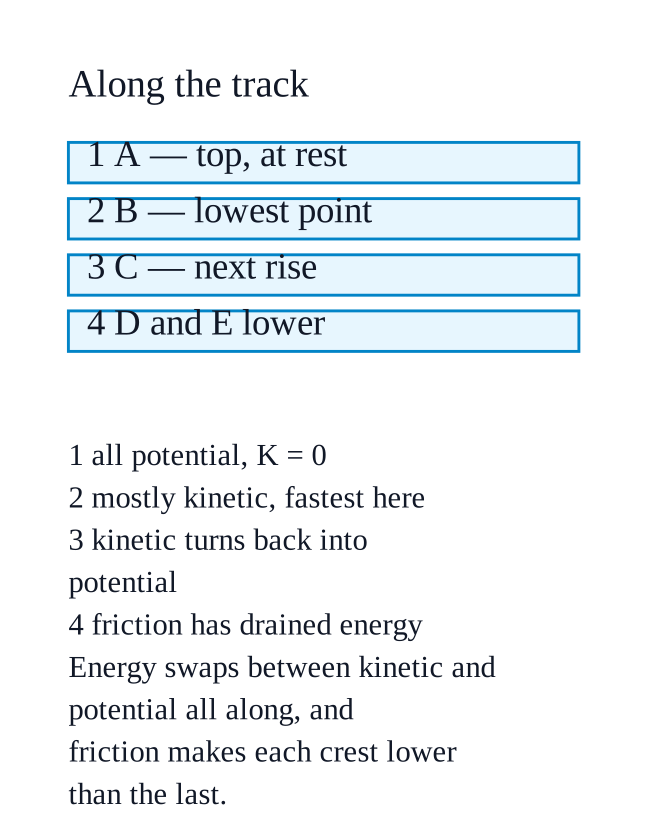
    At A the energy is all potential; lower down at B most of it has become kinetic; at C the ball climbs again and turns kinetic energy back into potential — and each later crest is lower because friction and air resistance drain mechanical energy away.
    NCERT_Solution_Class9_Science_Ch7_PP_Q7-8
    A (release point, the highest point): the ball starts at rest, so \(\displaystyle K = 0 \) and \(\displaystyle U = mgh_{A} \) is at its maximum. Mechanical energy \(\displaystyle = mgh_{A} \).
    B (lower down the track): the height has dropped, so \(\displaystyle U \) has dropped; the potential energy lost reappears as kinetic energy, \(\displaystyle K = mg(h_{A} - h_{B}) \). The ball is fastest where the track is lowest.
    C (the next rise): the ball is now climbing, so \(\displaystyle K \) falls and \(\displaystyle U \) rises again. It can only rise until \(\displaystyle mgh \) equals the mechanical energy it still has.
    Why C, D, E are lower: yes, this is friction. The ball rubs on the track and pushes through air, and both forces act opposite to its displacement, so they do negative work at every stage. That energy leaves as thermal energy and sound and is not stored — the chapter notes that work done against friction does not lead to storage of energy.
    With less mechanical energy left after each stretch, the ball can only climb to a smaller height, so the crests get steadily lower. This is the same reason the pendulum of Activity $\displaystyle 7.2$ does not quite return to its starting line.
  9. Exercise 7.9

    Explain why roads on hills are built to wind around in gentle slopes rather than going straight up (Fig. 4.26\displaystyle 4.26)?

    Not cross-checked

    NCERT prints no numerical answer for this exercise, so this working has not been cross-checked against the book.

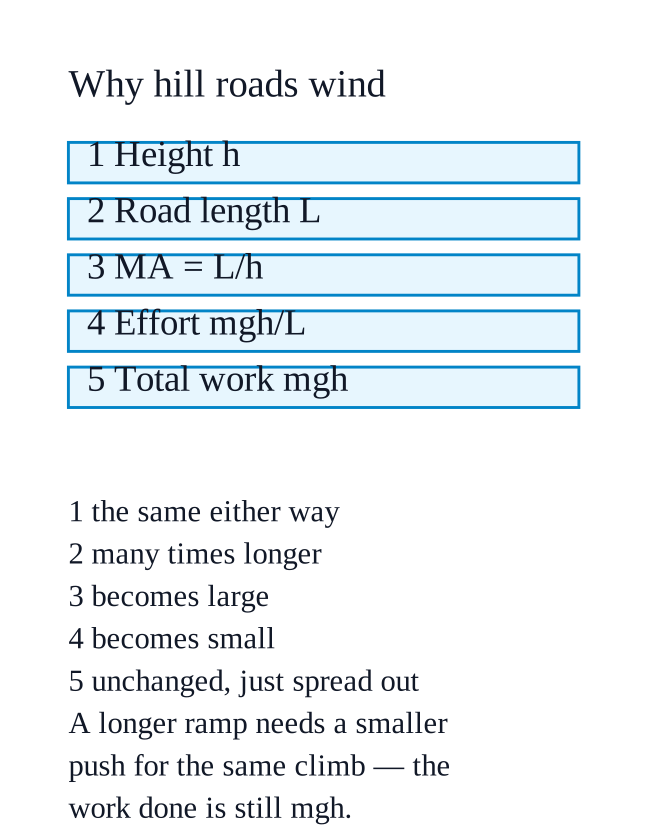
    Because a winding road is a long inclined plane, and a longer ramp needs a smaller force to climb the same hill.
    NCERT_Solution_Class9_Science_Ch7_PP_Q7-9
    The mechanical advantage of an inclined plane is \(\displaystyle \text{MA} = \dfrac{L}{h} \) (Eq. $\displaystyle 7.13$), where \(\displaystyle L \) is the length of the road and \(\displaystyle h \) the height of the hill.
    Winding round and round makes \(\displaystyle L \) many times larger while \(\displaystyle h \) stays fixed, so the MA becomes large.
    The effort needed at any instant is \(\displaystyle F' = \dfrac{mgh}{L} \) — a bigger \(\displaystyle L \) means a much smaller push from the engine, and a gentler slope that vehicles can actually manage.
    The total work is not reduced: it is still \(\displaystyle mgh \). The same work is simply spread over a much longer distance.
  10. Exercise 7.10

    To reach a higher floor, we find climbing an inclined ladder easier in comparison to climbing a vertical ladder (Fig. 7.30\displaystyle 7.30). Explain why.NCERT_Question_Class9_Science_Ch7_PP_Q7-10

    Not cross-checked

    NCERT prints no numerical answer for this exercise, so this working has not been cross-checked against the book.

    Because the inclined ladder works as an inclined plane, and reduces the force you must apply at each step.
    Vertical ladder: you lift your whole weight straight up, so the effort you must supply is the full \(\displaystyle mg \).
    Inclined ladder of length \(\displaystyle L \) reaching the same height \(\displaystyle h \): from \(\displaystyle F' \times L = mgh \), the effort is \(\displaystyle F' = \dfrac{mgh}{L} \).
    Since \(\displaystyle L > h \), we get \(\displaystyle F' < mg \), and \(\displaystyle \text{MA} = \dfrac{L}{h} > 1 \).
    You have to travel a longer distance along the slanted ladder, so the total work is still \(\displaystyle mgh \) — it only feels easier because each step demands less force.
  11. Exercise 7.11

    Why is it easier to open the lid of a can by using a spoon as shown in Fig. 7.35\displaystyle 7.35?NCERT_Question_Class9_Science_Ch7_PP_Q7-11

    Not cross-checked

    NCERT prints no numerical answer for this exercise, so this working has not been cross-checked against the book.

    Because the spoon acts as a lever with a long effort arm and a very short load arm.
    Fulcrum: the rim of the can, where the spoon rests. Load: the edge of the lid, gripped by the spoon's tip, just next to the rim. Effort: your hand pressing down at the far end of the handle.
    The effort arm (fulcrum to hand) is many times the load arm (fulcrum to lid).
    \(\displaystyle \text{MA} = \dfrac{\text{effort arm}}{\text{load arm}} \) (Eq. $\displaystyle 7.16$) is therefore much greater than 1.
    So a small effort at the handle produces a large force on the lid, enough to prise it off — your hand moves through a large distance while the lid lifts only a little, keeping the total work the same.
  12. Exercise 7.12

    Why do you push an object closer to scissors fulcrum when you want to cut an object which is hard?

    Not cross-checked

    NCERT prints no numerical answer for this exercise, so this working has not been cross-checked against the book.

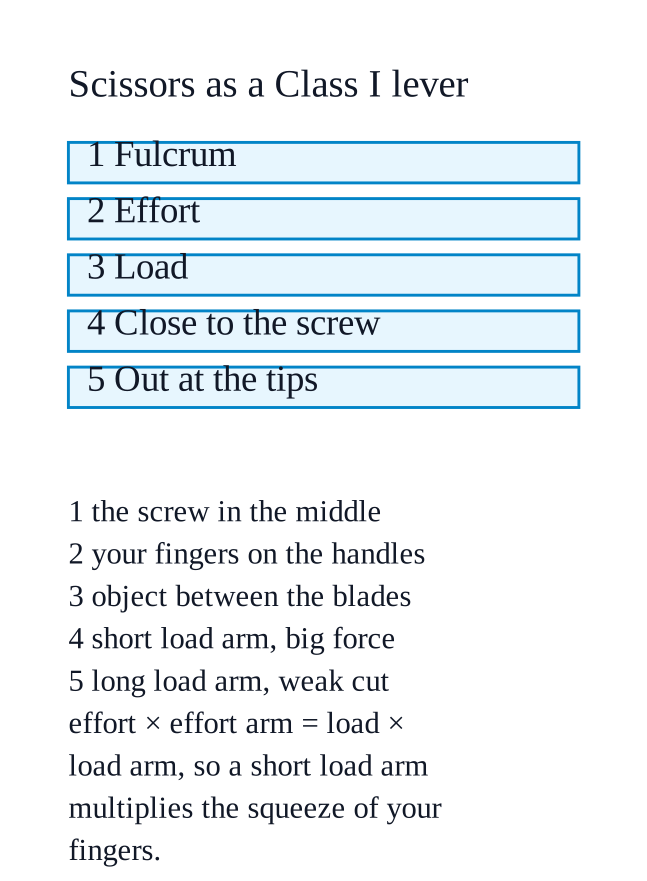
    To make the load arm as short as possible, which raises the mechanical advantage and gives a bigger cutting force.
    NCERT_Solution_Class9_Science_Ch7_PP_Q7-12
    Scissors are a Class I lever (Table $\displaystyle 7.2$): the screw is the fulcrum, your fingers supply the effort at the handles, the object is the load between the blades.
    The balance condition is \(\displaystyle \text{effort} \times \text{effort arm} = \text{load} \times \text{load arm} \) (Eq. $\displaystyle 7.15$), so \(\displaystyle \text{load} = \text{effort} \times \dfrac{\text{effort arm}}{\text{load arm}} \).
    Pushing the object close to the fulcrum makes the load arm small, so that ratio is large and the same squeeze of your fingers delivers a much larger force on the object.
    Near the tips of the blades the load arm is long, the force is small, and a hard object will not cut.
  13. Exercise 7.13

    Throughout history, many designs of perpetual machines (using wheels, weights or magnets) have been proposed but none actually work. Why do all real machines eventually slow down and stop? Explain in terms of work and energy.

    Not cross-checked

    NCERT prints no numerical answer for this exercise, so this working has not been cross-checked against the book.

    Because friction and air resistance do negative work all the time, and a machine can never create the energy to make up for it.
    NCERT_Solution_Class9_Science_Ch7_PP_Q7-13
    Every moving part rubs against another and against the air; these forces act opposite to the displacement, so they continuously take energy out of the machine.
    Work done against friction is not stored as potential energy — it leaves as thermal energy and sound, and cannot be fed back into the motion.
    So the mechanical energy of the machine falls step by step. Unless fuel, electricity or some other supply keeps replacing it, there is nothing to replenish it.
    When the mechanical energy is used up, the machine stops. A perpetual machine would have to deliver useful work forever out of nothing; machines do not create energy, they only help us use it more effectively.