SolveItClass 9 · NCERT

NCERT Solutions · Class 9 Science Work, Energy, and Simple Machines

28 questions · 20 still being checked

Revise, Reflect, Refine 7.1–7.10 (part 2 of 3)

  1. Exercise 7.1

    State whether True or False. (i) Work is said to be done when a force is applied, even if the object does not move. (ii) Lifting a bucket vertically upward results in positive work done on the bucket. (iii) The SI unit for both work and energy is joule (J). (iv) A motionless stretched rubber band has kinetic energy. (v) Energy can change from one form to another.

    Not cross-checked

    NCERT prints no numerical answer for this exercise, so this working has not been cross-checked against the book.

    NCERT’s answer
    (i)
    F (ii) T (iii) T (iv) F (v) T
    (i) False — work needs displacement. \(\displaystyle W = F \times s \), and if \(\displaystyle s = 0 \) then \(\displaystyle W = 0 \), however hard you push.
    (ii) True — the applied force is upward and the bucket's displacement is upward, so force and displacement are in the same direction and the work done is positive.
    (iii) True — both work and energy are measured in the joule (J), where \(\displaystyle 1\ \text{J} = 1\ \text{N} \times 1\ \text{m} \).
    (iv) False — it is motionless, so \(\displaystyle K = \frac{1}{2}mv^{2} = 0 \). What it stores, because of its deformation, is potential energy.
    (v) True — for example electrical energy becomes light energy in a bulb, and chemical energy of food becomes mechanical energy in our muscles.
  2. Exercise 7.2

    Fill in the blanks. (i) Work done = ______ × ______ (in the direction of force). (ii) 1\displaystyle 1 joule of work is done when a force of ______ newton displaces an object by 1\displaystyle 1 metre in the direction of the force. (iii) The expression for kinetic energy of a body of mass m and velocity v is ______. (iv) The potential energy of an object of mass m at a small height h from the Earth’s surface is ______. (v) Power is defined as the ______ at which work is done.
    NCERT’s answer
    (i)
    Force; Displacement $\displaystyle 1$ $\displaystyle 2$ $\displaystyle 2$ mv (ii) $\displaystyle 1$ (iii) (iv) mgh (v) rate
    (i) Work done = force × displacement (in the direction of force).
    (ii) A force of $\displaystyle 1$ newton — since \(\displaystyle 1\ \text{J} = 1\ \text{N} \times 1\ \text{m} \).
    (iii) Kinetic energy \(\displaystyle = \) \(\displaystyle \frac{1}{2}mv^{2} \).
    (iv) Potential energy \(\displaystyle = \) \(\displaystyle mgh \).
    (v) Power is the rate at which work is done, \(\displaystyle P = \dfrac{W}{t} \).
  3. Exercise 7.3

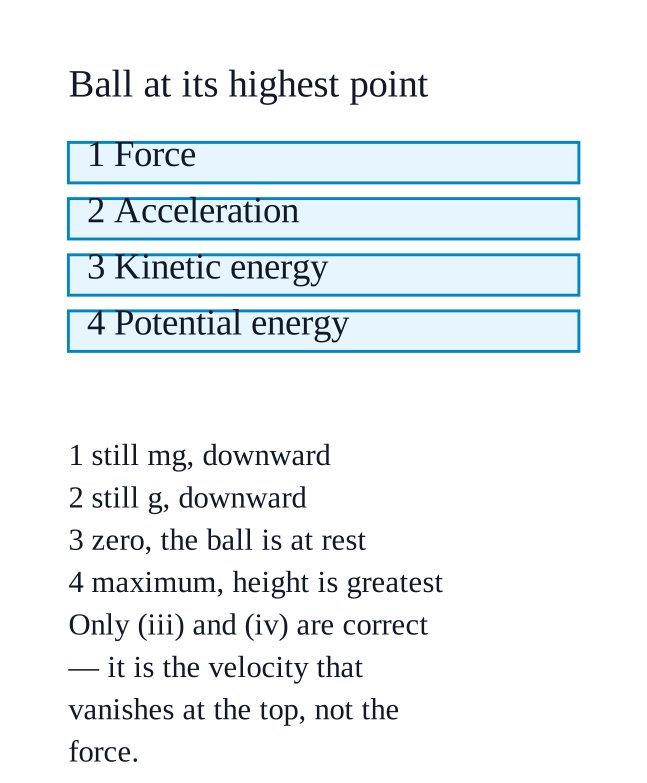
    When a ball thrown upwards reaches its highest point, tick which of the following statement(s) are correct? (i) The force acting on the ball is zero. (ii) The acceleration of the ball is zero. (iii) Its kinetic energy is zero. (iv) Its potential energy is maximum.

    Not cross-checked

    NCERT prints no numerical answer for this exercise, so this working has not been cross-checked against the book.

    NCERT’s answer
    (iii)
    ; (iv)
    Correct statements: (iii) and (iv).
    NCERT_Solution_Class9_Science_Ch7_RRR_Q7-3
    (i) Wrong — gravity still pulls on the ball at the top, with force \(\displaystyle mg \) downward. Nothing switches it off.
    (ii) Wrong — since the force \(\displaystyle mg \) still acts, the acceleration is still \(\displaystyle g \) downward (about \(\displaystyle 10\ \text{m s}^{-2} \)). It is the velocity, not the acceleration, that is zero.
    (iii) Correct — at the highest point the ball is momentarily at rest, \(\displaystyle v = 0 \), so \(\displaystyle K = \frac{1}{2}mv^{2} = 0 \).
    (iv) Correct — the height \(\displaystyle h \) is largest there, so \(\displaystyle U = mgh \) is maximum. All the kinetic energy the ball started with has been converted into potential energy.
  4. Exercise 7.4

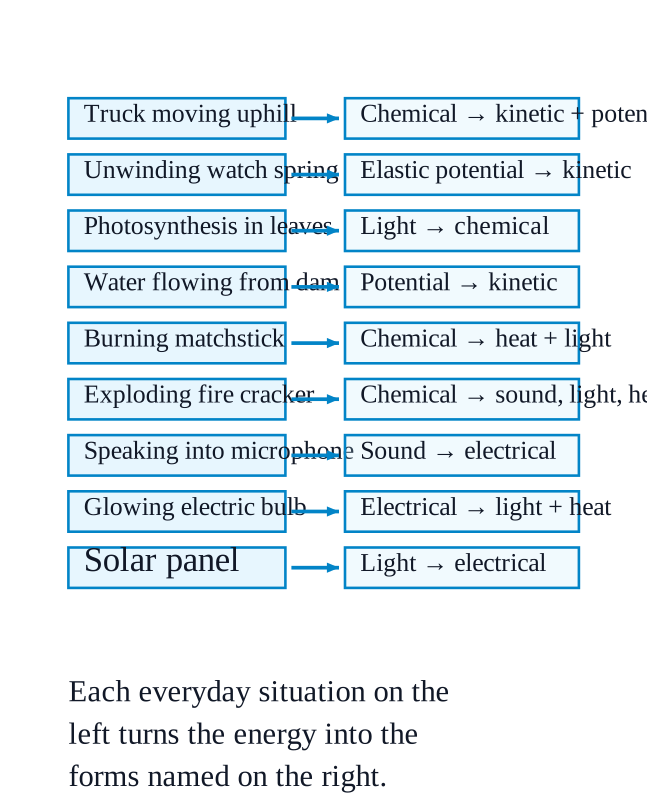
    For each of the following situations, identify the energy transformation that takes place: (i) a truck moving uphill, (ii) unwinding of a watch spring, (iii) photosynthesis in green leaves, (iv) water flowing from a dam, (v) burning of a matchstick, (vi) explosion of a fire cracker, (vii) speaking into a microphone, (viii) a glowing electric bulb, and (ix) a solar panel.

    Not cross-checked

    NCERT prints no numerical answer for this exercise, so this working has not been cross-checked against the book.

    (i) Truck moving uphill: chemical energy of the fuel → kinetic energy of the truck + gravitational potential energy as it gains height (with some thermal energy lost to friction).
    NCERT_Solution_Class9_Science_Ch7_RRR_Q7-4
    (ii) Unwinding of a watch spring: potential energy stored in the deformed spring → kinetic (mechanical) energy of the gears and hands.
    (iii) Photosynthesis in green leaves: light energy from the Sun → chemical energy stored in food.
    (iv) Water flowing from a dam: potential energy of the stored water → kinetic energy of the falling water (which is then used to generate electrical energy).
    (v) Burning of a matchstick: chemical energythermal energy + light energy.
    (vi) Explosion of a fire cracker: chemical energysound energy + light energy + thermal energy + kinetic energy of the flying pieces.
    (vii) Speaking into a microphone: sound energyelectrical energy.
    (viii) Glowing electric bulb: electrical energylight energy + thermal energy.
    (ix) Solar panel: light energy (solar) → electrical energy.
  5. Exercise 7.5

    A student is slowly lifted straight up in an elevator from the ground level to the top floor of a building. Later, the same student climbs the staircase, all the way to the top. Given that the height of the building is h = 72.5\displaystyle 72.5 m, acceleration due to gravity is g = 10\displaystyle 10 m s2\displaystyle s^{-2}, and student’s mass is m = 50\displaystyle 50 kg. (i) Find the gain in the potential energy if the student is lifted straight up to the top. (ii) Find the gain in the potential energy when the student climbs the stairs to the same top. (iii) What do you conclude about the dependence of the potential energy on the path taken?
    NCERT’s answer
    (i)
    $\displaystyle 36250$ J (ii) $\displaystyle 36250$ J (iii) does not depend upon the path
    (i) Gain in potential energy in the lift = $\displaystyle 36250$ J.
    NCERT_Solution_Class9_Science_Ch7_RRR_Q7-5
    \(\displaystyle U = mgh = 50\ \text{kg} \times 10\ \text{m s}^{-2} \times 72.5\ \text{m} = 36250\ \text{J} \)
    (ii) Gain in potential energy up the stairs = $\displaystyle 36250$ J — exactly the same.
    \(\displaystyle U = mgh = 50\ \text{kg} \times 10\ \text{m s}^{-2} \times 72.5\ \text{m} = 36250\ \text{J} \)
    The staircase is longer than the lift shaft, but the height gained is the same $\displaystyle 72.5$ m, and only the height enters \(\displaystyle mgh \).
    (iii) Gravitational potential energy does not depend on the path taken — only on the vertical height between the starting and finishing points.
  6. Exercise 7.6

    A crane lifts a mass m to the 10th floor of a building in a certain time. It then raises the same mass to the 20th floor of the same building in double the time. How much more energy and power are required? Assume that the height of all floors is equal.

    Not cross-checked

    NCERT prints no numerical answer for this exercise, so this working has not been cross-checked against the book.

    NCERT’s answer
    Energy twice of initial energy; power same as initial power
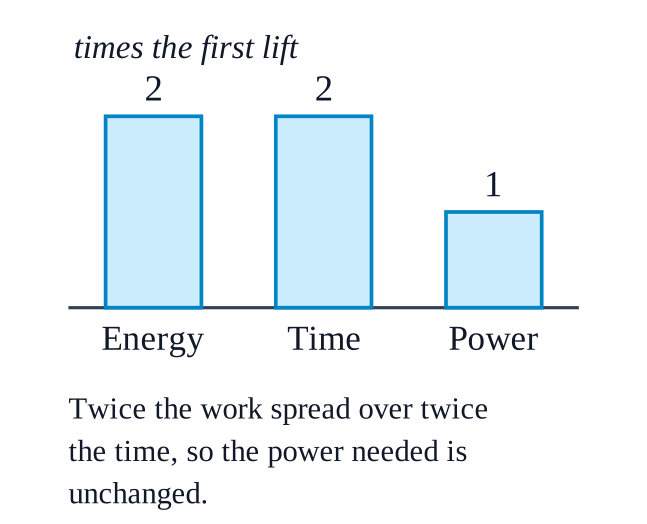
    Twice the energy is needed, but the same power — no extra power at all.
    NCERT_Solution_Class9_Science_Ch7_RRR_Q7-6
    Let the height of each floor be \(\displaystyle x \), so the 10th floor is at \(\displaystyle 10x \) and the 20th floor at \(\displaystyle 20x \).
    Energy for the first lift: \(\displaystyle E_{1} = mg \times 10x \)
    Energy for the second lift: \(\displaystyle E_{2} = mg \times 20x = 2 \times (mg \times 10x) = 2E_{1} \)
    So the crane needs an extra \(\displaystyle mg \times 10x \), i.e. the energy is doubled.
    Power for the first lift: \(\displaystyle P_{1} = \dfrac{E_{1}}{t} \)
    Power for the second lift: \(\displaystyle P_{2} = \dfrac{2E_{1}}{2t} = \dfrac{E_{1}}{t} = P_{1} \)
    Twice the work spread over twice the time gives the same rate of doing work, so the power required is unchanged.
  7. Exercise 7.7

    Which factors determine the energy required to raise a flag from the ground to the top of a tall flagpole using a pulley? Does raising the flag slowly or quickly change the amount of work done? If the speed at which the flag is raised is doubled, how does the power requirement change? Explain your answers.

    Not cross-checked

    NCERT prints no numerical answer for this exercise, so this working has not been cross-checked against the book.

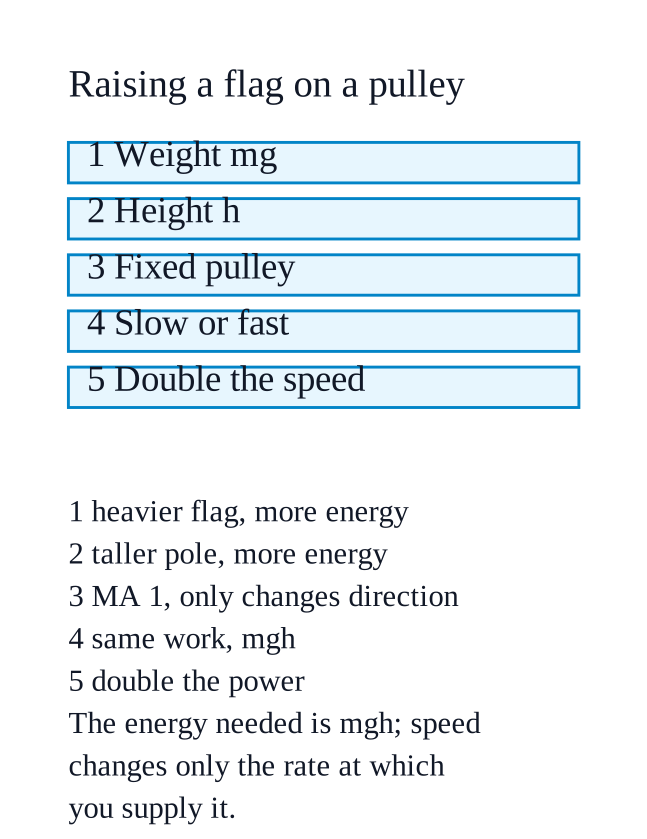
    The energy needed depends on just two things — the weight of the flag \(\displaystyle mg \) and the height of the flagpole \(\displaystyle h \): energy \(\displaystyle = mgh \).
    NCERT_Solution_Class9_Science_Ch7_RRR_Q7-7
    The pulley at the top is a fixed pulley, so its mechanical advantage is $\displaystyle 1$ — it only changes the direction of your effort so you can pull down instead of lifting up. Ignoring friction, it does not change the energy needed.
    Slowly or quickly makes no difference to the work done. \(\displaystyle W = mgh \) contains no time at all, so the same work is done either way.
    Doubling the speed doubles the power. The same work \(\displaystyle W \) is now done in half the time:
    \(\displaystyle P_{1} = \dfrac{W}{t} \) and \(\displaystyle P_{2} = \dfrac{W}{t/2} = \dfrac{2W}{t} = 2P_{1} \)
    So you must work at twice the rate, even though you do exactly the same amount of work.
  8. Exercise 7.8

    A man of mass 60\displaystyle 60 kg rides a scooter of mass 100\displaystyle 100 kg. He accelerates the scooter to a velocity v. The next day, his son with a mass of 40\displaystyle 40 kg joins him as a passenger. If the scooter reaches the same speed on both days in the same time interval, what is the ratio of the fuel of the tank used on the two days? Assume that the energy transfer to the scooter happens entirely due to fuel, and no other losses occur due to air resistance and friction.
    NCERT’s answer
    $\displaystyle 4$:$\displaystyle 5$
    Ratio of fuel used, day $\displaystyle 1$ : day $\displaystyle 2$ = $\displaystyle 4$ : $\displaystyle 5$.
    NCERT_Solution_Class9_Science_Ch7_RRR_Q7-8
    Day $\displaystyle 1$ — mass set in motion = scooter + man \(\displaystyle = 100\ \text{kg} + 60\ \text{kg} = 160\ \text{kg} \)
    Energy supplied \(\displaystyle E_{1} = \frac{1}{2}m_{1}v^{2} = \frac{1}{2} \times 160\ \text{kg} \times v^{2} = 80v^{2} \)
    Day $\displaystyle 2$ — mass set in motion \(\displaystyle = 100\ \text{kg} + 60\ \text{kg} + 40\ \text{kg} = 200\ \text{kg} \)
    Energy supplied \(\displaystyle E_{2} = \frac{1}{2} \times 200\ \text{kg} \times v^{2} = 100v^{2} \)
    All this energy comes from the fuel and nothing is lost to air resistance or friction, so the fuel used is in the same ratio as the energy:
    \(\displaystyle \dfrac{E_{1}}{E_{2}} = \dfrac{80v^{2}}{100v^{2}} = \dfrac{4}{5} \)
    The final speed is the same on both days, so the extra fuel is needed only because of the extra $\displaystyle 40$ kg that must be given kinetic energy.
  9. Exercise 7.9

    On a seesaw with sliding seats, a child is sitting on one side and an adult on the other side. The adult weighs twice that of the child. The seesaw however is balanced. Draw a figure which depicts this situation showing the distances from the fulcrum where the child and the adult are seated.

    Not cross-checked

    NCERT prints no numerical answer for this exercise, so this working has not been cross-checked against the book.

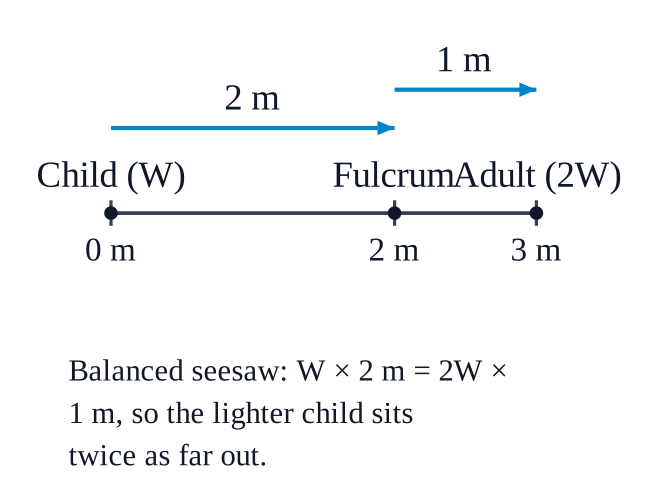
    The child sits twice as far from the fulcrum as the adult — for example, child at $\displaystyle 2$ m and adult at $\displaystyle 1$ m.
    NCERT_Solution_Class9_Science_Ch7_RRR_Q7-9
    A balanced seesaw is a lever obeying \(\displaystyle \text{effort} \times \text{effort arm} = \text{load} \times \text{load arm} \) (Eq. $\displaystyle 7.15$).
    Let the child's weight be \(\displaystyle W \) at distance \(\displaystyle d_{c} \), and the adult's weight \(\displaystyle 2W \) at distance \(\displaystyle d_{a} \):
    \(\displaystyle W \times d_{c} = 2W \times d_{a} \)
    \(\displaystyle d_{c} = 2 d_{a} \)
    What your figure must show:
    A horizontal plank resting on a triangular fulcrum at its middle, drawn level to show it is balanced.
    The adult seated on the right, with the distance from the fulcrum marked \(\displaystyle d = 1\ \text{m} \), and a downward arrow labelled \(\displaystyle 2W \).
    The child seated on the left, with the distance marked \(\displaystyle 2d = 2\ \text{m} \), and a downward arrow labelled \(\displaystyle W \).
    Label the three parts — fulcrum, load arm and effort arm — and write \(\displaystyle W \times 2\ \text{m} = 2W \times 1\ \text{m} \) beneath the drawing.
    Any pair of distances in the ratio $\displaystyle 2$ : $\displaystyle 1$ (child : adult) is correct; the sliding seats are what let them find it.
  10. Exercise 7.10

    A ball of mass 2\displaystyle 2 kg is thrown up with a velocity of 20\displaystyle 20 m s1\displaystyle s^{-1}. (i) Identify the sign of the work done by gravity on the ball during its upward motion and its downward motion. (ii) If the ball reaches a height of 19.4\displaystyle 19.4 m, how much work was done by air resistance (assume g = 10\displaystyle 10 m s2\displaystyle s^{-2}).

    Disagrees with the book

    This working does not reach the answer printed in NCERT. One of the two is wrong and it has not yet been settled which — check it before you rely on it.

    NCERT’s answer
    (i)
    Negative and positive (ii) - $\displaystyle 12$ J
    (i) Upward motion: work done by gravity is negative. Downward motion: it is positive.
    NCERT_Solution_Class9_Science_Ch7_RRR_Q7-10
    Going up, gravity acts downward while the displacement is upward — opposite directions, so negative work.
    Coming down, gravity and the displacement are both downward — same direction, so positive work.
    (ii) Work done by air resistance = \(\displaystyle -12\ \text{J} \).
    Initial kinetic energy: \(\displaystyle K_{i} = \frac{1}{2}mv^{2} = \frac{1}{2} \times 2\ \text{kg} \times (20\ \text{m s}^{-1})^{2} = 400\ \text{J} \)
    At the top the ball is momentarily at rest, so \(\displaystyle K_{f} = 0\ \text{J} \).
    Total work done on the ball \(\displaystyle = K_{f} - K_{i} = 0 - 400 = -400\ \text{J} \)
    Work done by gravity over the $\displaystyle 19.4$ m rise \(\displaystyle = -mgh = -(2\ \text{kg} \times 10\ \text{m s}^{-2} \times 19.4\ \text{m}) = -388\ \text{J} \)
    The only other force is air resistance, so \(\displaystyle W_{\text{air}} = -400\ \text{J} - (-388\ \text{J}) = -12\ \text{J} \)
    It is negative because air resistance always opposes the motion. Without it the ball would have risen to $\displaystyle 20$ m.