Exercise 3.5
Which type of joint is involved when you bend your knees and ankles? (i) Ball and socket (ii) Hinge (iii) Pivot
Check this one against your book
NCERT’s printed answer for this exercise does not match its own question. This working follows the question as printed.
Hinge joint — option (ii).
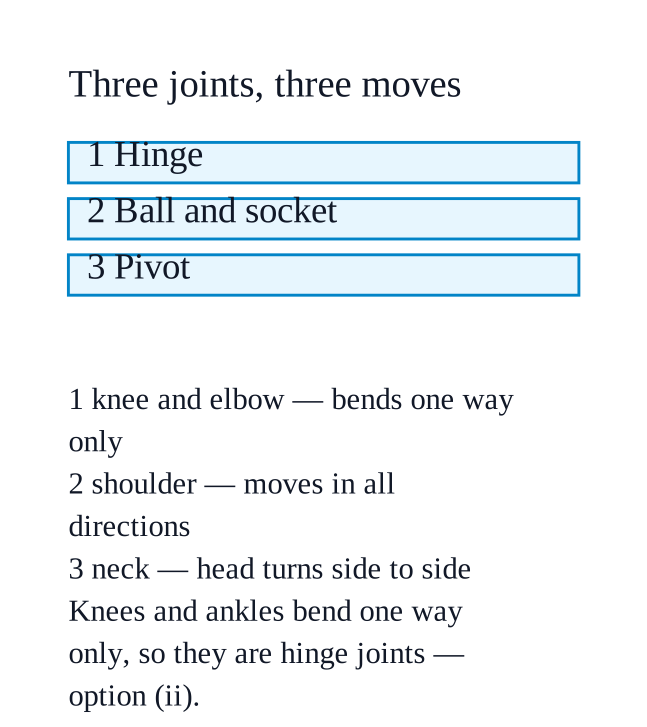
Section $\displaystyle 3.5.2$ names the knee outright: "the elbow bends and straightens in one direction only like a door hinge… This type of joint is called a hinge joint. A similar hinge joint is present in the knee, where a small bone called the kneecap protects the joint." Bending your knee is precisely the movement that section is describing.
Why not (iii) Pivot: Section $\displaystyle 3.5.3$ gives the pivot joint a different action in a different place — the skull is "connected to the backbone through a pivot joint, which allows the head to move side to side like a doorknob turning in its socket." That is a turn about an axis, not a bend, and it sits at the neck.
Why not (i) Ball and socket: Section $\displaystyle 3.5.1$ places it at the shoulder, where "the rounded top of the upper arm bone fits into a shallow hollow of the shoulder bone", and the joint "allows forward, backwards, sideways and circular movements." The knee has no such freedom — recording that contrast is the point of Table $\displaystyle 3.5$, whose worked Elbow row reads Complete rotation: No, Partial rotation: No, Bending: Yes.
On the ankle — this is reasoning, not chapter content. The chapter never classifies the ankle: it is not one of the body parts listed in Table $\displaystyle 3.5$ (Elbow, Shoulder, Knee, Neck, Fingers, Toes, Wrist), and none of Sections $\displaystyle 3.5.1$–$\displaystyle 3.5.4$ mentions it. Applying the chapter's own definition, pointing the toes down and up is bending in one direction only rather than rotating, which fits the hinge description and not the pivot's side-to-side turn. Treat that as an inference from the chapter's criteria, not as a statement the book makes.
The book's printed Answer Key gives (iii) Pivot, which does not agree with Sections $\displaystyle 3.5.2$ and 3.5.3. Section $\displaystyle 3.5.2$ says in so many words that a hinge joint "is present in the knee", and Section $\displaystyle 3.5.3$ assigns the pivot joint to the skull-and-backbone connection at the neck, so the chapter's own text settles it the other way: the answer is (ii) Hinge, and the key entry should be treated as an error.