Exercise 3.3
Vascular tissue system: This consists of conducting tissues — xylem and phloem.
Not cross-checked
NCERT prints no numerical answer for this exercise, so this working has not been cross-checked against the book.
Water rises because the dead cells of the xylem form open, unblocked pipes while the living cells of the leaf pull the water up by transpiration — the plant does not push water from below, it is sucked up from the top.
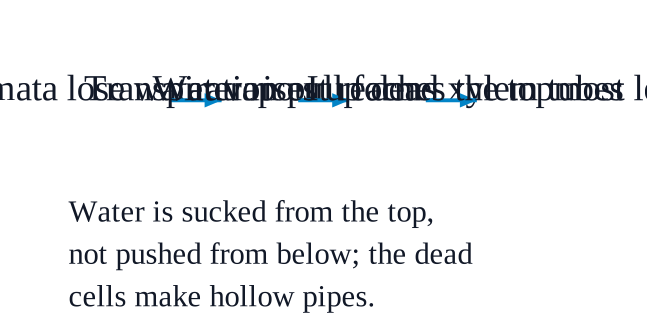
Tracheids and vessels are tubular and thick-walled and lose their living contents. Joined end to end, they make a continuous hollow tube running from root to leaf with no cytoplasm or nucleus in the way — being dead is exactly what makes them good pipes.
Their thick, lignified walls stop the tube from collapsing while the water inside it is under tension, and the chapter notes that xylem also gives strength to the plant.
At the top, the living epidermal cells of the leaf carry pores called stomata, through which water escapes as vapour. This evaporation is transpiration.
The chapter states the link directly: transpiration helps in water transportation by creating a transpiration pull in the xylem.
Every water molecule that leaves at the leaf drags the column behind it, so the loss of water at the top is what lifts fresh water at the bottom, against gravity, without any pump.
At the other end, living root hairs — projections of the root epidermal cells — increase the surface area for absorbing water and minerals and keep the column supplied.
So it is a partnership: dead cells supply the plumbing, living cells supply the force.