SolveItClass 9 · NCERT

NCERT Solutions · Class 9 Science Sound Waves: Characteristics and Applications

28 questions · 16 still being checked

Revise, Reflect, Refine 10.11–10.15 (part 3 of 3)

  1. Exercise 10.11

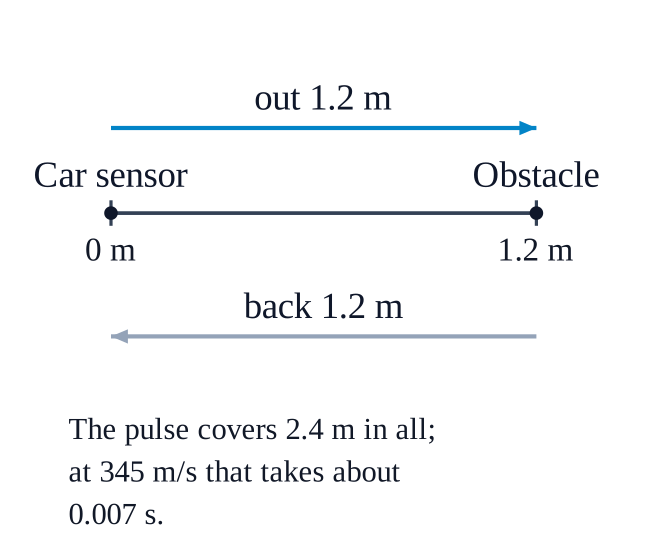
    A vehicle is fitted with an ultrasonic distance sensor as part of parking assistance system which provides echolocation, while the driver is reversing the vehicle. It emits ultrasonic wave (about 40\displaystyle 40 kHz) which is reflected by the obstacle. When the warning beep starts sounding at a distance of 1.2\displaystyle 1.2 m from the obstacle, how much time is taken by ultrasonic wave to travel to the obstacle and come back? Assume the speed of ultrasonic wave in air to be 345\displaystyle 345 m s1\displaystyle s^{-1}.
    NCERT’s answer
    0.$\displaystyle 007$ s
    About \(\displaystyle 0.007\ \text{s} \).
    NCERT_Solution_Class9_Science_Ch10_RRR_Q10-11
    The pulse goes to the obstacle and comes back, so the path length is \(\displaystyle 2 \times 1.2\ \text{m} = 2.4\ \text{m} \).
    \(\displaystyle t = \dfrac{\text{distance}}{\text{speed}} = \dfrac{2.4\ \text{m}}{345\ \text{m s}^{-1}} = 0.00696\ \text{s} \approx 0.007\ \text{s} \).
    The $\displaystyle 40$ kHz is not needed for the time — it only tells you the wave is ultrasonic (above $\displaystyle 20$ kHz), so the driver never hears the pulse itself, only the warning beep the system produces.
  2. Exercise 10.12

    The speed of sound in air is about 331\displaystyle 331 m s1\displaystyle s^{-1} at 0\displaystyle 0 ºC and nearly 344\displaystyle 344 m s1\displaystyle s^{-1} at 22\displaystyle 22 ºC. Roughly how much extra time will the sound of thunder take to travel a distance of 1720\displaystyle 1720 m, if the air temperature changes from 22\displaystyle 22 ºC to 0\displaystyle 0 ºC? Assume that all other conditions remain unchanged.

    Check this one against your book

    NCERT’s printed answer for this exercise does not match its own question. This working follows the question as printed.

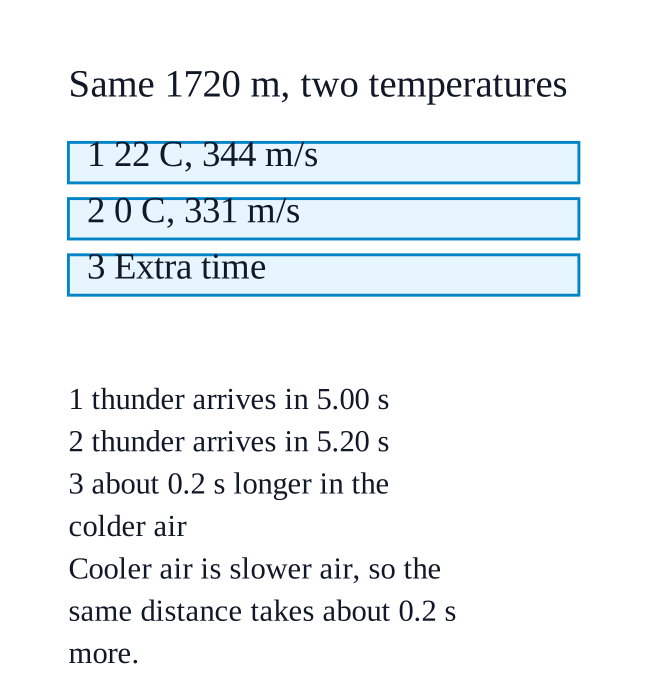
    The sound of the thunder takes about \(\displaystyle 0.2\ \text{s}\) extra to cover the same \(\displaystyle 1720\ \text{m}\) once the air cools from \(\displaystyle 22\ ^\circ\text{C}\) to \(\displaystyle 0\ ^\circ\text{C}\).
    NCERT_Solution_Class9_Science_Ch10_RRR_Q10-12
    Section $\displaystyle 10.6.3$ gives the tool: speed \(\displaystyle =\) distance \(\displaystyle \div\) time, used in Example $\displaystyle 10.3$ as distance \(\displaystyle = v \times t\); rearranged, time \(\displaystyle = \dfrac{\text{distance}}{\text{speed}}\).
    At \(\displaystyle 22\ ^\circ\text{C}\) the speed is \(\displaystyle 344\ \text{m s}^{-1}\) (Section $\displaystyle 10.6.3$, repeated in the question), so \(\displaystyle t_{22} = \dfrac{1720\ \text{m}}{344\ \text{m s}^{-1}} = 5.00\ \text{s} \).
    At \(\displaystyle 0\ ^\circ\text{C}\) the speed is \(\displaystyle 331\ \text{m s}^{-1}\), so \(\displaystyle t_{0} = \dfrac{1720\ \text{m}}{331\ \text{m s}^{-1}} = 5.196\ \text{s} \approx 5.2\ \text{s} \).
    The extra time is the difference: \(\displaystyle \Delta t = t_{0} - t_{22} = 5.196\ \text{s} - 5.00\ \text{s} = 0.196\ \text{s} \approx 0.2\ \text{s} \).
    Direction check against the chapter: Section $\displaystyle 10.6.3$ states that as the temperature is increased the speed of sound increases, so cooling the air lowers the speed, and a slower wave needs longer for the same distance. The difference therefore has to come out positive and small compared with the \(\displaystyle 5\ \text{s}\) journey itself \(\displaystyle -\) which \(\displaystyle 0.196\ \text{s}\) is.
    The book's printed Answer Key gives $\displaystyle 331$ s, which does not agree with Section $\displaystyle 10.6.3$ (nor with the question's own stem): \(\displaystyle 331\) there is the speed of sound in dry air at \(\displaystyle 0\ ^\circ\text{C}\), in \(\displaystyle \text{m s}^{-1}\), not a time. The key entry appears to have copied that speed and re-labelled it as seconds.
    Reasoning beyond the chapter, to show the printed figure cannot be rescued by any reading of the question: the entire trip at \(\displaystyle 0\ ^\circ\text{C}\) lasts only \(\displaystyle 5.2\ \text{s}\), so no delay inside this problem can be \(\displaystyle 331\ \text{s}\); and \(\displaystyle 331\ \text{s}\) of travel at roughly \(\displaystyle 340\ \text{m s}^{-1}\) would be \(\displaystyle 331\ \text{s} \times 340\ \text{m s}^{-1} = 112540\ \text{m} \approx 113\ \text{km} \), not the \(\displaystyle 1720\ \text{m}\) the question sets. The chapter's own two speeds settle it the other way, at \(\displaystyle 0.196\ \text{s} \approx 0.2\ \text{s}\).
  3. Exercise 10.13

    The variation of density of medium for a sound wave propagating with a speed of 340\displaystyle 340 m s1\displaystyle s^{-1} is shown in Fig. 10.32. Calculate the wavelength and frequency of the sound wave.NCERT_Question_Class9_Science_Ch10_RRR_Q10-13
    NCERT’s answer
    0.$\displaystyle 04$ m; $\displaystyle 8500$ Hz
    Wavelength \(\displaystyle \lambda = 0.04\ \text{m} \) ($\displaystyle 4$ cm) and frequency \(\displaystyle \nu = 8500\ \text{Hz} \).
    The $\displaystyle 8$ cm marked in Fig. $\displaystyle 10.32$ spans two complete cycles — two compressions and two rarefactions — so one wavelength is \(\displaystyle \lambda = \dfrac{8\ \text{cm}}{2} = 4\ \text{cm} = 0.04\ \text{m} \).
    From \(\displaystyle v = \nu \times \lambda \), \(\displaystyle \nu = \dfrac{v}{\lambda} = \dfrac{340\ \text{m s}^{-1}}{0.04\ \text{m}} = 8500\ \text{Hz} \).
    \(\displaystyle 8500\ \text{Hz} \) lies inside the audible range of $\displaystyle 20$ Hz to $\displaystyle 20$ kHz, so this sound can be heard.
  4. Exercise 10.14

    The graphical representation of two sound waves A and B propagating at the same speed of 345\displaystyle 345 m s1\displaystyle s^{-1} is shown in Fig. 10.33. What is the wavelength of each of them? Also, calculate their frequencies. DensityNCERT_Question_Class9_Science_Ch10_RRR_Q10-14
    NCERT’s answer
    0.$\displaystyle 025$ m, $\displaystyle 0.05$ m; $\displaystyle 13800$ Hz, $\displaystyle 6900$ Hz
    Wave A: \(\displaystyle \lambda_A = 0.025\ \text{m} \), \(\displaystyle \nu_A = 13800\ \text{Hz} \). Wave B: \(\displaystyle \lambda_B = 0.05\ \text{m} \), \(\displaystyle \nu_B = 6900\ \text{Hz} \).
    Read each wavelength crest-to-consecutive-crest off the shared distance axis of Fig. $\displaystyle 10.33$: A repeats every \(\displaystyle 2.5\ \text{cm} = 0.025\ \text{m} \), B every \(\displaystyle 5.0\ \text{cm} = 0.05\ \text{m} \).
    \(\displaystyle \nu_A = \dfrac{v}{\lambda_A} = \dfrac{345\ \text{m s}^{-1}}{0.025\ \text{m}} = 13800\ \text{Hz} \).
    \(\displaystyle \nu_B = \dfrac{v}{\lambda_B} = \dfrac{345\ \text{m s}^{-1}}{0.05\ \text{m}} = 6900\ \text{Hz} \).
    B's wavelength is exactly twice A's, so its frequency is exactly half — the two share one speed, as \(\displaystyle v = \nu \lambda \) requires.
  5. Exercise 10.15

    Two identical sound sources are placed at A and B — one in air and one submerged in water (Fig. 10.34\displaystyle 10.34). Both produce sounds at the same time, which travel horizontally to the vertical side of the cliff and come back. If the time taken by the sound to return to A is 4.5\displaystyle 4.5 times than that of B, what is the ratio between the speeds of sound in air and water?NCERT_Question_Class9_Science_Ch10_RRR_Q10-15
    NCERT’s answer
    $\displaystyle 2$:$\displaystyle 9$
    \(\displaystyle v_{\text{air}} : v_{\text{water}} = 2 : 9 \).
    Both sources sit the same horizontal distance \(\displaystyle d \) from the cliff face, and each sound travels there and back, covering \(\displaystyle 2d \).
    Times to return: \(\displaystyle t_A = \dfrac{2d}{v_{\text{air}}} \) and \(\displaystyle t_B = \dfrac{2d}{v_{\text{water}}} \).
    Given \(\displaystyle t_A = 4.5\, t_B \): \(\displaystyle \dfrac{2d}{v_{\text{air}}} = 4.5 \times \dfrac{2d}{v_{\text{water}}} \), and \(\displaystyle 2d \) cancels from both sides.
    \(\displaystyle \dfrac{1}{v_{\text{air}}} = \dfrac{4.5}{v_{\text{water}}} \Rightarrow \dfrac{v_{\text{air}}}{v_{\text{water}}} = \dfrac{1}{4.5} = \dfrac{2}{9} \).
    So sound is $\displaystyle 4.5$ times faster in water than in air — matching the chapter's statement that sound travels about $\displaystyle 4$–$\displaystyle 5$ times faster in water.