SolveItClass 9 · NCERT

NCERT Solutions · Class 9 Science Sound Waves: Characteristics and Applications

28 questions · 16 still being checked

Revise, Reflect, Refine 10.1–10.10 (part 2 of 3)

  1. Exercise 10.1

    Which observation best supports the idea that sound is a mechanical wave? (i) Sound shows reflection (ii) Sound needs a medium to propagate (iii) Sound has frequency (iv) Sound carries energy

    Not cross-checked

    NCERT prints no numerical answer for this exercise, so this working has not been cross-checked against the book.

    NCERT’s answer
    (ii)
    (ii) Sound needs a medium to propagate.
    A mechanical wave is defined as one that requires a material medium, so this observation alone identifies sound as mechanical.
    The bell jar experiment supplies the evidence: the sound fades as air is pumped out and is almost gone at near vacuum, though the bell is still seen ringing.
    (i), (iii) and (iv) are all true of sound, but light also reflects, has a frequency and carries energy — and light crosses vacuum, so none of them can prove a wave is mechanical.
  2. Exercise 10.2

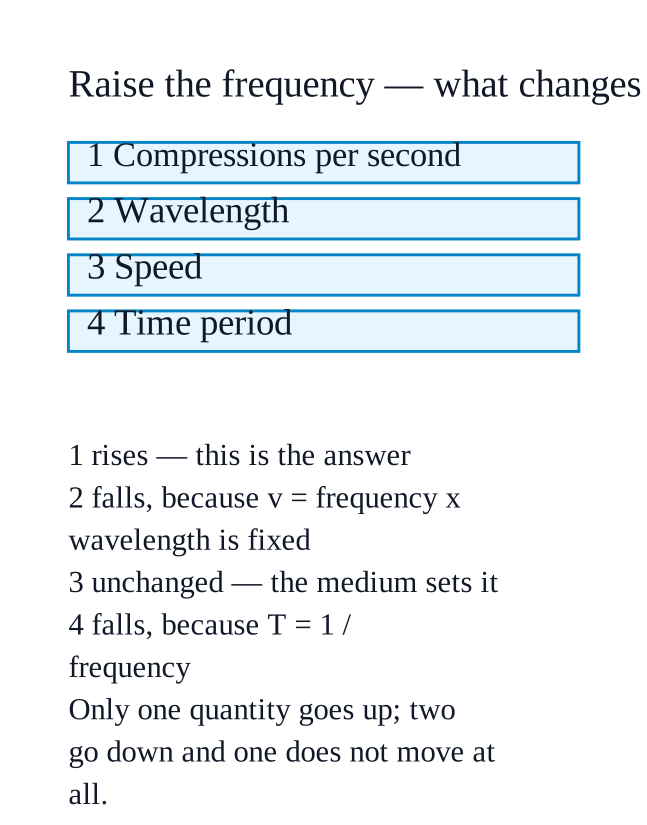
    For a sound wave propagating in a medium, increasing its frequency will increase its (i) wavelength (ii) speed (iii) number of compressions per second (iv) time period

    Not cross-checked

    NCERT prints no numerical answer for this exercise, so this working has not been cross-checked against the book.

    NCERT’s answer
    (iii)
    (iii) number of compressions per second.
    NCERT_Solution_Class9_Science_Ch10_RRR_Q10-2
    Frequency is the number of density oscillations passing a point each second, so raising it means more compressions arrive every second.
    (ii) is wrong: in a given medium the speed depends on the medium (and its temperature and humidity), not on the source or its frequency.
    (i) is wrong: since \(\displaystyle v = \nu \times \lambda \) stays fixed, a larger \(\displaystyle \nu \) forces a smaller \(\displaystyle \lambda \).
    (iv) is wrong: \(\displaystyle T = \dfrac{1}{\nu} \), so a higher frequency gives a shorter time period.
  3. Exercise 10.3

    If 20\displaystyle 20 compressions pass a point in 4\displaystyle 4 seconds, the frequency is (i) 80\displaystyle 80 Hz (ii) 5\displaystyle 5 Hz (iii) 10\displaystyle 10 Hz (iv) 0.2\displaystyle 0.2 Hz
    NCERT’s answer
    $\displaystyle 5$ Hz
    (ii) $\displaystyle 5$ Hz.
    Each compression passing the point counts as one complete density oscillation there.
    \(\displaystyle \nu = \dfrac{\text{number of oscillations}}{\text{time taken}} = \dfrac{20}{4\ \text{s}} = 5\ \text{Hz} \).
    $\displaystyle 5$ Hz is below $\displaystyle 20$ Hz, so this would in fact be an infrasonic wave — inaudible to humans.
  4. Exercise 10.4

    In a room, the reflected sound reaches the ear 0.05\displaystyle 0.05 s after its production. Will it produce an echo or reverberation? Justify your answer.

    Not cross-checked

    NCERT prints no numerical answer for this exercise, so this working has not been cross-checked against the book.

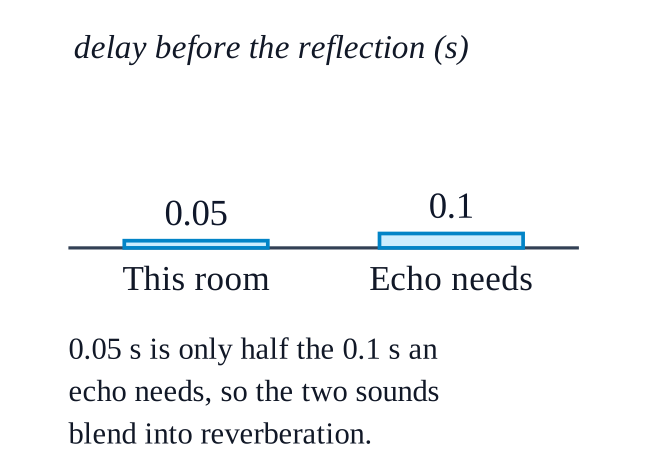
    Reverberation, not an echo.
    NCERT_Solution_Class9_Science_Ch10_RRR_Q10-4
    An echo is heard as a separate sound only if the reflection arrives at least \(\displaystyle 0.1\ \text{s} \) after the original.
    Here the gap is \(\displaystyle 0.05\ \text{s} \), and \(\displaystyle 0.05\ \text{s} < 0.1\ \text{s} \), so the brain cannot separate the two — no echo is heard.
    Instead the quick multiple reflections from the walls blend with the original and make the sound persist after the source has stopped, which is reverberation.
    This is why small rooms never echo: their walls are too close, and the reflections come back too soon.
  5. Exercise 10.5

    Graphs representing two sound waves are given in Fig. 10.30. If the scales on the X and Y axes of the two graphs are the same, which of the two sound waves has (i) greater wavelength, and (ii) smaller amplitude? DensityNCERT_Question_Class9_Science_Ch10_RRR_Q10-5

    Not cross-checked

    NCERT prints no numerical answer for this exercise, so this working has not been cross-checked against the book.

    NCERT’s answer
    (a)
    (ii) (a)
    (i) Wave (a) has the greater wavelength. (ii) Wave (a) has the smaller amplitude.
    Both graphs plot density against distance on the same scales, so they can be compared square for square.
    Wavelength is the distance between two consecutive crests: the crests in (a) are farther apart along the distance axis than those in (b), so \(\displaystyle \lambda_a > \lambda_b \).
    Amplitude is the maximum change in density, i.e. the height of a crest above the average-density line: the curve in (a) rises less above that dashed line than the curve in (b), so (a) has the smaller amplitude.
    So (a) is the long, gentle wave — lower frequency and less energy — and (b) is the short, tall one that carries more energy and sounds louder.
  6. Exercise 10.6

    The sound waves emitted by three sources A, B and C are represented in Fig. 10.31. If the frequency of A is maximum and C is minimum, identify the corresponding curves, and mark A, B and C on them.NCERT_Question_Class9_Science_Ch10_RRR_Q10-6

    Not cross-checked

    NCERT prints no numerical answer for this exercise, so this working has not been cross-checked against the book.

    NCERT’s answer
    A - Green curve; B - Red curve; C - Blue curve
    A is the green curve, B is the red curve and C is the blue curve.
    All three waves travel in the same medium, so they share one speed \(\displaystyle v \), and \(\displaystyle v = \nu \times \lambda \) gives \(\displaystyle \lambda = \dfrac{v}{\nu} \) — the highest frequency must have the shortest wavelength.
    A has the maximum frequency, so mark A on the curve whose crests are packed closest together — the green one.
    C has the minimum frequency, so mark C on the curve with the widest crest-to-crest spacing — the blue one.
    B is left with the in-between spacing, the red curve, giving \(\displaystyle \lambda_A < \lambda_B < \lambda_C \) while \(\displaystyle \nu_A > \nu_B > \nu_C \).
    Write the letters A, B and C directly on their three curves in Fig. 10.31.
  7. Exercise 10.7

    Draw a graph to represent a sound wave for which the density amplitude is 3\displaystyle 3 units and wavelength is 4\displaystyle 4 cm.

    Not cross-checked

    NCERT prints no numerical answer for this exercise, so this working has not been cross-checked against the book.

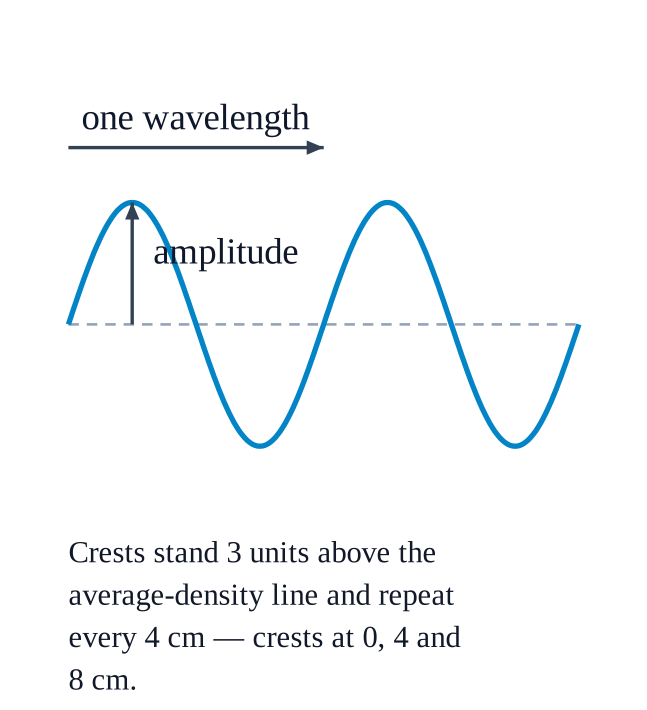
    Draw a density-versus-distance graph whose crests stand $\displaystyle 3$ units above the average-density line and which repeats every \(\displaystyle 4\ \text{cm} \). It must contain:
    NCERT_Solution_Class9_Science_Ch10_RRR_Q10-7
    An x-axis labelled "Distance (cm)", marked \(\displaystyle 0, 1, 2, 3, 4, 5, \ldots \) up to at least $\displaystyle 8$ cm.
    A y-axis labelled "Density (units)", marked from \(\displaystyle -3 \) to \(\displaystyle +3 \) about the average value.
    A horizontal dashed line right across the graph for the average density — the level the curve oscillates about.
    A smooth wave whose crests sit exactly $\displaystyle 3$ units above the dashed line and whose troughs dip $\displaystyle 3$ units below it; that $\displaystyle 3$ units is the density amplitude.
    A crest-to-crest spacing of \(\displaystyle \lambda = 4\ \text{cm} \): put crests at \(\displaystyle 0,\ 4\ \text{and}\ 8\ \text{cm} \), troughs midway between them at \(\displaystyle 2\ \text{and}\ 6\ \text{cm} \), and the curve crossing the dashed line at \(\displaystyle 1,\ 3,\ 5\ \text{and}\ 7\ \text{cm} \).
    C marked under each crest and R under each trough, with a double-headed arrow between two consecutive crests labelled \(\displaystyle \lambda = 4\ \text{cm} \).
    At least two full cycles, so that the repetition is visible.
  8. Exercise 10.8

    In a movie, while showing the explosion of a spacecraft in space, a flash of light is shown along with sound at the same time. What are the errors in this depiction?

    Not cross-checked

    NCERT prints no numerical answer for this exercise, so this working has not been cross-checked against the book.

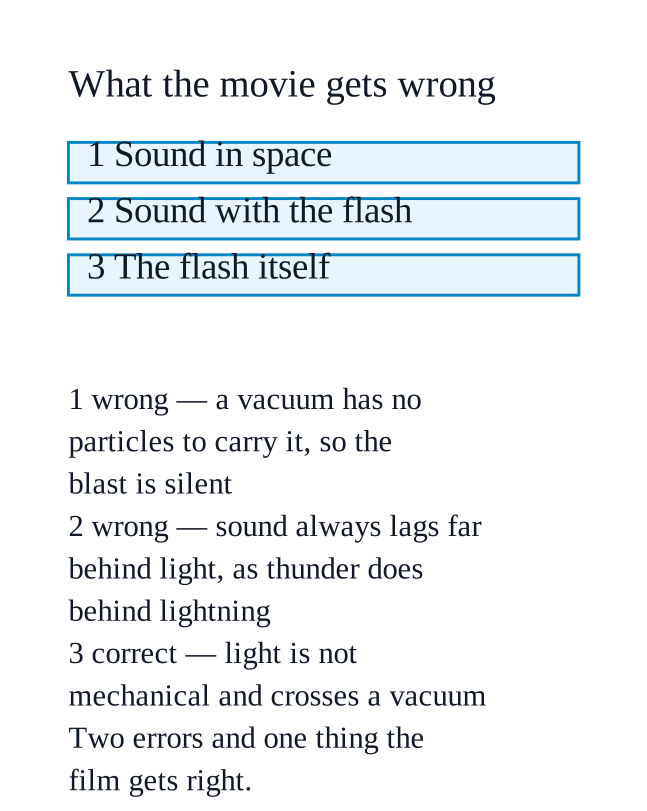
    Two errors: there should be no sound at all, and even where sound is possible it could never arrive together with the flash.
    NCERT_Solution_Class9_Science_Ch10_RRR_Q10-8
    Error $\displaystyle 1$ — sound in space. Space is a near vacuum, and sound is a mechanical wave that needs a material medium to carry its compressions and rarefactions. With no particles, the explosion would be completely silent to a distant observer.
    This is the same reason astronauts on a spacewalk cannot hear each other speak or hear metal clanking, and must use radio devices in their spacesuits.
    Error $\displaystyle 2$ — the timing. Light travels at about \(\displaystyle 300000\ \text{km s}^{-1} \) while sound in air manages only about \(\displaystyle 340\ \text{m s}^{-1} \), so sound always lags far behind the flash — as thunder does behind lightning. Showing them at the same instant is wrong even on Earth.
    The flash itself is correct: light is not a mechanical wave and travels through vacuum, which is how starlight reaches us.
  9. Exercise 10.9

    A source produces a sound wave of wavelength 3.44\displaystyle 3.44 m. If the wave travels with a speed of 344\displaystyle 344 m s1\displaystyle s^{-1} find its time period.
    NCERT’s answer
    0.$\displaystyle 01$ s
    Time period \(\displaystyle T = 0.01\ \text{s} \).
    NCERT_Solution_Class9_Science_Ch10_RRR_Q10-9
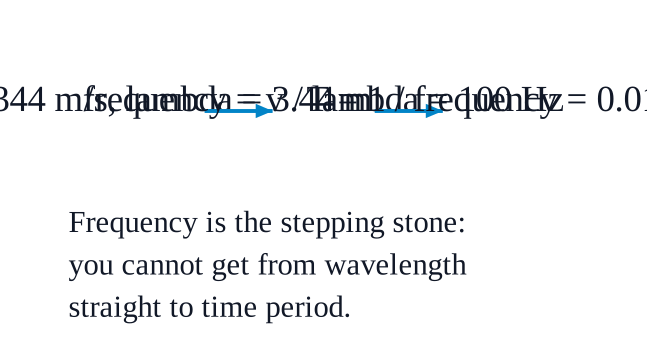
    From \(\displaystyle v = \nu \times \lambda \), the frequency is \(\displaystyle \nu = \dfrac{v}{\lambda} = \dfrac{344\ \text{m s}^{-1}}{3.44\ \text{m}} = 100\ \text{Hz} \).
    From \(\displaystyle \nu = \dfrac{1}{T} \), the time period is \(\displaystyle T = \dfrac{1}{\nu} = \dfrac{1}{100\ \text{Hz}} = 0.01\ \text{s} \).
  10. Exercise 10.10

    A ship searching for a sunken ship sent a sonar signal and detected an echo after 5\displaystyle 5 s. If ultrasonic wave travels at 1525\displaystyle 1525 m s1\displaystyle s^{-1} in seawater, approximately how far down in the ocean is the wreckage of the sunken ship located?

    Disagrees with the book

    This working does not reach the answer printed in NCERT. One of the two is wrong and it has not yet been settled which — check it before you rely on it.

    NCERT’s answer
    $\displaystyle 3812.5$ m $\displaystyle 65$
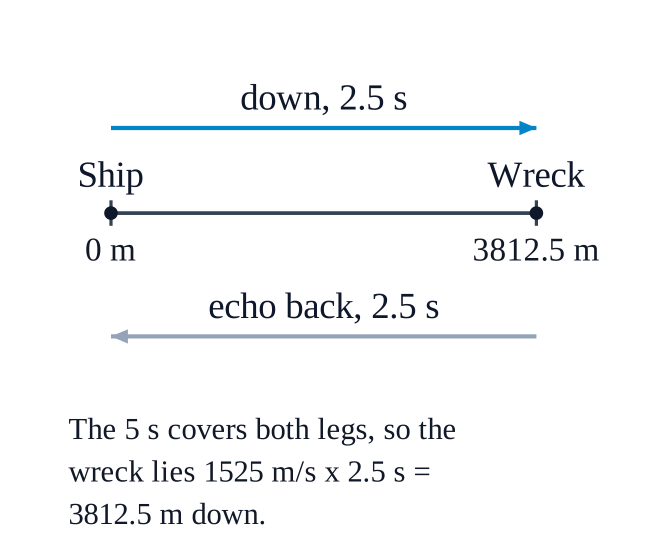
    The wreck lies about $\displaystyle 3812.5$ m down.
    NCERT_Solution_Class9_Science_Ch10_RRR_Q10-10
    The $\displaystyle 5$ s is the round trip, so the signal takes \(\displaystyle \dfrac{5\ \text{s}}{2} = 2.5\ \text{s} \) to reach the wreck.
    \(\displaystyle \text{depth} = v \times t = 1525\ \text{m s}^{-1} \times 2.5\ \text{s} = 3812.5\ \text{m} \).
    In one step: \(\displaystyle d = \dfrac{v t}{2} = \dfrac{1525\ \text{m s}^{-1} \times 5\ \text{s}}{2} = 3812.5\ \text{m} \).