Exercise 10.7
Conduct Activity once again with a thick rubber band and then with a thin rubber band. Does the thin rubber band vibrate faster than the thick rubber band? If yes, how do the frequency and time period of the sound produced by the thin rubber band differ from that of the thick rubber band?
Not cross-checked
NCERT prints no numerical answer for this exercise, so this working has not been cross-checked against the book.
Yes — the thin rubber band vibrates faster than the thick one.
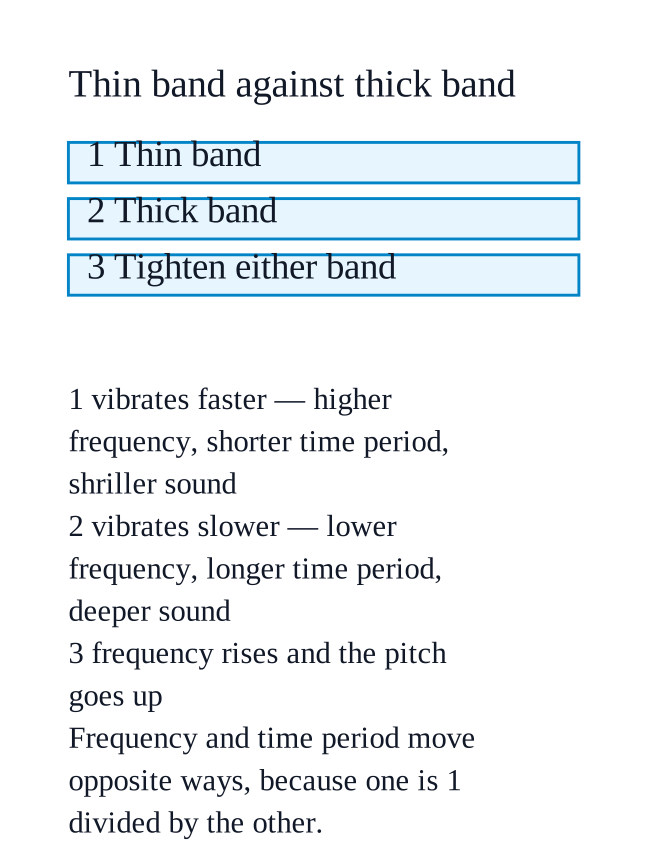
Faster vibration means more density oscillations reach your ear each second, so the thin band gives the higher frequency and the shriller, higher-pitched sound.
Its time period is shorter, because frequency and time period are inversely related: \(\displaystyle \nu = \dfrac{1}{T} \), so a larger \(\displaystyle \nu \) forces a smaller \(\displaystyle T \).
The thick band is the opposite — lower frequency, longer time period, deeper sound.
The chapter gives the same rule in the human voice: during adolescence boys' vocal cords lengthen and thicken, vibrate less frequently, and the voice 'deepens'.
Tightening either band also raises its frequency, which is the change you hear in step $\displaystyle 6$ of Activity 10.1.