Exercise 10.8
In a movie, while showing the explosion of a spacecraft in space, a flash of light is shown along with sound at the same time. What are the errors in this depiction?
Not cross-checked
NCERT prints no numerical answer for this exercise, so this working has not been cross-checked against the book.
Two errors: there should be no sound at all, and even where sound is possible it could never arrive together with the flash.
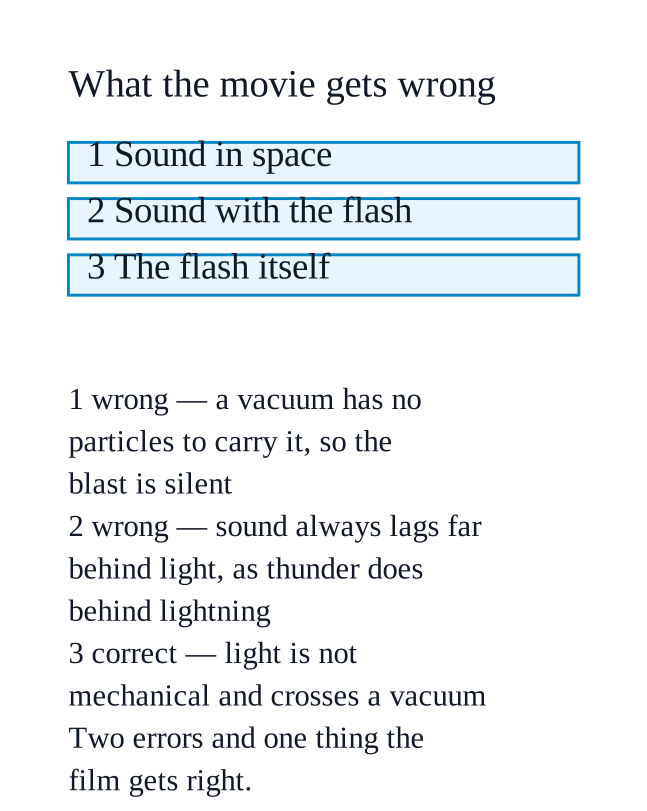
Error $\displaystyle 1$ — sound in space. Space is a near vacuum, and sound is a mechanical wave that needs a material medium to carry its compressions and rarefactions. With no particles, the explosion would be completely silent to a distant observer.
This is the same reason astronauts on a spacewalk cannot hear each other speak or hear metal clanking, and must use radio devices in their spacesuits.
Error $\displaystyle 2$ — the timing. Light travels at about \(\displaystyle 300000\ \text{km s}^{-1} \) while sound in air manages only about \(\displaystyle 340\ \text{m s}^{-1} \), so sound always lags far behind the flash — as thunder does behind lightning. Showing them at the same instant is wrong even on Earth.
The flash itself is correct: light is not a mechanical wave and travels through vacuum, which is how starlight reaches us.