SolveItClass 9 · NCERT

NCERT Solutions · Class 9 Science Reproduction: How Life Continues

24 questions · 22 still being checked

Revise, Reflect, Refine 11.3–11.4 (part 5 of 19)

  1. Exercise 11.3

    Assertion (A): The zygote formed after fertilisation immediately attaches to the uterus wall. Reason (R): The uterus wall is always prepared to receive the zygote. (i) Both A and R are true, and R is the correct explanation of A. (ii) Both A and R are true, but R is not the correct explanation of A. (iii) A is true, but R is false. (iv) A is false, but R is true.

    Not cross-checked

    NCERT prints no numerical answer for this exercise, so this working has not been cross-checked against the book.

    NCERT’s answer
    (iv)
    (iv) A is false, but R is true.
    NCERT_Solution_Class9_Science_Ch11_RRR_Q11-3
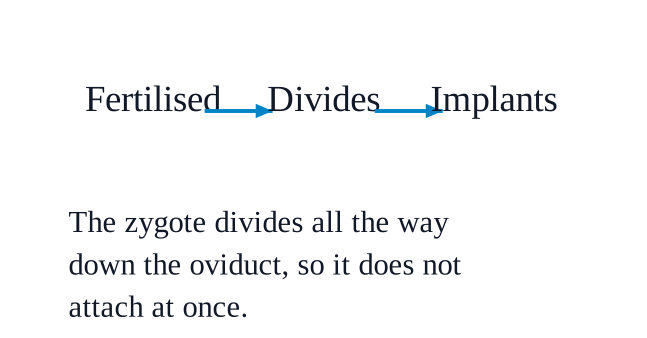
    A is false. The zygote does not attach immediately. It undergoes a series of mitotic divisions while it travels down the oviduct to the uterus, and only then implants into the inner lining — and it is that implantation, not fertilisation, that marks the beginning of pregnancy.
    R is true in the sense meant: the uterus prepares itself in advance, not in response to a zygote. Before ovulation the inner lining becomes thick, and after ovulation it becomes thicker and richer in blood vessels — ready to receive and nourish a zygote should one arrive.
    Once A is judged false, options (i), (ii) and (iii) are all eliminated, because each of them requires A to be true. Only (iv) remains.
  2. Exercise 11.4

    Why does asexual reproduction produce offsprings that are genetically identical to the parent?

    Not cross-checked

    NCERT prints no numerical answer for this exercise, so this working has not been cross-checked against the book.

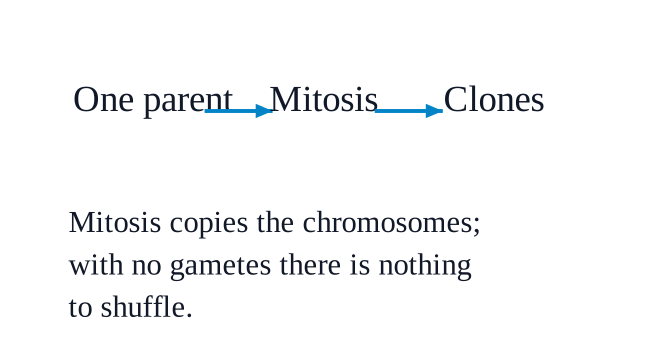
    Because asexual reproduction involves only one parent, and the cells divide by mitosis.
    NCERT_Solution_Class9_Science_Ch11_RRR_Q11-4
    Mitosis produces two daughter cells, each having the same number of chromosomes, identical to the parent cell — the genetic information is copied, not mixed.
    There is no meiosis and no formation of gametes, so no second set of chromosomes is brought in from another individual and no random recombination of characters takes place.
    The offspring are therefore exact genetic copies of the parent and are called clones — as in budding in yeast and hydra, spore formation in moulds, and vegetative propagation in potato, ginger, sugarcane and Bryophyllum.
    This is also why the method is fast and lets an organism build up its population quickly when conditions are favourable.