Exercise 11.4
Why do animals with external fertilisation generally produce more eggs than animals with internal fertilisation?
Not cross-checked
NCERT prints no numerical answer for this exercise, so this working has not been cross-checked against the book.
Because in external fertilisation the gametes are released into open water, so only a tiny fraction of the eggs ever becomes a young one — laying huge numbers is what makes up for the losses.
The female sheds her eggs into the water and the male sheds sperm over them; whether a sperm actually meets an egg is left to chance in a moving medium.
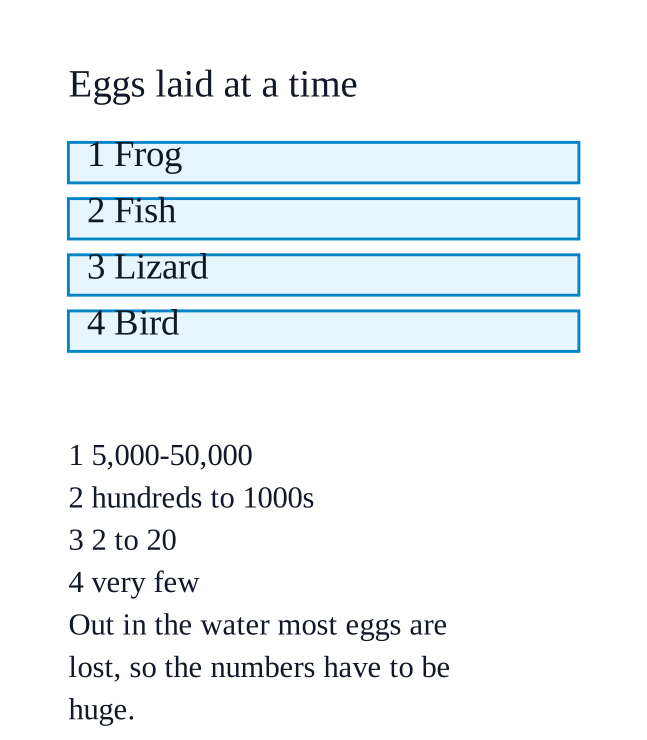
Even the eggs that are fertilised are destroyed by water currents or eaten by other animals, so Table $\displaystyle 11.4$ lists the estimated survival of young in fish and frog as low.
Numbers compensate: a frog releases \(\displaystyle 5{,}000\)–\(\displaystyle 50{,}000\) eggs at a time and fish hundreds to thousands, so a few survivors are almost certain.
In internal fertilisation the sperm meets the egg inside the female's body and the fertilised egg or embryo is protected there, so survival is moderate to high — a lizard needs only \(\displaystyle 2\)–\(\displaystyle 20\) eggs and a bird only \(\displaystyle 1\)–\(\displaystyle 15\).