Exercise 11.12
In the lower Himalayan region of northern India, apples are an important cash crop that contribute significantly to farmer’s livelihoods. The fruit yield in apple cultivation is declining continuously, associated with climate change and a significant decline in the population of natural pollinators. A researcher-farmer group set up two experimental apple orchards at two distinct locations: Places A and B. In apple orchards at Place A, they allowed natural pollinators (iv) Based on your analysis, what do you infer from the data?
Not cross-checked
NCERT prints no numerical answer for this exercise, so this working has not been cross-checked against the book.
(i) Hypotheses behind the investigation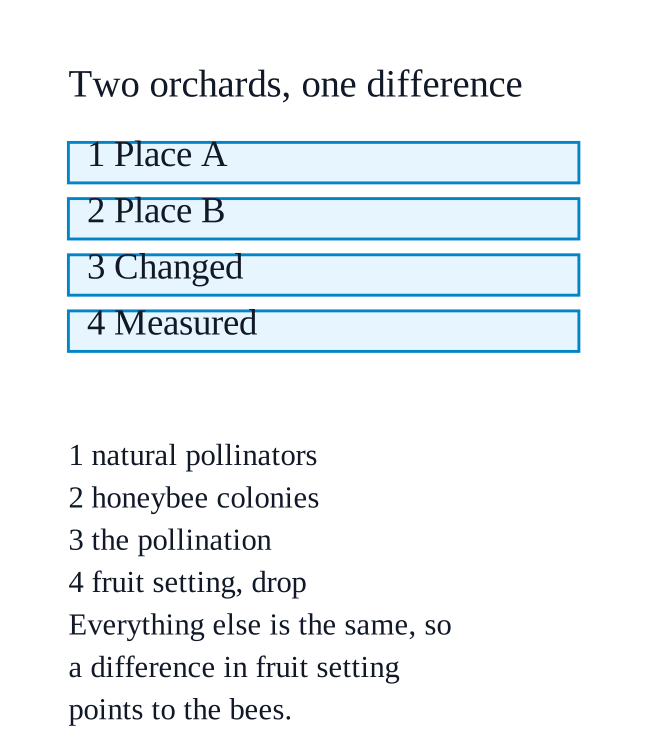
The falling apple yield is caused by the decline in pollinator numbers, not by the trees themselves.
Adding managed honeybee colonies (beekeeping) to an orchard increases pollination and so raises fruit setting.
Better pollination lowers fruit drop, because a well-pollinated flower whose ovules are fertilised develops into a fruit that stays on the branch instead of falling prematurely.
Mixed farming of apples with beekeeping gives the farmer a higher total return — apples and honey — than depending on natural pollinators alone.
(ii) Parameters in the experiment
Independent variable (what the group changed): the pollination treatment — natural pollinators only at Place A, versus honeybee colonies added at Place B.
Dependent variables (what they measured): per cent fruit setting, defined here as number of fruits ÷ total number of corresponding fruit-bearing branches, and per cent fruit drop.
Parameters that should be held the same at both places: apple variety, age, number and spacing of trees, soil, irrigation, manure and spray schedule, pruning, and the same season and dates of recording.
Weakness of the design to note: Places A and B are two distinct locations, so altitude, weather and soil may also differ. Any difference in yield cannot then be attributed to bees alone with full confidence.
(iii) Comparing the two orchards
Read both bars for each place off Fig. $\displaystyle 11.24$ — one for fruit setting, one for fruit drop.
The comparison the design is built to show is Place B (with beekeeping) having the higher per cent fruit setting and the lower per cent fruit drop, and Place A — left to the declining natural pollinators — the lower fruit setting and the higher fruit drop.
The mechanism: more pollinators → more pollen grains carried to stigmas → more ovules fertilised → more flowers turning into fruits, and fewer young fruits shed before they mature.
(iv) Inference
Apple yield in this region is limited by pollination, not by the trees' capacity to bear fruit.
Introducing honeybees repairs that limitation, so beekeeping alongside the orchard is a practical answer to the decline of natural pollinators — and it yields honey as a second product.
More broadly, a fruit crop is only as productive as its pollinators, so protecting pollinator populations directly protects the farmer's livelihood.