Exercise 12.2
Sponges represent one of the simplest animal body plans. Their bodies lack true tissues and organs. Which feature of sponge cells supports its classification under the animal kingdom? (i) Absence of mitochondria (ii) Ability to photosynthesise (iii) Presence of a cell membrane (iv) Presence of a cell wall
Not cross-checked
NCERT prints no numerical answer for this exercise, so this working has not been cross-checked against the book.
NCERT’s answer
(iii)
(iii) Presence of a cell membrane.
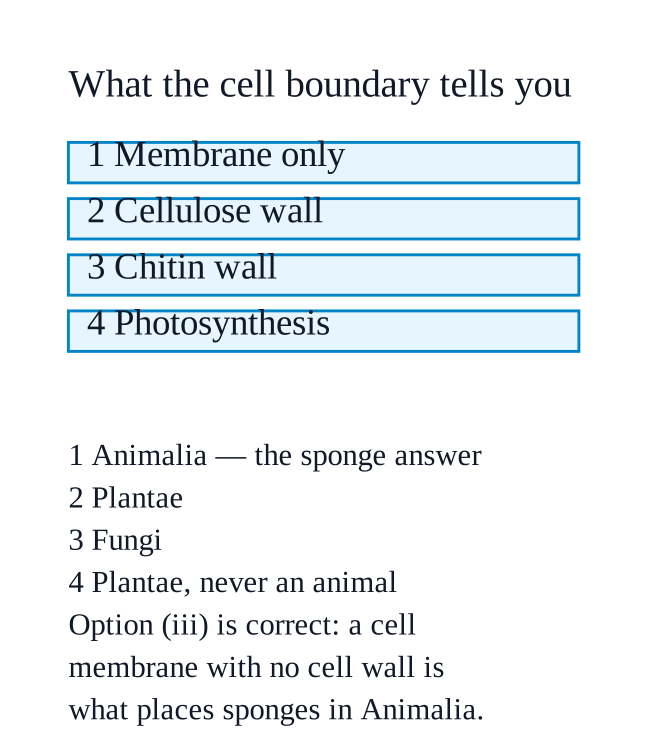
An animal cell is bounded by a cell membrane alone, with no cell wall — that is the cell-structure criterion that puts sponges in Animalia even though they have no true tissues or organs.
(iv) is wrong — a cell wall would place the organism in Plantae (cellulose), Fungi (chitin) or Monera, not Animalia.
(ii) is wrong — the ability to photosynthesise means autotrophic nutrition, the mark of Plantae. Sponges are heterotrophic; water flowing through their pores brings food particles to individual cells.
(i) is wrong — sponge cells are eukaryotic and do have mitochondria; absence of mitochondria would not support animal classification.
Read together with the rest of the chapter's animal criteria — multicellular, eukaryotic, heterotrophic, no cell wall — sponges qualify as animals despite their simple body plan.