Exercise 12.3
Internal structures — skeletal patterns, presence or absence of organs and different types of tissues.
Not cross-checked
NCERT prints no numerical answer for this exercise, so this working has not been cross-checked against the book.
This item's stored line is a stray fragment of the §$\displaystyle 12.3.1$ criteria list. The chapter's Pause and Ponder $\displaystyle 3$ (page $\displaystyle 239$) asks: which plant features reduce dependence on water but still require moist conditions?
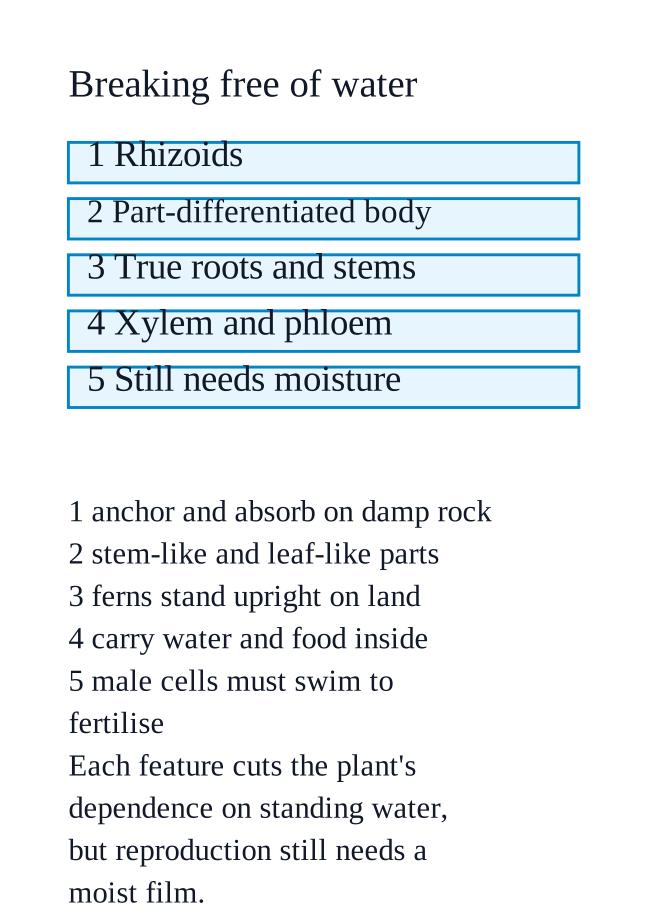
Rhizoids and a partly differentiated body (bryophytes). Mosses and Marchantia have root-like rhizoids that anchor and absorb, plus stem-like and leaf-like parts — so they can grow on damp rock, walls and soil instead of living in water like a thallophyte.
True roots, stems and leaves (pteridophytes). A fern draws water from the soil and holds itself upright on land.
Vascular tissue — xylem and phloem (pteridophytes). Xylem carries water and phloem carries food to every part of the plant, so the plant no longer needs to be surrounded by water for transport.
Moisture is still needed for one thing: reproduction. The male reproductive cells must swim to reach the female cells, so both bryophytes and pteridophytes must be wet to breed.
That is exactly why bryophytes are called the 'amphibians' of the plant kingdom — living on land, but breeding in water.
The tie to water is only broken higher up: gymnosperms produce seeds and need no aquatic conditions for fertilisation.