(i) Organism belonging to Kingdom Fungi
Organism Q.
Supporting observation: it grows on dead organic matter with no chlorophyll — heterotrophic nutrition by absorption from decaying material, which is the saprophytic, decomposer role of fungi.
It also fits on the rest of the fungal profile: multicellular, with a filamentous body (a mycelium of fine filaments) and a cell wall present.
(ii) Organism belonging to Kingdom Monera
Organism P.
Justifying characteristic: it has no true nucleus — a prokaryote, with only a primitive nucleus that has no bounding membrane. This is the single defining feature of Monera.
Consistent with the rest: microscopic, unicellular, with a rigid cell covering, and surviving high salinity and temperature — the chapter notes that monerans live in hot springs and other extreme environments where most organisms cannot survive.
(iii) Why R and Q are in different kingdoms although both are eukaryotic
The separating criterion is the level of organisation. Q is multicellular (a filamentous body) and R is unicellular (a single cell). A single-celled eukaryote goes to Protista; a multicellular eukaryote with a wall and absorptive nutrition goes to Fungi.
Supporting criterion — mode of nutrition: Q has no chlorophyll and absorbs food from dead matter; R photosynthesises in light and turns heterotrophic in the dark, exactly like Euglena.
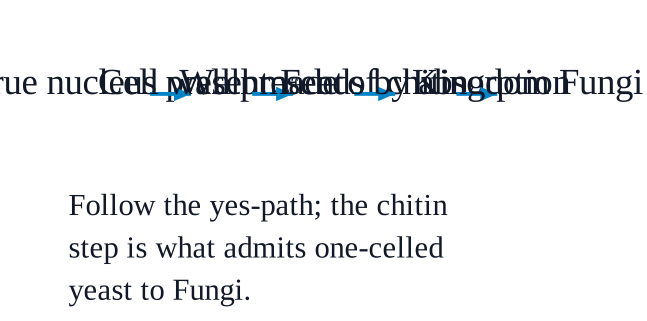
Supporting criterion — cell structure: a fungal wall is made of chitin, whereas a protist has no wall or a cellulose one; R's contractile vacuole and flagella are protist features.
(iv) Why organism S cannot be classified by mode of nutrition alone
Because heterotrophic nutrition is shared by three kingdoms — Animalia, Fungi and many members of Monera and Protista. Knowing only that S depends on others for food would not distinguish it from organism Q.
The features that actually place S are structural and cellular: multicellular, no cell wall, well-differentiated tissues and an organ system level of organisation — this rules out Fungi and Protista and puts it in Animalia.
Within Animalia, one more structural feature decides everything: a backbone, so S is a chordate and a vertebrate, not an invertebrate.
Aquatic respiration during the early life stage then narrows it further among the five vertebrate groups (fish, amphibians, reptiles, birds, mammals) — a life beginning in water and continuing on land points to an amphibian. Nutrition tells you none of this.
(v) What organism T lacks, and what that reveals
T lacks cellular organisation — it is acellular. The cell is the fundamental characteristic on which the whole five kingdom system is built.
Because there is no cell, none of the criteria can be applied: no cell type (prokaryote or eukaryote), no cell wall, no unicellular/multicellular level, and no mode of nutrition of its own. It also shows no life processes outside a host — it stays inactive until it enters a host cell.
What it reveals: the five kingdom system has no place for acellular entities. A classification can only sort what its criteria can measure, and every criterion here assumes a cell. Systems are built on the knowledge available at the time and must be revised as new tools and new forms of life appear.
(vi) If classification were based only on habitat
Wrongly grouped: P, R and S would all become 'aquatic' — a prokaryote, a single-celled eukaryotic protist and a multicellular backboned vertebrate filed together, despite belonging to three different kingdoms.
T would be grouped with parasites such as flatworms and roundworms, because all live inside a host — a non-cellular entity placed among animals.
Q would join every soil organism, from earthworms to bacteria, on the strength of damp soil alone.
True relatives would be torn apart. Fig. $\displaystyle 12.16$ shows arthropods living on land and in water, and molluscs in water and on moist land — one phylum would be split across several 'habitat' groups.
Scientific consequences: the groups would not reflect ancestry, so classification would stop telling us how organisms are related; identifying and naming new organisms would give misleading results; and conservation planning, which depends on knowing what is related to what, would be built on a false map.
This mistake has already been made. Aristotle grouped animals by habitat — land, water and air — and the system had to be abandoned because it relied only on easily observable external characteristics.
(vii) The new organism — Fungi or Animalia?
Place it under Fungi.
Multicellular and eukaryotic puts it in Fungi, Plantae or Animalia; lacking chlorophyll removes Plantae.
The decider is how it feeds. Fungi obtain nutrients by absorption — from dead matter, from a partner, or from a host as parasites. Animals are heterotrophic too, but they take food in and digest it internally, and most show locomotion and rapid response to stimuli. This organism absorbs nutrients externally from a host, which is the fungal pattern.
Confirm with one structural test — the cell wall. A wall of chitin, a body of fine filaments forming a mycelium, and reproduction by spores confirm Fungi. No cell wall at all, with food ingested and digested inside the body, would send it to Animalia instead.
The caution worth stating: parasitic flatworms also attach to host tissues to obtain nutrients, so 'lives on a host' by itself proves nothing. Nutrition plus cell structure together give the answer — which is the general lesson that no single criterion classifies an organism.