SolveItClass 9 · NCERT

NCERT Solutions · Class 9 Science Patterns in Life: Diversity and Classification

25 questions · 25 still being checked

Pause and Ponder 12.1–12.10 (part 1 of 3)

  1. Exercise 12.1

    If many organisms share common features, could they also share a common ancestry?

    Not cross-checked

    NCERT prints no numerical answer for this exercise, so this working has not been cross-checked against the book.

    Yes — shared features are the main clue to shared ancestry. The chapter says it directly: similar features in organisms suggest that they have evolved from common ancestors.
    NCERT_Solution_Class9_Science_Ch12_PP_Q12-1
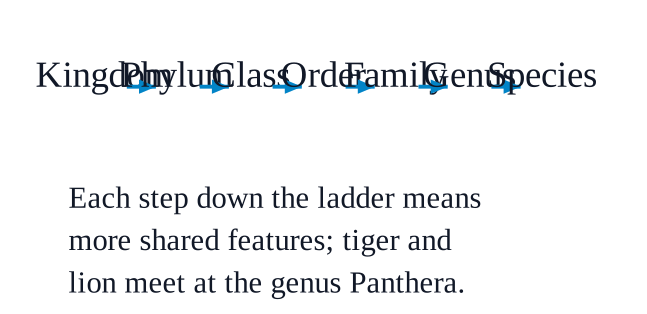
    The more features two organisms share, the closer the ancestry. That is why classification is a ladder — Kingdom → Phylum → Class → Order → Family → Genus → Species — and at each lower level organisms share more common features.
    Example from the chapter: tiger (Panthera tigris) and lion (Panthera leo) sit in the same genus Panthera because both can roar and have a similar skull structure.
    But the kind of feature matters. Easily visible outside features can mislead — Aristotle grouped animals by habitat (land, water, air) and that system had to be abandoned. Scientists therefore also compare internal structure, cell structure and reproduction.
    The strongest evidence is genetic: DNA carries the instructions for growth and function, and organisms with similar DNA are taken to have a common ancestry. This is how Carl Woese proposed the three domains in \(\displaystyle 1977\).
  2. Exercise 12.2

    Mode of nutrition — autotrophic or heterotrophic.

    Not cross-checked

    NCERT prints no numerical answer for this exercise, so this working has not been cross-checked against the book.

    This item's stored line is a stray fragment of the §$\displaystyle 12.3.1$ criteria list. The chapter's Pause and Ponder $\displaystyle 2$ (page $\displaystyle 237$) asks: how can a single-celled organism carry out all its life processes when billions of cells are needed for the same functions in us?
    Because in a unicellular organism the single cell is the whole body — that one cell performs nutrition, movement, response, waste removal and reproduction by itself.
    The division of labour happens inside the cell, among organelles, not among tissues and organs. A true nucleus controls the cell, a contractile vacuole handles excess water, and cilia or flagella move it — Amoeba, Paramecium and Euglena in Fig. $\displaystyle 12.7$ are the chapter's examples.
    Small size is what makes this possible. Every part of the cell is close to the surrounding water, so food, gases and wastes pass directly in and out across the cell membrane. No transport system is required.
    A large multicellular body cannot work that way — its inner cells are far from the surface. So its cells specialise into tissues and organs, and the body needs transport tissue.
    The chapter shows the same logic twice more: a thallus exchanges gases, nutrients and water directly with its surroundings, and a flatworm's flattened body lets gases diffuse without any respiratory organ.
    NCERT_Solution_Class9_Science_Ch12_PP_Q12-2
  3. Exercise 12.3

    Internal structures — skeletal patterns, presence or absence of organs and different types of tissues.

    Not cross-checked

    NCERT prints no numerical answer for this exercise, so this working has not been cross-checked against the book.

    This item's stored line is a stray fragment of the §$\displaystyle 12.3.1$ criteria list. The chapter's Pause and Ponder $\displaystyle 3$ (page $\displaystyle 239$) asks: which plant features reduce dependence on water but still require moist conditions?
    NCERT_Solution_Class9_Science_Ch12_PP_Q12-3
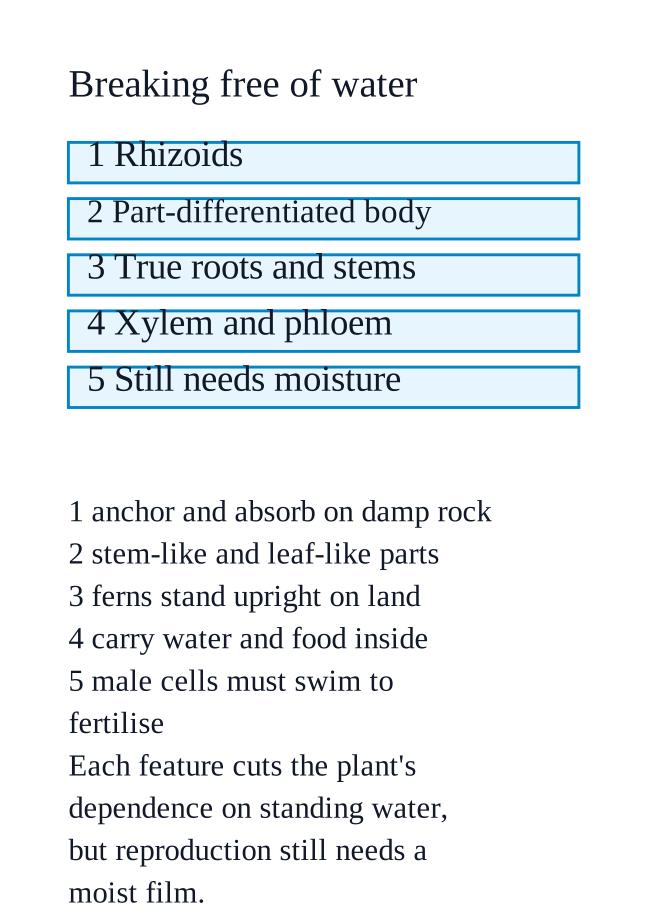
    Rhizoids and a partly differentiated body (bryophytes). Mosses and Marchantia have root-like rhizoids that anchor and absorb, plus stem-like and leaf-like parts — so they can grow on damp rock, walls and soil instead of living in water like a thallophyte.
    True roots, stems and leaves (pteridophytes). A fern draws water from the soil and holds itself upright on land.
    Vascular tissue — xylem and phloem (pteridophytes). Xylem carries water and phloem carries food to every part of the plant, so the plant no longer needs to be surrounded by water for transport.
    Moisture is still needed for one thing: reproduction. The male reproductive cells must swim to reach the female cells, so both bryophytes and pteridophytes must be wet to breed.
    That is exactly why bryophytes are called the 'amphibians' of the plant kingdom — living on land, but breeding in water.
    The tie to water is only broken higher up: gymnosperms produce seeds and need no aquatic conditions for fertilisation.
  4. Exercise 12.4

    Cell structure — whether the organism is unicellular or multicellular, the cell is eukaryote or prokaryote, presence or absence of cell wall.

    Not cross-checked

    NCERT prints no numerical answer for this exercise, so this working has not been cross-checked against the book.

    This item's stored line is a stray fragment of the §$\displaystyle 12.3.1$ criteria list. The chapter's Pause and Ponder $\displaystyle 4$ (page $\displaystyle 239$) asks: why do taller plants need specialised transport tissues?
    NCERT_Solution_Class9_Science_Ch12_PP_Q12-4
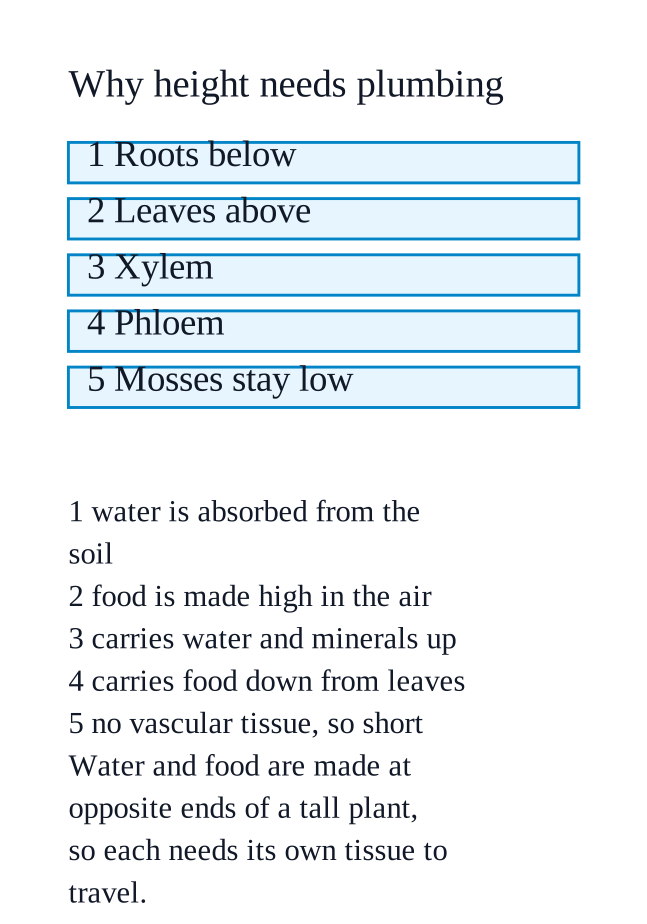
    Because in a tall plant the water and the food are made in different places, far apart. Water is absorbed by roots in the soil; food is made in leaves held high in the air. Something must carry each to the other end.
    Direct exchange with the surroundings only works over short distances. A thallus or a moss mat is thin and low, so water soaks in everywhere — that is why bryophytes lack vascular tissue and stay small, growing as green mats on damp ground.
    Xylem transports water and minerals upward from the roots; phloem transports food from the leaves to the rest of the plant. Pteridophytes were the first group to have both, and it is why ferns can stand well above the soil.
    The tissue also gives mechanical support — a stiff vascular core lets the stem hold a tall body up against gravity, which a moss cannot do.
    Chapter evidence: bryophytes lack vascular tissue and remain moisture-bound mats; pteridophytes have xylem and phloem and are listed as being able to transport food and water to all parts of the plant.
  5. Exercise 12.5

    Ecological role — producer, consumer, or decomposer.

    Not cross-checked

    NCERT prints no numerical answer for this exercise, so this working has not been cross-checked against the book.

    This item's stored line is a stray fragment of the §$\displaystyle 12.3.1$ criteria list. The chapter's Pause and Ponder $\displaystyle 5$ (page $\displaystyle 239$) asks: how do seeds and fruits affect where and how plants can survive?
    NCERT_Solution_Class9_Science_Ch12_PP_Q12-5
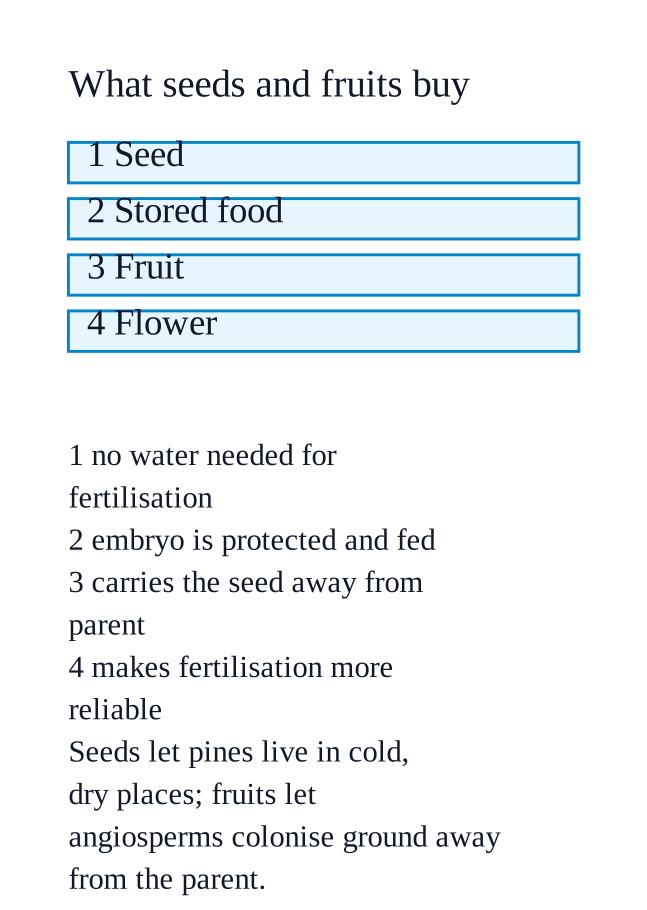
    Seeds cut the plant's last link to water. Gymnosperms do not need aquatic conditions for fertilisation, so pines and cycads can live in cold and dry regions where a fern or a moss could never reproduce.
    A seed protects and feeds the young plant. It shields the developing embryo and carries stored food, so the seedling can start growing when conditions become suitable rather than dying at once.
    Fruits move the seed away from the parent. In angiosperms the seed is enclosed in a fruit, and the fruit is dispersed by insects, birds, other animals, wind or water — the plant colonises new ground instead of crowding its own parent.
    Flowers make the fertilisation itself more reliable, because they attract pollinators rather than leaving pollen transfer to chance.
    Result: these features let angiosperms occupy a wide range of environments, which is why the chapter calls them the most diverse plant group on the Earth.
    The trade-off the chapter lists: gymnosperm seeds are naked on cones and unprotected, and angiosperm reproduction now depends on pollinating agents being present.
  6. Exercise 12.6

    Reproduction — asexual and/or sexual methods.

    Not cross-checked

    NCERT prints no numerical answer for this exercise, so this working has not been cross-checked against the book.

    This item's stored line is a stray fragment of the §$\displaystyle 12.3.1$ criteria list. The chapter's Pause and Ponder $\displaystyle 6$ (page $\displaystyle 242$) asks how a beetle's hard external skeleton helps it survive, given that an earthworm is segmented too.
    It protects the body. The rigid outer covering shields the soft parts underneath from injury and from predators — an earthworm has no skeleton at all (Fig. $\displaystyle 12.16$ marks Annelida with an X for skeleton).
    It reduces water loss. The hard covering seals the body surface, so the beetle does not dry out. This is the decisive difference: the earthworm must stay in moist soil or water, while the beetle can live on open, dry land.
    It supports powerful muscles. Muscles anchor to the exoskeleton, giving the beetle strong, precise movement — walking, digging, flying.
    Segmentation plus the exoskeleton together give flexibility with strength: the segments allow bending and controlled movement, the hard plates supply protection.
    Net effect, in the chapter's own terms: the exoskeleton lets arthropods survive in dry and exposed environments that annelids cannot enter.
    NCERT_Solution_Class9_Science_Ch12_PP_Q12-6
  7. Exercise 12.7

    Genetic similarity — similarities in inherited features, which scientists study in detail using DNA. These features help in understanding the similarities and differences among organisms. Similar features in organisms suggest that they have evolved from common ancestors.

    Not cross-checked

    NCERT prints no numerical answer for this exercise, so this working has not been cross-checked against the book.

    This item's stored text is a long mis-extracted block of body text. The chapter's Pause and Ponder $\displaystyle 7$ (page $\displaystyle 248$) asks whether 'biodiversity' means only the variety of organisms, or something wider.
    NCERT_Solution_Class9_Science_Ch12_PP_Q12-7
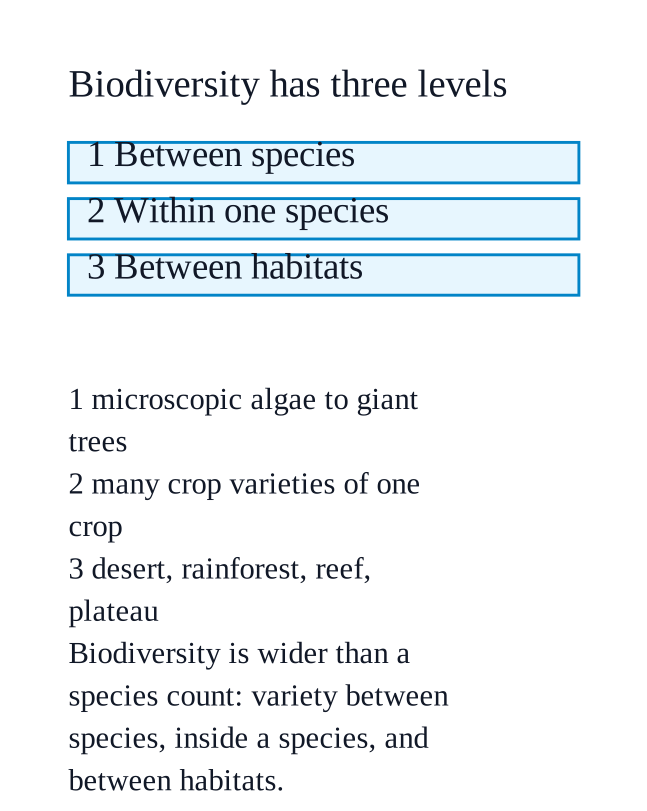
    It is wider than a species count — biodiversity covers variety at three levels, all of which the chapter uses.
    Variety between species. The plain meaning: the immense variety of living organisms, from microscopic algae to giant trees, from glowing jellyfish to soaring eagles.
    Variety within a single species. Farmers conserved diverse crop varieties of the same crop — some drought-tolerant, some pest-resistant, some able to grow in nutrient-poor soils. That is inherited variation inside one species, and it is why diversity reduces the risk of crop failure.
    Variety of habitats and ecosystems. Mountains, desert, rainforest, plateaus, coastlines, coral reefs — each with its own soil and climate. The chapter even classifies the floating phumdis of Loktak Lake as one of the world's unique habitats.
    The interconnections themselves. Algae releasing oxygen, fungi and bacteria decomposing litter, bees and bats pollinating — these links keep ecosystems working and are part of what is lost when biodiversity falls.
    Practical proof it is more than a list of names: a region counts as a biodiversity hotspot only if it has many endemic species and has suffered significant habitat loss — habitat is built into the idea.
  8. Exercise 12.8

    If you find a new organism in a pond, what features will you observe to classify it and why?

    Not cross-checked

    NCERT prints no numerical answer for this exercise, so this working has not been cross-checked against the book.

    Work from broad, easily visible features down to detailed ones — that is the order the chapter says scientists use.
    Cell type — prokaryote or eukaryote. Is there a membrane-bound nucleus? No nucleus → Monera. This is the single most fundamental split, and it is the very difference that separated bacteria from amoeba historically.
    Level of organisation — unicellular or multicellular. One cell with a true nucleus → Protista (Fig. $\displaystyle 12.7$: Amoeba, Paramecium, Chlamydomonas, Euglena). Many cells → Fungi, Plantae or Animalia.
    Cell structure — cell wall present or absent, and made of what. No wall → Animalia or a protist; cellulose → Plantae or a protist; chitin → Fungi, even in a one-celled form like yeast.
    Mode of nutrition — autotrophic or heterotrophic. Is it green and photosynthesising, or does it depend on others? And if heterotrophic, does it absorb food (fungal) or take it in (animal)?
    External features — shape, size, body organisation, and how it moves (cilia, flagella, or fixed in place).
    Internal structure — presence of tissues, organs, and in an animal the notochord or backbone, which is the main criterion separating non-chordates from chordates.
    Ecological role — producer, consumer or decomposer — and reproduction, sexual or asexual, by spores or otherwise.
    Why these features: they are the criteria the five kingdom system is actually built on, so each observation moves the organism one step down the ladder Kingdom → Phylum → Class → … → Species. Where the features are still ambiguous, DNA comparison settles the relationship.
    Practical note: a pond organism should be examined in a drop of pond water under a microscope — the hay infusion of Activity $\displaystyle 12.5$ is set up for exactly this.
    NCERT_Solution_Class9_Science_Ch12_PP_Q12-8
  9. Exercise 12.9

    Why do genetic studies provide deep information about living beings?

    Not cross-checked

    NCERT prints no numerical answer for this exercise, so this working has not been cross-checked against the book.

    Because DNA is the cause of the features, not just another feature. Every living cell contains genetic material that carries the instructions for its growth and function, so comparing DNA compares organisms at the level where their similarities and differences actually originate.
    It reveals ancestry directly. Organisms with similar DNA are taken to have a common ancestry — a relationship you can only guess at from outward appearance.
    It corrects mistakes made from looks alone. Aristotle's habitat-based grouping failed because it relied on easily observable external characteristics. Genetic data does not depend on how an organism happens to look or where it lives.
    It works where the microscope runs out. Microscopic organisms look alike but are not alike. Genetic study showed that microscopic life is far more diverse than anyone had believed.
    It has already rewritten classification. On genetic data, Carl Woese proposed the three domain system in \(\displaystyle 1977\) — Bacteria, Archaea, Eukarya — splitting two groups of prokaryotes that a microscope could not tell apart.
    This is why 'genetic similarity' appears in the chapter's list of classification criteria alongside external features, internal structure and cell structure.
  10. Exercise 12.10

    How can changes in climate affect the biodiversity? wet soil

    Not cross-checked

    NCERT prints no numerical answer for this exercise, so this working has not been cross-checked against the book.

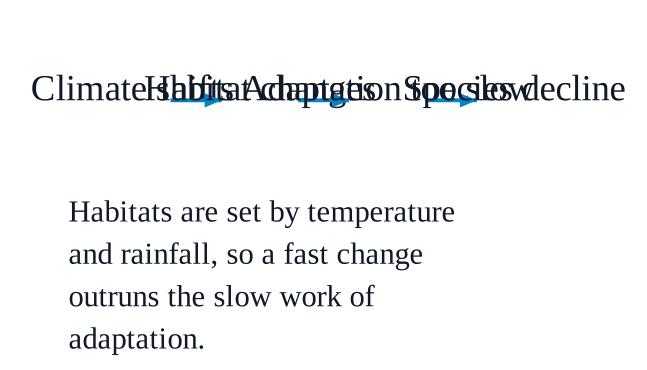
    Climate change reduces biodiversity, mainly by changing habitats faster than species can adapt to them. The chapter lists it beside pollution, deforestation and the overuse of resources as a cause of biodiversity loss.
    NCERT_Solution_Class9_Science_Ch12_PP_Q12-10
    Habitats are defined by climate. Each Indian region — Himalaya, western desert, north-eastern rainforest, southern plateau, coastline — has its own temperature and rainfall, and it is these conditions that decide which species live there. Shift the temperature and rainfall and the habitat itself changes.
    Species survive by adaptation, and adaptation is slow. Diversity arose from small differences accumulating over many generations. A rapid change in conditions does not leave enough generations for that to happen, so the organisms that cannot cope simply decline.
    Endemic species are hit hardest. Nilgiri tahr, lion-tailed macaque, Nepenthes khasiana and Neelakurinji are found naturally nowhere else — if their one region becomes unsuitable, they have nowhere to move to.
    Losses spread through the food web. When one species disappears, others that depend on it decline and may disappear too — pollinators lose their flowers, hornbills lose their fruiting trees.
    Special features become liabilities. Thick fur in polar bears and fat storage in camels suit particular extremes; a change in those extremes turns a survival feature into a burden.
    Habitat loss is the mechanism to name in an answer. The chapter's own example is the phumdis of Loktak Lake degenerating and putting the endemic Sangai deer on the IUCN Red Data list.