SolveItClass 9 · NCERT

NCERT Solutions · Class 9 Science Patterns in Life: Diversity and Classification

25 questions · 25 still being checked

Revise, Reflect, Refine 12.1–12.10 (part 2 of 3)

  1. Exercise 12.1

    Meena and Hari observed an animal in their garden. Hari called it an insect while Meena said it was an earthworm. Choose the correct option which confirms that it is an insect. (i) Bilateral symmetrical body (ii) Body with jointed legs (iii) Cylindrical body (iv) Body with little segmentation

    Not cross-checked

    NCERT prints no numerical answer for this exercise, so this working has not been cross-checked against the book.

    NCERT’s answer
    (ii)
    (ii) Body with jointed legs.
    Jointed legs are the defining feature of Arthropoda, the phylum insects belong to — the name itself comes from arthro (limbs) and poda (appendages). An earthworm has no legs at all.
    (i) is wrong because it does not separate them: both an insect and an earthworm are bilaterally symmetrical, with distinct head-tail and front-back regions.
    (iii) is wrong — a cylindrical body describes the earthworm (Annelida), not the insect.
    (iv) is wrong in both directions: the earthworm's body is clearly divided into segments, and arthropods are segmented too, with different segments specialised for different jobs.
    Quick check for Hari: an insect also carries a hard exoskeleton, which Fig. $\displaystyle 12.16$ marks for Arthropoda and marks absent (X) for Annelida.
    NCERT_Solution_Class9_Science_Ch12_RRR_Q12-1
  2. Exercise 12.2

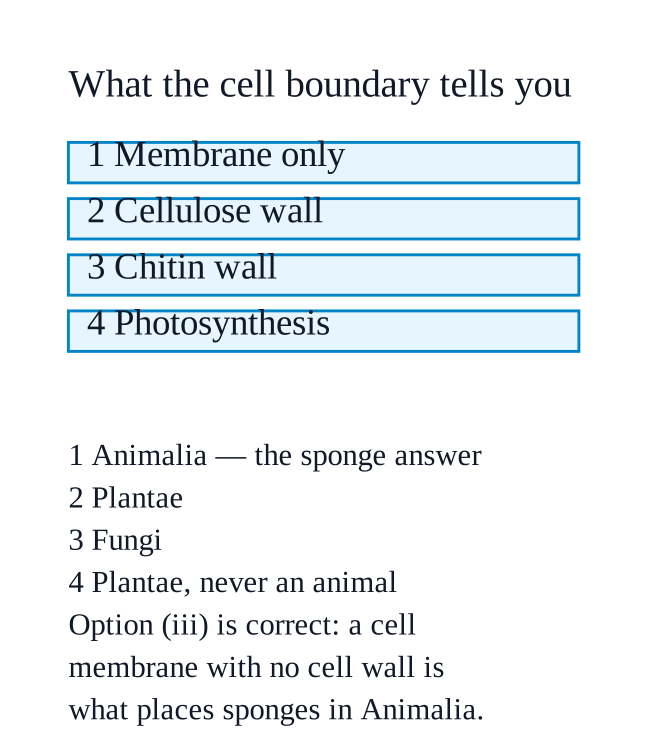
    Sponges represent one of the simplest animal body plans. Their bodies lack true tissues and organs. Which feature of sponge cells supports its classification under the animal kingdom? (i) Absence of mitochondria (ii) Ability to photosynthesise (iii) Presence of a cell membrane (iv) Presence of a cell wall

    Not cross-checked

    NCERT prints no numerical answer for this exercise, so this working has not been cross-checked against the book.

    NCERT’s answer
    (iii)
    (iii) Presence of a cell membrane.
    NCERT_Solution_Class9_Science_Ch12_RRR_Q12-2
    An animal cell is bounded by a cell membrane alone, with no cell wall — that is the cell-structure criterion that puts sponges in Animalia even though they have no true tissues or organs.
    (iv) is wrong — a cell wall would place the organism in Plantae (cellulose), Fungi (chitin) or Monera, not Animalia.
    (ii) is wrong — the ability to photosynthesise means autotrophic nutrition, the mark of Plantae. Sponges are heterotrophic; water flowing through their pores brings food particles to individual cells.
    (i) is wrong — sponge cells are eukaryotic and do have mitochondria; absence of mitochondria would not support animal classification.
    Read together with the rest of the chapter's animal criteria — multicellular, eukaryotic, heterotrophic, no cell wall — sponges qualify as animals despite their simple body plan.
  3. Exercise 12.3

    Observe two different animals in your immediate environment. What features help you distinguish between them? How do these features help place them into different groups?

    Not cross-checked

    NCERT prints no numerical answer for this exercise, so this working has not been cross-checked against the book.

    The features that separate two animals are the same ones that place them in different groups. Take a garden ant and a house lizard (use any pair you can actually observe — the reasoning is what is being marked).
    Backbone — the biggest split. The lizard has a vertebral column; the ant has none. This one feature separates them at the top: lizard → chordata (vertebrata), ant → non-chordata (invertebrata).
    Skeleton. The ant's hard covering is on the outside — an exoskeleton, which Fig. $\displaystyle 12.16$ gives as the mark of Arthropoda. The lizard's skeleton is internal.
    Legs. The ant has jointed legs — the defining arthropod feature. The lizard's four limbs are built on an internal bony frame.
    Body segmentation. The ant's body is divided into segments specialised for different functions; the lizard's body is not built that way.
    Body covering. Dry scaly skin on the lizard; a hard chitinous covering on the ant, which also cuts its water loss.
    What does not separate them: both are multicellular, heterotrophic, eukaryotic and show locomotion and rapid response to stimuli. Those features only confirm both are Animalia.
    Placing them: ant → Animalia → non-chordata → Arthropoda; lizard → Animalia → chordata → vertebrata → reptiles.
    The method behind it: start with broad, easily visible features and move to detailed ones. Each feature you add carries the animal one step down Kingdom → Phylum → Class → Order → Family → Genus → Species.
    NCERT_Solution_Class9_Science_Ch12_RRR_Q12-3
  4. Exercise 12.4

    How would a scientist justify choosing cellular organisation as a more fundamental characteristic for the basis of classification rather than the presence of xylem and phloem?

    Not cross-checked

    NCERT prints no numerical answer for this exercise, so this working has not been cross-checked against the book.

    Because cellular organisation applies to every organism on the Earth, while xylem and phloem exist in only a part of one kingdom.
    A classification criterion must be usable on everything being classified. Cell type (prokaryote or eukaryote), presence and composition of a cell wall, and unicellular or multicellular can be checked in a bacterium, an amoeba, a mushroom, a mango tree and a tiger alike. 'Has xylem and phloem?' is meaningless for all but plants — you cannot use it to sort Monera, Protista, Fungi or Animalia at all.
    The five kingdom system is built on cellular criteria for exactly this reason — cell type, cell structure, level of organisation and mode of nutrition are what Fig. $\displaystyle 12.5$ branches on.
    Classification moves from broad to specific. Cellular organisation is the broad feature that opens the hierarchy; vascular tissue is a detail used much further down, to separate the classes within Kingdom Plantae (thallophytes and bryophytes lack it; pteridophytes, gymnosperms and angiosperms have it).
    History proves the point. It was a cellular feature that forced a change: an amoeba has a true membrane-bound nucleus and a bacterium does not, so bacteria were pulled out of Protista into Monera. No tissue-level feature could have made that distinction.
    Cellular features also track ancestry more reliably. Cell structure and DNA reflect deep relationships, whereas a tissue can be gained or lost as an adaptation — and Aristotle's system already showed how far a classification built on superficial features can go wrong.
    NCERT_Solution_Class9_Science_Ch12_RRR_Q12-4
  5. Exercise 12.5

    You find an unlabelled slide of a single-celled organism that has a well-defined nucleus and multiple cilia. Which group would it most likely belong to? Give reasons.

    Not cross-checked

    NCERT prints no numerical answer for this exercise, so this working has not been cross-checked against the book.

    Kingdom Protista — most likely a ciliate such as Paramecium.
    A well-defined nucleus means a eukaryote, so it cannot be Monera — bacteria and cyanobacteria have only a primitive nucleus with no bounding membrane.
    Single-celled rules out Plantae and Animalia, both of which are multicellular by definition in the five kingdom system.
    It also rules out Fungi in practice. Fungi are mostly multicellular, and the one-celled exception, yeast, is admitted only because its cell wall is made of chitin. A ciliated swimmer with no chitin wall does not qualify.
    What is left fits exactly: Protista is defined as single-celled eukaryotes with no cell wall, or with a cellulose wall — microscopic, highly diverse, living in water or moist places.
    The cilia confirm it. They are locomotory structures for a free-swimming, water-dwelling microorganism, and Paramecium is one of the protists the chapter illustrates in Fig. 12.7.
    To be sure, check two more things: whether a cell wall is present and what it is made of, and the mode of nutrition (protists may be autotrophic or heterotrophic — either is consistent).
    NCERT_Solution_Class9_Science_Ch12_RRR_Q12-5
  6. Exercise 12.6

    How does the diversity of organisms contribute to the balance and stability of an ecosystem?

    Not cross-checked

    NCERT prints no numerical answer for this exercise, so this working has not been cross-checked against the book.

    Because every organism performs a job that some other organism depends on — diversity keeps all the jobs filled.
    NCERT_Solution_Class9_Science_Ch12_RRR_Q12-6
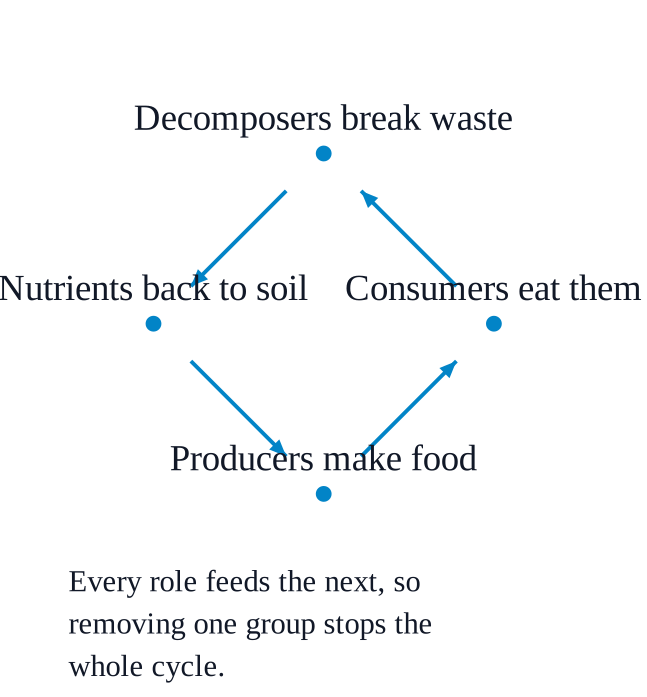
    The ecological roles are shared out. Producers capture sunlight and make food, consumers feed on them, and decomposers return the material to the soil. Remove any one role and the cycle stops.
    Oxygen and food supply. Microscopic algae in the oceans release most of the oxygen we breathe; plants form the base of most food chains.
    Nutrient recycling. Fungi and bacteria decompose fallen leaves and waste into manure, making the soil fertile. Without fungi, decay would be greatly reduced and soil fertility and ecological balance would suffer.
    Reproduction of plants depends on animals. Birds, bees and bats pollinate flowers; animals, birds, wind and water disperse seeds.
    Diversity is insurance against failure. The chapter's farming example makes it general: diversity reduces the risk of crop failure. In a diverse ecosystem, the loss of one species is less likely to bring everything down.
    Losses cascade the other way too. When one species disappears, others that depend on it decline and may disappear as well — which is why a low-diversity system is fragile.
    Diversity buffers real disasters. Villages with more mangroves suffered less destruction in the \(\displaystyle 1999\) Odisha super cyclone; forest diversity in the Western Ghats acts as a biological barrier against Kyasanur Forest Disease; diverse soil microorganisms break down pollutants and mangrove soils trap heavy metals.
  7. Exercise 12.7

    If all unicellular organisms were grouped into a single kingdom, what problems would arise?

    Not cross-checked

    NCERT prints no numerical answer for this exercise, so this working has not been cross-checked against the book.

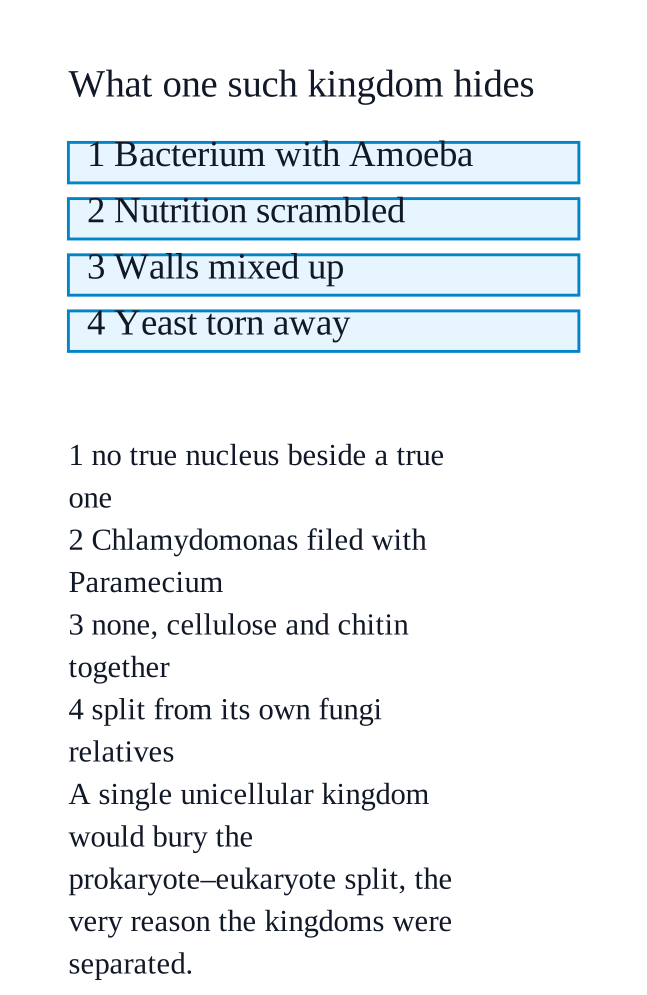
    It would hide the deepest difference in all of biology — prokaryote versus eukaryote — and that is precisely why the four kingdom system was created.
    NCERT_Solution_Class9_Science_Ch12_RRR_Q12-7
    Bacteria and Amoeba would sit together. A bacterium has a primitive nucleus with no bounding membrane; an amoeba has a true, membrane-bound nucleus. Grouping them says they are alike when they are not, and it was this very observation, made as microscopes improved, that moved bacteria out into Monera.
    Mode of nutrition would be scrambled. Autotrophs such as cyanobacteria and Chlamydomonas would share a kingdom with heterotrophs such as Amoeba and Paramecium.
    Cell wall differences would be lost. Monerans, walled protists (cellulose) and yeast (chitin) would all be filed together, even though the wall is a core classification criterion.
    Truly related organisms would be split apart. Yeast is unicellular but is placed in Fungi because of its chitin wall. A 'kingdom of unicellular organisms' would tear it away from the moulds and mushrooms it actually resembles.
    The group would not reflect ancestry. Number of cells alone is a single superficial criterion — the same mistake as Aristotle's habitat grouping. Classification is meant to show how organisms are related, not just how big they are.
    It contradicts what genetics found. Woese's three domain system showed microscopic life to be far more diverse than believed, with Bacteria and Archaea as separate domains. Collapsing all unicellular life into one kingdom moves in exactly the wrong direction.
  8. Exercise 12.8

    Viruses were studied in earlier classes. Why are they not placed in any of the five kingdoms? Give reasons.

    Not cross-checked

    NCERT prints no numerical answer for this exercise, so this working has not been cross-checked against the book.

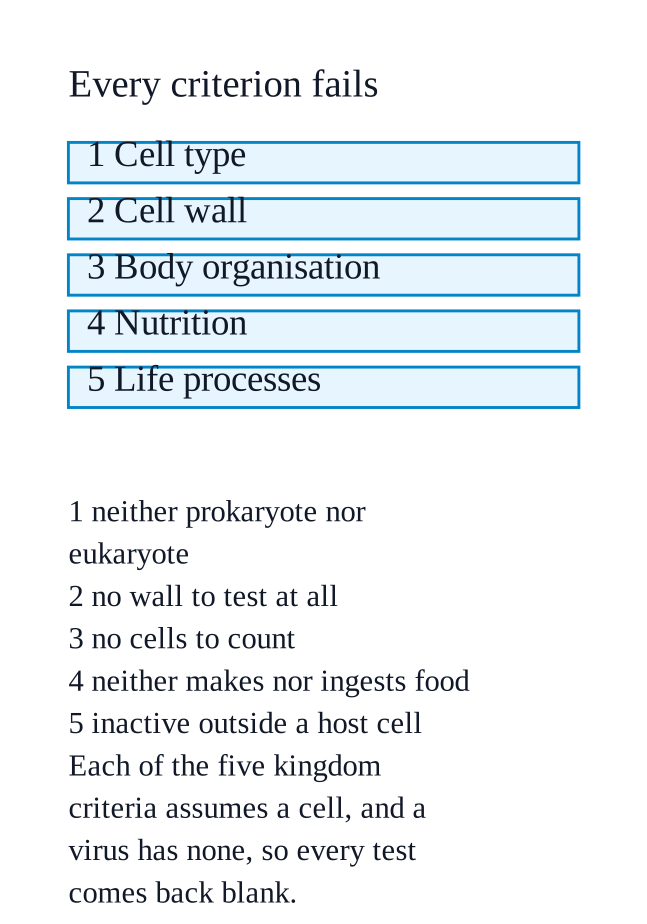
    Because viruses are acellular — they are not made of cells, and every criterion of the five kingdom system is a criterion about cells.
    No cell type to record. The first branch of Fig. $\displaystyle 12.5$ asks prokaryote or eukaryote. A virus is neither: it has no nucleus, primitive or true.
    No cell structure to record. There is no cell wall to be present or absent, and none to be made of cellulose or chitin.
    No level of organisation. It is neither unicellular nor multicellular, because it has no cells to count.
    No mode of nutrition. It does not take in, absorb or make food, so it cannot be called autotrophic or heterotrophic, and it has no ecological role as producer, consumer or decomposer.
    It shows no life processes on its own. Outside a host cell it remains inactive; it can only multiply inside a living cell.
    Yet it is not plainly non-living either — it contains genetic material, like every living organism. It sits between the two categories.
    So Whittaker's system has no box for it. The system was designed to sort cellular life, and NCERT's own key puts it in one line: there is no place for acellular entities.
    NCERT_Solution_Class9_Science_Ch12_RRR_Q12-8
  9. Exercise 12.9

    If you were asked to revise the five kingdom classification, would you create a separate category for viruses or keep them outside the system? Justify your answer and explain what this indicates about the evolving nature of scientific classification.

    Not cross-checked

    NCERT prints no numerical answer for this exercise, so this working has not been cross-checked against the book.

    My stand: create a separate category for viruses rather than leaving them outside — but make it a category alongside the five kingdoms, not one of them.
    Why not inside the five kingdoms. Every one of Whittaker's criteria — cell type, cell wall, unicellular or multicellular, mode of nutrition — assumes a cell. A virus has none, so forcing it into Monera or Protista would break the very rules the system runs on.
    Why not simply ignore them. Viruses contain genetic material, they multiply, they evolve, and they cause disease in every kingdom. A classification meant to help scientists identify, name and discuss organisms using a common system cannot leave out something so widespread.
    What the separate category would be built on. Non-cellular organisation, the type of genetic material carried, and complete dependence on a host cell for reproduction — criteria a virus can actually be tested against.
    The honest alternative view: keep them outside, on the ground that the five kingdom system classifies living organisms and a virus shows no life processes outside a host. This is a defensible answer too, provided the reasoning is stated.
    What this tells us about scientific classification: it is not fixed — it is an ongoing process of reasoning and change.
    The chapter's own timeline proves it. Aristotle grouped by habitat in the 4th century BCE; two kingdoms in \(\displaystyle 1758\); Protista added in \(\displaystyle 1866\); Monera in \(\displaystyle 1938\); Whittaker's five kingdoms in \(\displaystyle 1969\); Woese's three domains in \(\displaystyle 1977\).
    Each change followed a new tool or a new fact — better microscopes, staining techniques, then DNA comparison. Viruses are simply the next case pressing on the boundary, and a system that can be revised is a strength of science, not a flaw.
  10. Exercise 12.10

    Viruses contain genetic material like living organisms but lack cellular organisation. Which features prevent them from fitting into the five kingdom system? What does this tell us about the limitations of classification systems?

    Not cross-checked

    NCERT prints no numerical answer for this exercise, so this working has not been cross-checked against the book.

    The blocking features, in order of the five kingdom criteria:
    NCERT_Solution_Class9_Science_Ch12_RRR_Q12-10
    Acellular organisation. No cell means no cell type — a virus is neither prokaryote nor eukaryote, and the first branch of the whole system cannot be applied.
    No cell structure to test. No cell wall, so the cellulose/chitin distinction that separates Plantae, Fungi and Protista is meaningless.
    No level of organisation. Neither unicellular nor multicellular, because there are no cells to count — so it cannot be sorted against Monera, Protista, Fungi, Plantae or Animalia.
    No independent mode of nutrition. It neither makes food nor absorbs nor ingests it, so it is neither autotrophic nor heterotrophic, and it fills no ecological role.
    No independent life processes. It is inactive outside a host cell and can multiply only inside one — while still carrying genetic material, like living things do.
    What this reveals about classification systems:
    A system can only sort what its criteria can measure. Whittaker's criteria are all cellular, so anything non-cellular falls straight through, no matter how important it is.
    Every system is limited by the knowledge of its time. Aristotle's habitat groups failed when microscopes revealed microorganisms; the two kingdom system failed on Amoeba and bacteria; the five kingdom system, comprehensive as it was, still could not fully explain the diversity of life.
    So classification must keep changing — genetic research led to the three domain system, and viruses mark the boundary where the present system still needs work. Classification is a working tool for understanding relationships, not a final and complete truth.