Exercise 8.10
Both Rutherford’s and Bohr’s models have electrons orbiting the nucleus. Why did Rutherford’s model fail to explain atomic stability, while Bohr’s model succeeded?
Not cross-checked
NCERT prints no numerical answer for this exercise, so this working has not been cross-checked against the book.
Rutherford had no answer to the accelerating electron; Bohr blocked the problem by postulating stationary states.
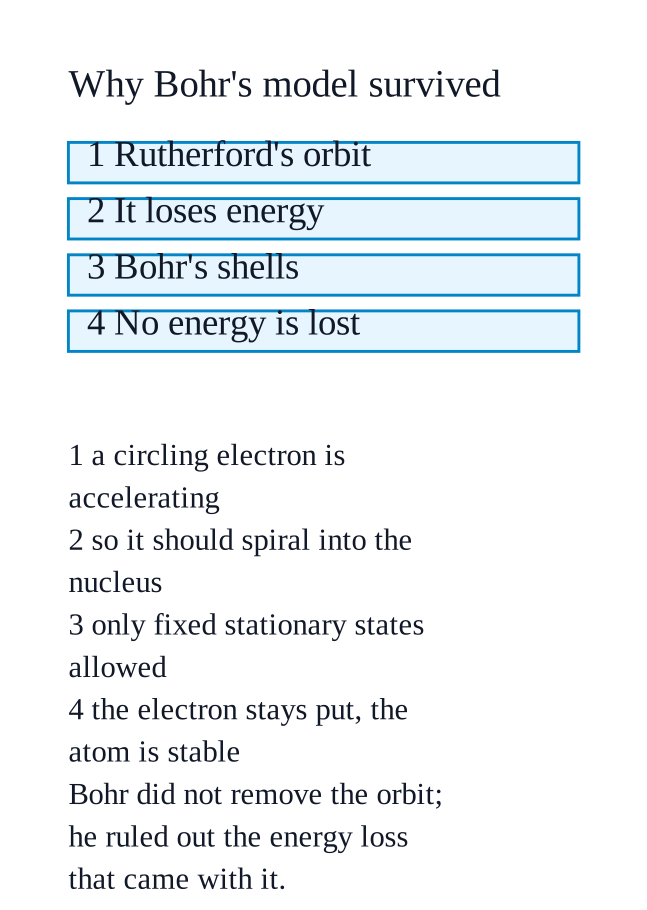
Why Rutherford's model failed: an electron moving in a circular path is constantly changing direction, which means it is accelerating.
An accelerating charged particle loses energy. As it lost energy the electron would spiral inward and eventually fall into the nucleus.
Every atom would then collapse — but real atoms are stable, which is why the matter around us stays intact. So the model had to be incomplete.
Why Bohr's model succeeded: he allowed the electron only certain fixed circular paths, the stationary states or shells K, L, M, N ... (\(\displaystyle n = 1, 2, 3, 4 ...\)).
He postulated that while an electron moves in one of these shells its energy stays constant, even though it is in motion — it radiates no energy at all.
With no energy lost there is no spiral and no collapse. The electron changes only by absorbing or releasing a fixed amount of energy to jump between allowed shells.
Worth noting honestly: Bohr did not prove this, he assumed it as a postulate; it was accepted because it explained many experimental observations. Later work showed even Bohr's model is not entirely correct.