SolveItClass 9 · NCERT

NCERT Solutions · Class 9 Science Journey Inside the Atom

33 questions · 19 still being checked

Revise, Reflect, Refine 8.1–8.10 (part 3 of 4)

  1. Exercise 8.1

    Choose the correct options and explain the reason for the correct and incorrect options in the context of Ernest Rutherford’s gold foil experiment: (i) The experiment clearly showed the existence of neutrons in the nucleus. (ii) The results disproved the plum pudding model and led to the idea of a nucleus at the centre of the atom. (iii) The large deflection of a few alpha particles indicated that most of the mass of the atom and positive charge are packed into a tiny centre. (iv) The way alpha particles were deflected showed that electrons move around the nucleus.

    Not cross-checked

    NCERT prints no numerical answer for this exercise, so this working has not been cross-checked against the book.

    NCERT’s answer
    (ii)
    , (iii) are correct
    Correct: (ii) and (iii). Incorrect: (i) and (iv).
    NCERT_Solution_Class9_Science_Ch8_RRR_Q8-1
    (ii) Correct — Thomson's evenly spread positive charge predicted that every α-particle would pass through or be deflected only slightly. Large deflections and bounce-backs contradicted that prediction outright, and forced the idea of a nucleus at the centre.
    (iii) Correct — only a very small region carrying a large positive charge and most of the atom's mass can turn a fast α-particle through a large angle. That such deflections were rare shows how tiny that centre is.
    (i) Incorrect — the experiment revealed nothing about neutrons. The neutron was discovered by James Chadwick in $\displaystyle 1932$, twenty-one years later; being uncharged, it could not have repelled α-particles at all.
    (iv) Incorrect — the scattering only recorded what happens to positive particles near the positive centre. Electrons are far too light to deflect an α-particle noticeably, so the experiment gave no evidence about how electrons move. The orbiting-electron picture was a proposal Rutherford added to his model, not something the deflections showed — and it was in fact the part his model could not defend, since it failed to explain atomic stability.
  2. Exercise 8.2

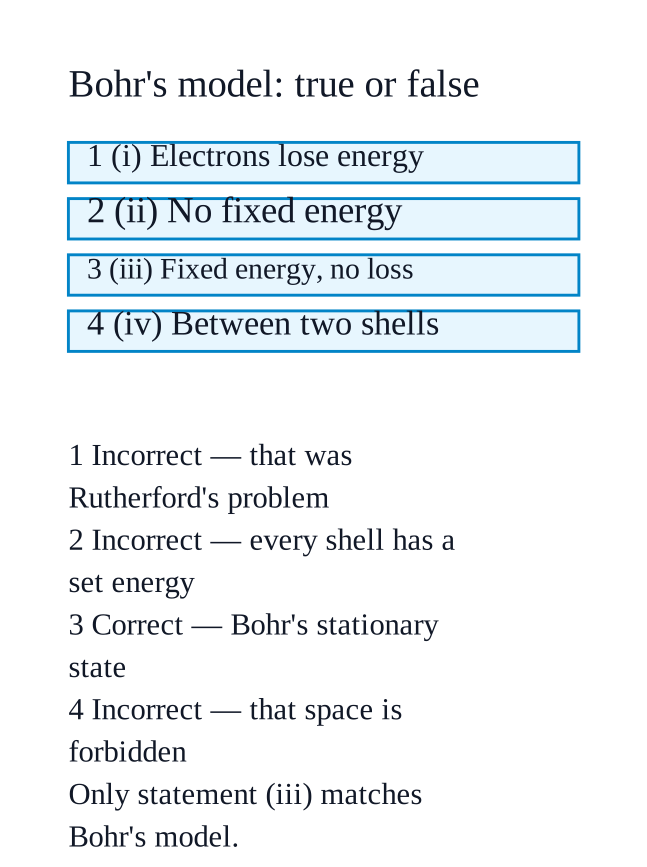
    Which of the following statements are correct or incorrect according to the Bohr’s atomic model? Give a reason for each statement. (i) Electrons lose energy while moving in fixed orbits and slowly fall into the nucleus. (ii) Electrons can exist anywhere around the nucleus with no fixed energy. (iii) Electrons revolve around the nucleus in orbits of fixed energy without losing energy. (iv) Electrons can be found between energy levels as they move around the nucleus.

    Not cross-checked

    NCERT prints no numerical answer for this exercise, so this working has not been cross-checked against the book.

    NCERT’s answer
    (iii)
    is correct
    Only (iii) is correct. (i), (ii) and (iv) are all incorrect.
    NCERT_Solution_Class9_Science_Ch8_RRR_Q8-2
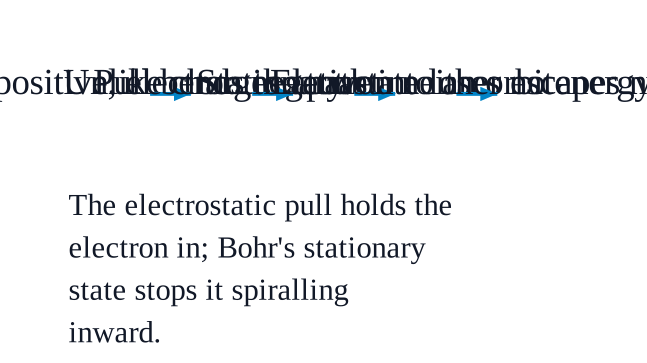
    (i) Incorrect — Bohr's model says the opposite. In a fixed orbit, a stationary state, the electron's energy stays constant and it does not lose energy, so it never spirals in. The spiralling problem belonged to Rutherford's model, and Bohr's model exists precisely to remove it.
    (ii) Incorrect — electrons cannot exist just anywhere. Each shell (K, L, M, N ... or \(\displaystyle n = 1, 2, 3, 4 ...\)) has a definite energy, and an electron must occupy one of them.
    (iii) Correct — this is Bohr's stationary-state postulate exactly: electrons revolve in orbits of fixed energy without losing energy. It is what explains why atoms are stable and do not collapse.
    (iv) Incorrect — the space between two shells is forbidden. An electron changes shell only by absorbing or releasing a fixed amount of energy equal to the difference between the two levels; it is never found in between.
  3. Exercise 8.3

    The composition of the nuclei of three atomic species X, Y, and Z are given as follows. Number of protons Number of neutrons Explain the relation between the following: (i) Y and Z (ii) Z and X

    Not cross-checked

    NCERT prints no numerical answer for this exercise, so this working has not been cross-checked against the book.

    NCERT’s answer
    (i)
    Isotopes (ii) Isobars
    (i) Y and Z are isotopes. (ii) Z and X are isobars.
    NCERT_Solution_Class9_Science_Ch8_RRR_Q8-3
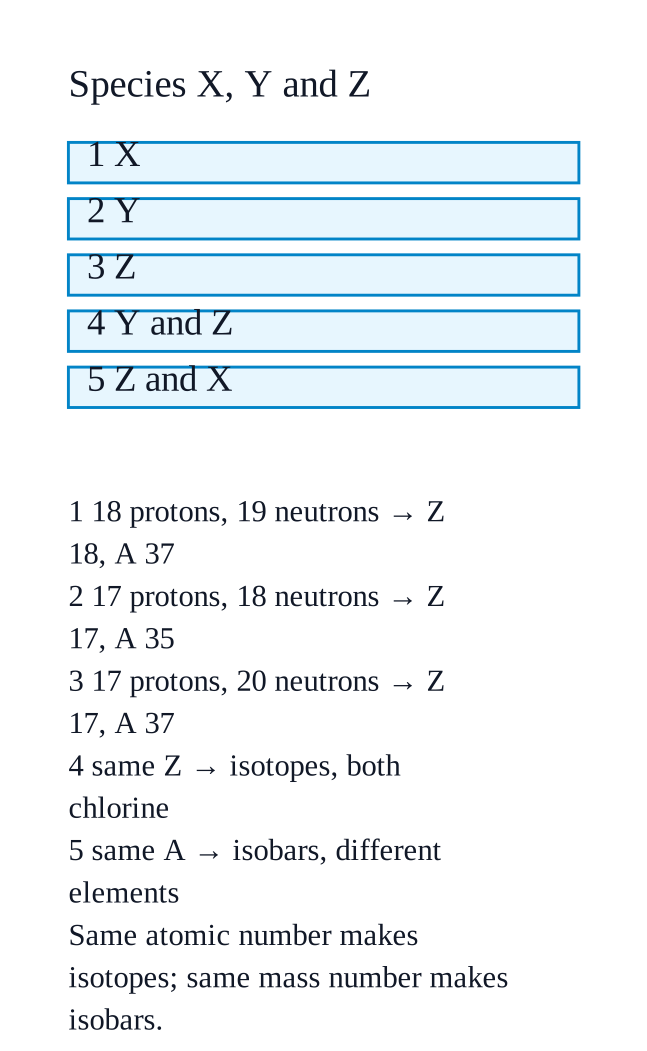
    First work out the atomic number and mass number of each species, using \(\displaystyle Z = \text{protons}\) and \(\displaystyle A = \text{protons} + \text{neutrons}\):
    X: atomic number \(\displaystyle = 18\), mass number \(\displaystyle = 18 + 19 = 37\)
    Y: atomic number \(\displaystyle = 17\), mass number \(\displaystyle = 17 + 18 = 35\)
    Z: atomic number \(\displaystyle = 17\), mass number \(\displaystyle = 17 + 20 = 37\)
    (i) Y and Z both have $\displaystyle 17$ protons, so the same atomic number, but mass numbers $\displaystyle 35$ and 37. Same \(\displaystyle Z\), different \(\displaystyle A\) → isotopes. They are the same element (chlorine), with the same electronic configuration and so the same chemical properties.
    (ii) Z and X both have mass number $\displaystyle 37$, but atomic numbers $\displaystyle 17$ and 18. Same \(\displaystyle A\), different \(\displaystyle Z\) → isobars. Because the atomic number differs, these are different elements.
  4. Exercise 8.4

    What conclusion did Rutherford draw about the position and characteristics of the atom’s positively charged part based on the few alpha particles that bounced back or were deflected at large angles in the gold foil experiment?

    Not cross-checked

    NCERT prints no numerical answer for this exercise, so this working has not been cross-checked against the book.

    Rutherford concluded that the positive charge is not spread through the atom at all, but packed into a tiny, dense centre he called the nucleus.
    NCERT_Solution_Class9_Science_Ch8_RRR_Q8-4
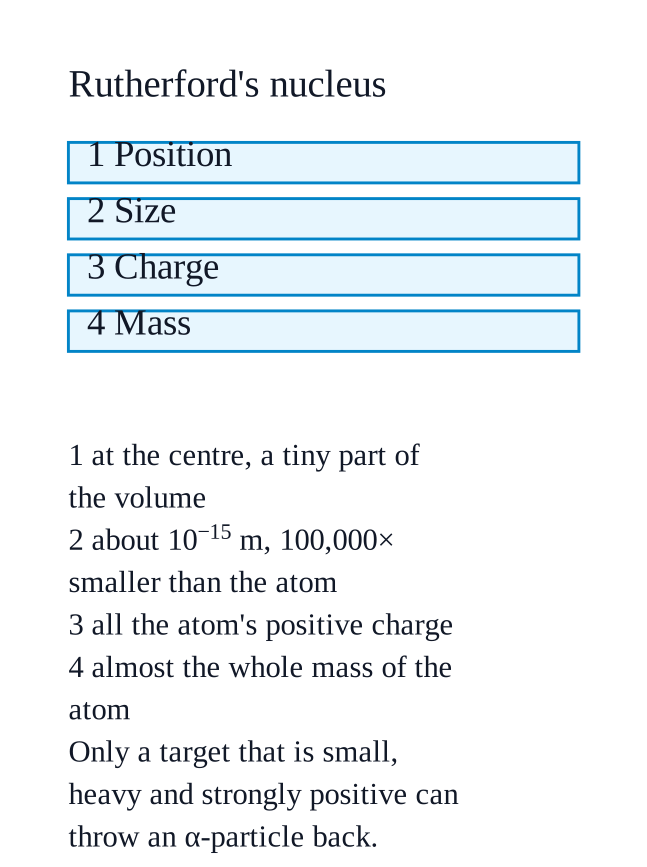
    Position — at the centre of the atom, occupying an extremely small part of its volume.
    Size — diameter about \(\displaystyle 10^{-15}\ \text{m}\), against an atom's \(\displaystyle 10^{-10}\ \text{m}\); that is roughly \(\displaystyle 10^{5}\) times smaller than the atom itself.
    Charge — it carries all the positive charge of the atom, concentrated enough to repel an approaching α-particle violently.
    Mass — it is dense, holding almost the entire mass of the atom.
    Why the bounce-backs prove this: an α-particle is itself positive, fast and heavy, so only a near head-on approach to a small region of large positive charge and large mass can push it straight back the way it came.
    Why so few bounced back: such a target is a very small mark to hit. Most α-particles missed it completely and went straight through, which is what shows that the rest of the atom is empty space.
  5. Exercise 8.5

    Explain and arrange the following statements in the correct chronological order to show how atomic models have evolved over time. (i) Bohr’s model proposed that electrons move in fixed orbits around the nucleus, each with a definite energy. (ii) Thomson’s model depicted the atom as a ʻplum puddingʼ with electrons embedded in a sphere of positive charge. (iii) Rutherford’s model proposed that atoms have a dense central nucleus. (iv) Dalton’s model described atoms as indivisible particles.

    Not cross-checked

    NCERT prints no numerical answer for this exercise, so this working has not been cross-checked against the book.

    Correct chronological order: (iv) → (ii) → (iii) → (i).
    NCERT_Solution_Class9_Science_Ch8_RRR_Q8-5
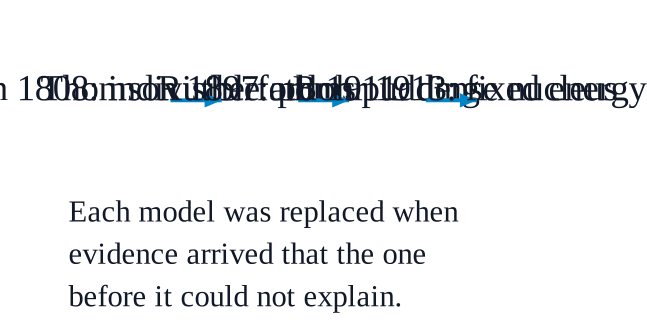
    (iv) Dalton, $\displaystyle 1808$ — all matter is made of indivisible particles called atoms, the fundamental building blocks that cannot be broken down. The first scientific description of matter, and the starting point for everything after it.
    (ii) Thomson, after his $\displaystyle 1897$ discovery of the electron — cathode-ray work showed atoms contain smaller negative particles, so atoms are not indivisible. To keep the atom neutral he placed electrons inside a sphere of positive charge: the plum pudding model.
    (iii) Rutherford, $\displaystyle 1911$ — the gold foil experiment showed most α-particles pass straight through while a few are thrown sharply back. The positive charge and most of the mass must therefore sit in a dense central nucleus, with the rest of the atom empty.
    (i) Bohr, $\displaystyle 1913$ — Rutherford's orbiting electrons should have lost energy and spiralled in. Bohr fixed this by allowing only certain shells of definite energy, in which an electron moves without losing energy — which explains why atoms are stable.
    Each step was forced by the failure of the one before it: this is how the chapter shows science moving forward, keeping what works and repairing what does not.
  6. Exercise 8.6

    Electrons move around the nucleus in orbits. Why do they not fly away from the atom? Explain what keeps them attracted to the nucleus.

    Not cross-checked

    NCERT prints no numerical answer for this exercise, so this working has not been cross-checked against the book.

    They are held in by the electrostatic force of attraction between the negatively charged electron and the positively charged nucleus.
    NCERT_Solution_Class9_Science_Ch8_RRR_Q8-6
    The nucleus contains protons, which carry positive charge; the electron carries negative charge. Unlike charges attract, so the electron is continuously pulled towards the centre.
    That inward pull is what bends the electron's path into a closed orbit instead of letting it fly off in a straight line.
    To actually escape the atom, an electron would have to be supplied with enough energy from outside to overcome this attraction.
    The opposite worry — that the pull should make the electron fall into the nucleus — is answered by Bohr: in a stationary state the electron keeps a fixed amount of energy and loses none while moving.
    With no energy lost, the electron neither escapes outward nor spirals inward. It stays in its shell, and can change only by absorbing or releasing a fixed amount of energy to jump to another shell.
  7. Exercise 8.7

    Assertion (A):  The discovery of subatomic particles helped in understanding the atomic structure. Reason (R): The number of electrons is equal to the number of protons in an atom. Choose the correct option: (i) Both A and R are true, and R is the correct explanation of A. (ii) Both A and R are true, but R is not the correct explanation of A. (iii) A is true, but R is false. (iv) A is false, but R is true.

    Not cross-checked

    NCERT prints no numerical answer for this exercise, so this working has not been cross-checked against the book.

    NCERT’s answer
    (ii)
    (ii) Both A and R are true, but R is not the correct explanation of A.
    NCERT_Solution_Class9_Science_Ch8_RRR_Q8-7
    A is true — the electron (Thomson, $\displaystyle 1897$), the proton (Rutherford) and the neutron (Chadwick, $\displaystyle 1932$) are exactly the particles out of which atomic structure is built. Each discovery forced a better model.
    R is true as well — in a neutral atom the number of electrons equals the number of protons: helium has $\displaystyle 2$ and $\displaystyle 2$, sodium has $\displaystyle 11$ and 11.
    But R is only one particular fact about two of those particles. It does not say why discovering subatomic particles advanced our understanding of atomic structure.
    Indeed R cannot explain A, because the neutron — one of the three discoveries — has nothing to do with the electron-proton balance at all.
    Both statements true, R not the explanation → option (ii).
  8. Exercise 8.8

    Magnesium is essential for many biological processes, including muscle contraction. For an atom of magnesium with a mass number of 24\displaystyle 24 and atomic number 12\displaystyle 12, determine the number of (i) protons, (ii) neutrons, (iii) electrons, and also illustrate the arrangement of electrons in a magnesium atom.
    NCERT’s answer
    (i)
    Protons $\displaystyle 12$ (ii) Neutrons $\displaystyle 12$ (iii) Electrons $\displaystyle 12$; Electronic configuration $\displaystyle 2$, $\displaystyle 8$, $\displaystyle 2$
    (i) protons \(\displaystyle = 12\) (ii) neutrons \(\displaystyle = 12\) (iii) electrons \(\displaystyle = 12\)
    NCERT_Solution_Class9_Science_Ch8_RRR_Q8-8
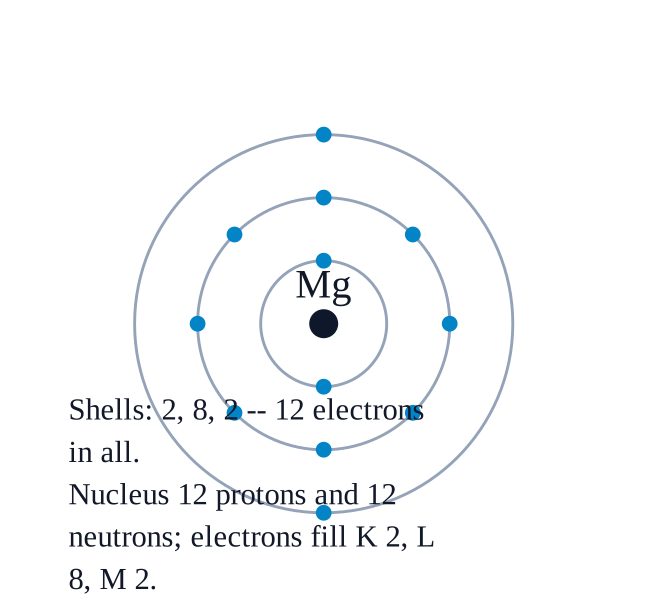
    (i) Atomic number \(\displaystyle Z = 12\), and \(\displaystyle Z\) is the number of protons → $\displaystyle 12$ protons.
    (ii) \(\displaystyle \text{neutrons} = A - Z = 24 - 12 = 12\) → $\displaystyle 12$ neutrons.
    (iii) A magnesium atom is electrically neutral, so electrons \(\displaystyle =\) protons \(\displaystyle = \) $\displaystyle 12$ electrons.
    Electronic configuration: fill K first (maximum \(\displaystyle 2\times1^{2} = 2\)), then L (maximum \(\displaystyle 2\times2^{2} = 8\)), and the $\displaystyle 2$ left over go into M → $\displaystyle 2$, $\displaystyle 8$, $\displaystyle 2$.
    What your drawing must contain:
    a small circle at the centre for the nucleus, labelled inside with "$\displaystyle 12$ p, $\displaystyle 12$ n";
    three concentric circles drawn around it, labelled K (n = $\displaystyle 1$), L (n = $\displaystyle 2$) and M (n = $\displaystyle 3$), with K nearest the nucleus;
    $\displaystyle 2$ dots on the K circle, $\displaystyle 8$ dots on the L circle, $\displaystyle 2$ dots on the M circle — check that \(\displaystyle 2 + 8 + 2 = 12\);
    the $\displaystyle 2$ electrons on the outermost M shell marked as the valence electrons;
    a title, "Magnesium, \(\displaystyle ^{24}_{12}\text{Mg}\)".
  9. Exercise 8.9

    Find the following information for the elements shown in Fig. 8.17\displaystyle 8.17: (i) Name of the element (ii) Symbol (iii) Total number of electrons (iv) Number of valence electrons (v) Valency of the element (vi) Number of protons (vii) Atomic number (a)NCERT_Question_Class9_Science_Ch8_RRR_Q8-9
    NCERT’s answer
    (i)
    Lithium; (ii) Li; (iii) $\displaystyle 3$; (iv) $\displaystyle 1$; (v) $\displaystyle 1$; (vi) $\displaystyle 3$; (vii) $\displaystyle 3$ (b) (i) Nitrogen; (ii) N; (iii) $\displaystyle 7$; (iv) $\displaystyle 5$; (v) $\displaystyle 3$; (vi) $\displaystyle 7$; (vii) $\displaystyle 7$ (c) (i) Aluminium; (ii) Al; (iii) $\displaystyle 13$; (iv) $\displaystyle 3$; (v) $\displaystyle 3$; (vi) $\displaystyle 13$; (vii) $\displaystyle 13$ (d) (i) Fluorine; (ii) F; (iii) $\displaystyle 9$; (iv) $\displaystyle 7$; (v) $\displaystyle 1$; (vi) $\displaystyle 9$; (vii) $\displaystyle 9$
    The four shell diagrams in Fig. $\displaystyle 8.17$ carry $\displaystyle 3$, $\displaystyle 7$, $\displaystyle 13$ and $\displaystyle 9$ electrons respectively, and everything asked follows from those counts.
    (a) Lithium — (i) lithium; (ii) Li; (iii) $\displaystyle 3$ electrons, arranged $\displaystyle 2$, $\displaystyle 1$; (iv) $\displaystyle 1$ valence electron; (v) valency $\displaystyle 1$; (vi) $\displaystyle 3$ protons; (vii) atomic number $\displaystyle 3$.
    (b) Nitrogen — (i) nitrogen; (ii) N; (iii) $\displaystyle 7$ electrons, arranged $\displaystyle 2$, $\displaystyle 5$; (iv) $\displaystyle 5$ valence electrons; (v) valency $\displaystyle 3$; (vi) $\displaystyle 7$ protons; (vii) atomic number $\displaystyle 7$.
    (c) Aluminium — (i) aluminium; (ii) Al; (iii) $\displaystyle 13$ electrons, arranged $\displaystyle 2$, $\displaystyle 8$, $\displaystyle 3$; (iv) $\displaystyle 3$ valence electrons; (v) valency $\displaystyle 3$; (vi) $\displaystyle 13$ protons; (vii) atomic number $\displaystyle 13$.
    (d) Fluorine — (i) fluorine; (ii) F; (iii) $\displaystyle 9$ electrons, arranged $\displaystyle 2$, $\displaystyle 7$; (iv) $\displaystyle 7$ valence electrons; (v) valency $\displaystyle 1$; (vi) $\displaystyle 9$ protons; (vii) atomic number $\displaystyle 9$.
    How the valencies were fixed: fewer than four valence electrons → the atom loses them (Li loses $\displaystyle 1$, so valency $\displaystyle 1$; Al loses $\displaystyle 3$, so valency $\displaystyle 3$).
    More than four valence electrons → the atom gains enough to complete its octet (N gains \(\displaystyle 8 - 5 = 3\), so valency $\displaystyle 3$; F gains \(\displaystyle 8 - 7 = 1\), so valency $\displaystyle 1$).
    Protons and atomic number are equal to the electron count in each case, because a neutral atom has as many protons as electrons.
  10. Exercise 8.10

    Both Rutherford’s and Bohr’s models have electrons orbiting the nucleus. Why did Rutherford’s model fail to explain atomic stability, while Bohr’s model succeeded?

    Not cross-checked

    NCERT prints no numerical answer for this exercise, so this working has not been cross-checked against the book.

    Rutherford had no answer to the accelerating electron; Bohr blocked the problem by postulating stationary states.
    NCERT_Solution_Class9_Science_Ch8_RRR_Q8-10
    Why Rutherford's model failed: an electron moving in a circular path is constantly changing direction, which means it is accelerating.
    An accelerating charged particle loses energy. As it lost energy the electron would spiral inward and eventually fall into the nucleus.
    Every atom would then collapse — but real atoms are stable, which is why the matter around us stays intact. So the model had to be incomplete.
    Why Bohr's model succeeded: he allowed the electron only certain fixed circular paths, the stationary states or shells K, L, M, N ... (\(\displaystyle n = 1, 2, 3, 4 ...\)).
    He postulated that while an electron moves in one of these shells its energy stays constant, even though it is in motion — it radiates no energy at all.
    With no energy lost there is no spiral and no collapse. The electron changes only by absorbing or releasing a fixed amount of energy to jump between allowed shells.
    Worth noting honestly: Bohr did not prove this, he assumed it as a postulate; it was accepted because it explained many experimental observations. Later work showed even Bohr's model is not entirely correct.