SolveItClass 9 · NCERT

NCERT Solutions · Class 9 Science Journey Inside the Atom

33 questions · 19 still being checked

Pause and Ponder 8.1–8.10 (part 1 of 4)

  1. Exercise 8.1

    Suppose you made up your own ‘atom’, as Thomson described, using clay for the positive charge and small beads for the electrons spread through it. What will happen if: (i) the positive charge on the clay is lesser than the total negative charge of the beads? (ii) by mistake, the clay itself carries a bit of negative charge? Would your model still represent a neutral atom?

    Not cross-checked

    NCERT prints no numerical answer for this exercise, so this working has not been cross-checked against the book.

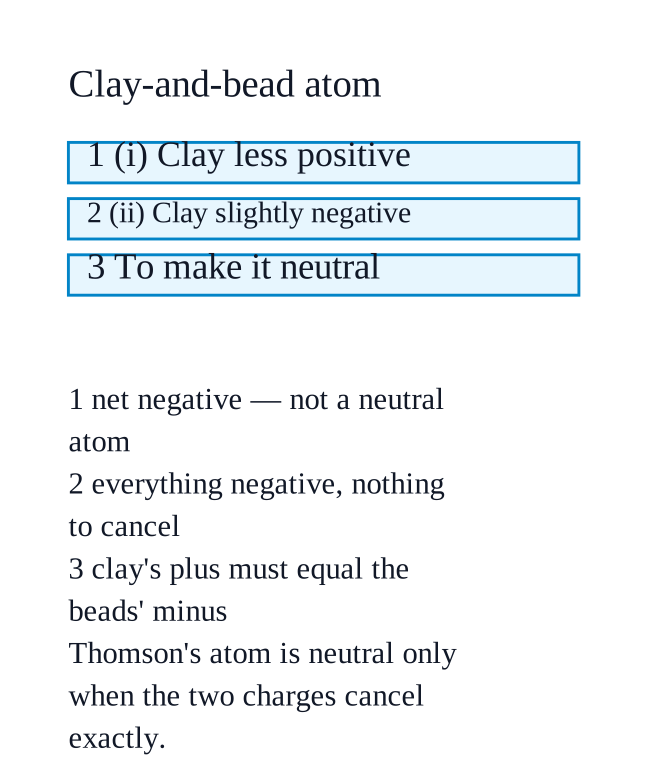
    (i) The model would carry a net negative charge — it would no longer stand for a neutral atom.
    NCERT_Solution_Class9_Science_Ch8_PP_Q8-1
    Thomson's atom is neutral only because the positive charge of the sphere exactly cancels the total negative charge of the electrons inside it.
    With less positive charge on the clay than the beads carry between them, some negative charge is left unbalanced.
    What you would be showing is a negatively charged particle, not an atom.
    (ii) No — it would still not represent a neutral atom.
    If the clay itself is a bit negative, then everything in the model is negative: negative clay plus negative beads, with nothing positive to cancel either.
    It also destroys Thomson's central idea, which needs a sphere of positive charge for the electrons to be embedded in.
    To repair the model, the clay must carry a positive charge exactly equal in size to the total negative charge on all the beads.
  2. Exercise 8.2

    Could an orange or a lemon, which also contain seeds inside soft pulp, be a good comparison? In what ways does it match Thomson’s idea and where does it fall short?

    Not cross-checked

    NCERT prints no numerical answer for this exercise, so this working has not been cross-checked against the book.

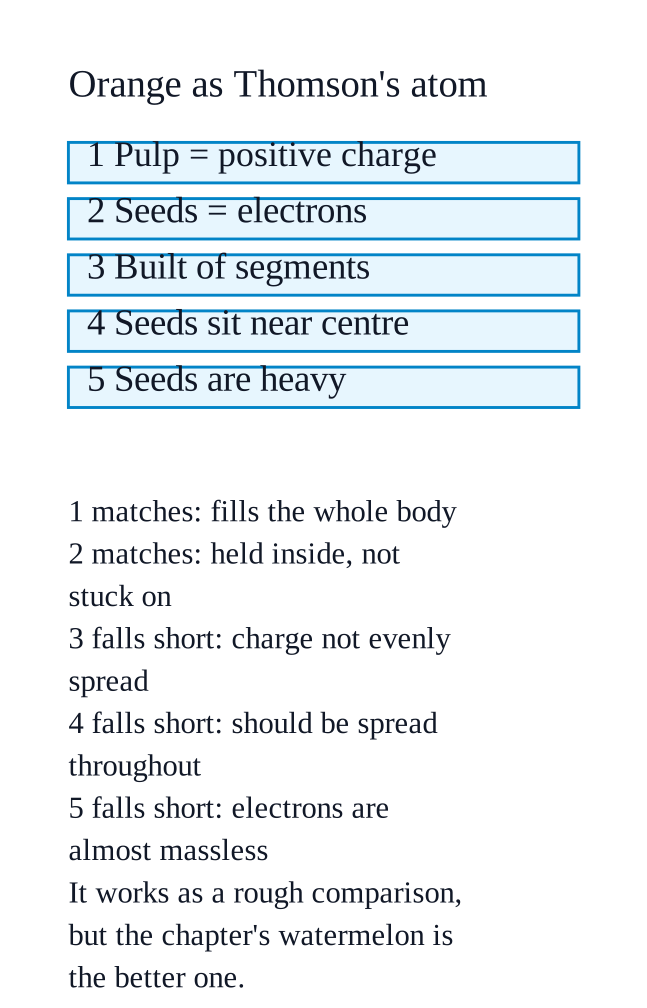
    Yes, it works as a rough comparison, but it is a weaker one than the watermelon the chapter uses.
    NCERT_Solution_Class9_Science_Ch8_PP_Q8-2
    Where it matches: the soft pulp plays the part of the positively charged matter that fills the whole atom.
    Where it matches: the seeds play the part of the electrons, held inside that matter rather than stuck on the outside.
    Where it matches: the fruit is a single round body, like Thomson's single sphere.
    Where it falls short: an orange is built of segments, so its pulp is not the smooth, evenly spread positive charge Thomson imagined.
    Where it falls short: the seeds sit in a few fixed places near the centre, whereas Thomson's electrons are spread throughout the sphere.
    Where it falls short: the seeds are heavy compared with the pulp, while an electron's mass is almost negligible compared with the atom.
    Where it falls short: no part of a fruit is charged at all, so it cannot show the balance of positive against negative charge — which is the entire point of the model.
  3. Exercise 8.3

    Why did Thomson conclude that electrons are present in all atoms? 8.2.2\displaystyle 8.2.2 Testing Thomson’s model: The gold foil experiment In 1911\displaystyle 1911, Geiger and Marsden, working under Ernest Rutherford, tested Thomson’s model of the atom through what became famous as the gold foil experiment. They aimed a narrow beam of alpha particles at an extremely thin sheet of gold foil. Alpha (symbol α) particles are tiny, positively charged particles emitted from certain radioactive elements. Later in this chapter, you will learn that an alpha particle is actually a nucleus of a helium atom containing two protons and two neutrons. According to Thomson’s model, the positive charge in the atom was spread out evenly. So they expected the alpha particles to pass straight through the gold foil or be deflected only slightly. But to their surprise, while most particles passed through undeflected, some were sharply deflected (Fig. 8.4\displaystyle 8.4), and a few even bounced back. This deflection from the straight path is called scattering. Hence, the gold foil experiment is also called an α-ray scattering experiment. T homson’s model failed to explain the results of the gold foil experiment, particularly the deflection of some α-particles through large angles and that most of the α-particles passed undeflected.NCERT_Question_Class9_Science_Ch8_PP_Q8-3

    Not cross-checked

    NCERT prints no numerical answer for this exercise, so this working has not been cross-checked against the book.

    Because cathode rays turned out to be exactly the same whatever atoms they came from.
    Thomson changed the material of the cathode and changed the gas filled in the tube, and the nature of the cathode rays did not change.
    In every case the rays were streams of negatively charged particles with a mass much smaller than that of an atom.
    These particles were being emitted out of atoms, so they had to be inside them to begin with.
    Since identical particles came out of every element tried, the electron must be a fundamental component of all atoms, not a feature of one particular substance.
  4. Exercise 8.4

    What do you think would happen if α-particles were replaced with negatively charged particles in Rutherford’s gold foil experiment?

    Not cross-checked

    NCERT prints no numerical answer for this exercise, so this working has not been cross-checked against the book.

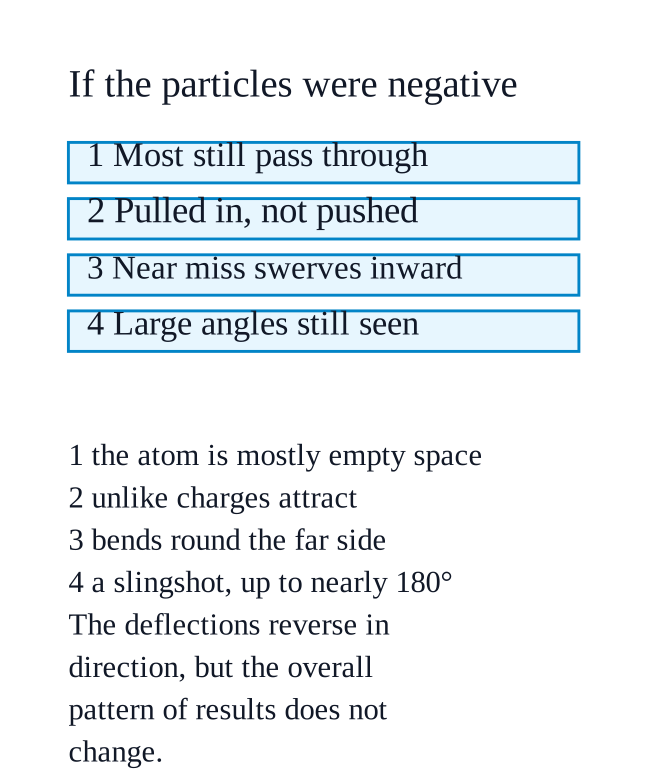
    The deflections would reverse in direction: negative particles would be pulled towards the nucleus instead of being pushed away from it.
    NCERT_Solution_Class9_Science_Ch8_PP_Q8-4
    The nucleus is positively charged. It repels a positive α-particle, but unlike charges attract, so it would attract a negative particle.
    Most particles would still pass straight through, because the atom is mostly empty space — that part of the result would not change at all.
    The few that came close to a nucleus would swerve inward, bending round the far side of it, instead of being pushed outward from the near side.
    Large-angle scattering, right up to nearly \(\displaystyle 180^\circ\), would still be seen. A particle aimed almost straight at the nucleus is whipped tightly around it and comes back out roughly the way it came — a slingshot, the way a comet swinging past the Sun is turned right around by attraction.
    For the same off-centre aim, an attracting nucleus turns a particle through the same angle as a repelling one; only the side it passes on differs. So the experiment would still show a tiny, dense, charged nucleus in a mostly empty atom.
    The atom's electrons would repel them slightly, but electrons have far too little mass to deflect a fast particle by much.
  5. Exercise 8.5

    Rutherford found that a few α-particles bounced back sharply. How does this single surprising result completely rule out Thomson’s ʻplum pudding modelʼ of the atom?

    Not cross-checked

    NCERT prints no numerical answer for this exercise, so this working has not been cross-checked against the book.

    Because a thinly spread positive charge can never turn a fast α-particle around — and thin spreading is the whole of Thomson's model.
    NCERT_Solution_Class9_Science_Ch8_PP_Q8-5
    In the plum pudding model the positive charge is smeared evenly over the entire atom, so an α-particle crossing it meets only a weak push at any one point.
    The embedded electrons cannot do it either: they are negative (so they attract, not repel) and far too light to reverse a heavy α-particle.
    To send a fast, massive, positively charged particle straight back, it must run almost head-on into something that is very small, very massive and strongly positive all at once.
    So even one bounce-back is fatal evidence: it proves such a concentrated centre exists, and Thomson's model contains no such thing anywhere.
    This single observation is what forced the idea of the nucleus.
  6. Exercise 8.6

    If you could ask Rutherford one question about his work, what would it be?

    Not cross-checked

    NCERT prints no numerical answer for this exercise, so this working has not been cross-checked against the book.

    This asks for your own question, so there is no single answer — but the chapter tells you where the good questions are.
    "Why did you take the few α-particles that bounced back seriously, instead of writing them off as experimental error?" — they were rare, yet they carried the entire discovery.
    "How did you decide the nucleus is positively charged, rather than merely small and heavy?"
    "You found the nucleus to be about \(\displaystyle 10^{5}\) times smaller than the atom — what convinced you that the atom really is that empty?"
    "Your model could not explain why atoms are stable. Did you already know this when you proposed it in $\displaystyle 1911$?"
    "Why did you have Geiger and Marsden fire the particles at gold foil in particular?"
    A strong question points either at something the chapter says his model could not explain, or at how he read evidence that others might have discarded.
  7. Exercise 8.7

    Assertion (A): Rutherford concluded that most of the mass of an atom is concentrated in a small region at the centre called the nucleus. Reason (R): According to Thomson’s model, electrons are embedded in a uniformly distributed positive charge sphere. Choose the correct option: (i) Both A and R are true, and R is the correct explanation of A. (ii) Both A and R are true, but R is not the correct explanation of A. (iii) A is true, but R is false. (iv) A is false, but R is true.

    Not cross-checked

    NCERT prints no numerical answer for this exercise, so this working has not been cross-checked against the book.

    NCERT’s answer
    (ii)
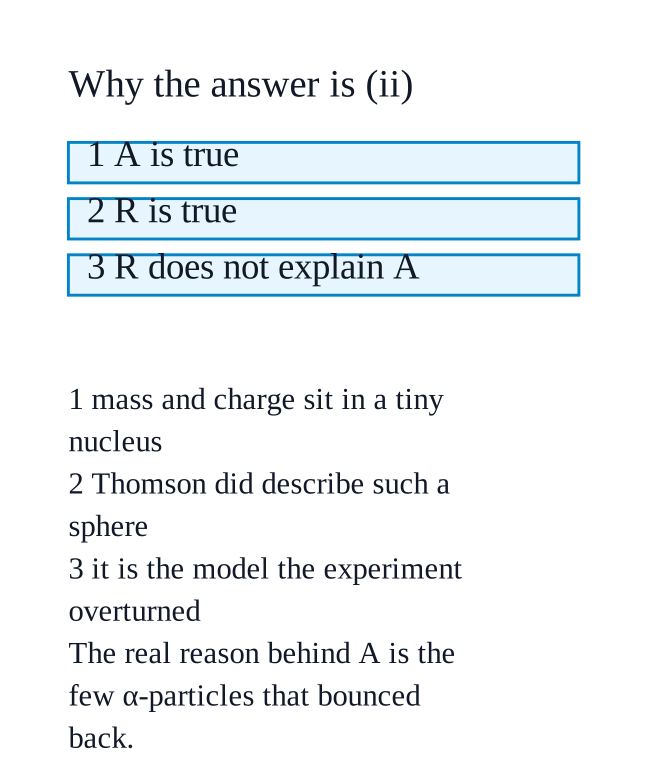
    (ii) Both A and R are true, but R is not the correct explanation of A.
    NCERT_Solution_Class9_Science_Ch8_PP_Q8-7
    A is true: from the gold foil experiment Rutherford concluded that the positive charge and most of the mass are concentrated in a tiny central region, the nucleus.
    R is also true: Thomson's model really does describe electrons embedded in a uniformly distributed sphere of positive charge.
    But R describes the older model that this experiment overturned. It gives no reason at all for Rutherford's conclusion.
    The real reason behind A is the observation that a few α-particles were deflected through large angles and a few bounced back.
    So both statements stand on their own, but R does not explain A — which is option (ii).
  8. Exercise 8.8

    Imagine you are a scientist who has discovered a new element. Name this element after yourself and justify that the symbol you have chosen follows the IUPAC rules.

    Not cross-checked

    NCERT prints no numerical answer for this exercise, so this working has not been cross-checked against the book.

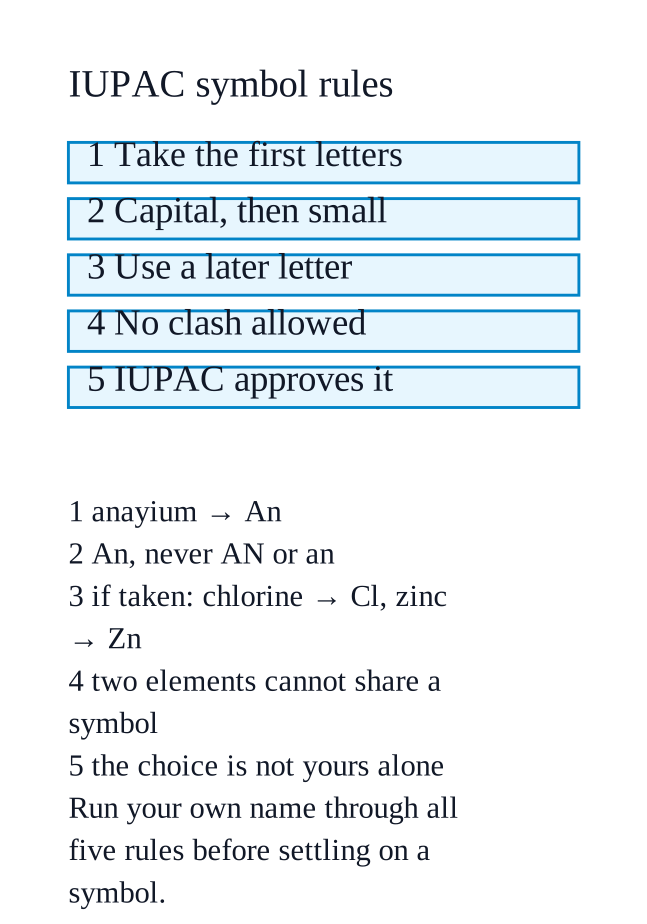
    Worked example: a student named Anaya discovers an element, names it anayium, and chooses the symbol An.
    NCERT_Solution_Class9_Science_Ch8_PP_Q8-8
    Rule $\displaystyle 1$ — the symbol is taken from the first letters of the name: Anayium gives An. ✓
    Rule $\displaystyle 2$ — the first letter is a capital and the second is small: An, never AN or an (just as cobalt is Co, not CO). ✓
    Rule $\displaystyle 3$ — if those first two letters are already in use, take the first letter with a later letter of the name instead, the way chlorine gives Cl and zinc gives Zn; so "Ay" or "Ai" would be the fallback here. Not "Am" — that is already americium. ✓
    Rule $\displaystyle 4$ — the symbol must not clash with an existing element's symbol, or the same two letters would stand for two elements at once. ✓
    Rule $\displaystyle 5$ — the choice is not yours alone to make final: IUPAC approves the names and symbols of all elements internationally.
    Now repeat this with your own name and check your symbol against the same five points.
  9. Exercise 8.9

    What problems could arise if every scientist used different symbols for the same element?

    Not cross-checked

    NCERT prints no numerical answer for this exercise, so this working has not been cross-checked against the book.

    The core problem: scientists would no longer understand one another.
    The same element would be written differently in different countries and languages, so a formula or equation written in one place could not be read in another — the very language barrier that symbols were invented to cross.
    Worse, one symbol could stand for two different elements, so a written formula would be genuinely ambiguous rather than merely unfamiliar.
    Results could not be checked, compared or repeated by other laboratories, which is how science is supposed to work.
    Textbooks, data tables and research papers would all need translating before use, wasting effort and introducing errors.
    In medicine, industry and the laboratory a mistaken element is not a small error — it can be dangerous.
    This is exactly why names and symbols are internationally agreed and approved by IUPAC, so that one symbol means one element everywhere.
  10. Exercise 8.10

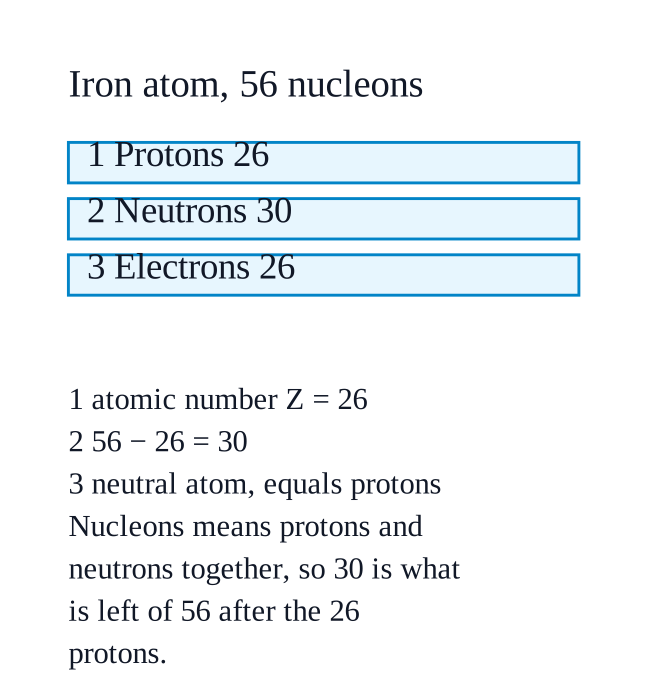
    An atom with an atomic number of 26\displaystyle 26 has 56\displaystyle 56 nucleons. Find out its number protons and neutrons.
    NCERT’s answer
    Electrons $\displaystyle 26$; Protons $\displaystyle 26$; Neutrons $\displaystyle 30$
    Electrons $\displaystyle 26$, protons $\displaystyle 26$, neutrons 30.
    NCERT_Solution_Class9_Science_Ch8_PP_Q8-10
    Atomic number \(\displaystyle Z = 26\), and \(\displaystyle Z\) is the number of protons, so protons \(\displaystyle = 26\).
    The atom is electrically neutral, so electrons \(\displaystyle =\) protons \(\displaystyle = 26\).
    Nucleons means protons and neutrons together, so the mass number is \(\displaystyle A = 56\).
    \(\displaystyle \text{neutrons} = A - Z = 56 - 26 = 30\)
    (This is iron, which the chapter lists as having $\displaystyle 26$ protons and $\displaystyle 30$ neutrons.)