SolveItClass 9 · NCERT

NCERT Solutions · Class 9 Science How Forces Affect Motion

26 questions · 19 still being checked

Revise, Reflect, Refine 6.11–6.16 (part 18 of 18)

  1. Exercise 6.11

    The velocity-time graph of an object of mass 10\displaystyle 10 kg moving along a straight line is shown in Fig. 6.41. Calculate the force acting on the object by using the graph.NCERT_Question_Class9_Science_Ch6_RRR_Q6-11
    NCERT’s answer
    $\displaystyle 25$ N
    The force acting on the object is $\displaystyle 25$ N, in the direction of motion.
    The velocity-time graph is a straight line inclined to the time axis, so the acceleration is constant.
    From the graph the velocity increases by \(\displaystyle 20\ \text{m s}^{-1} \) in \(\displaystyle 8\ \text{s} \) (the line rises from \(\displaystyle 10\ \text{m s}^{-1} \) to \(\displaystyle 30\ \text{m s}^{-1} \) between \(\displaystyle t = 0\ \text{s} \) and \(\displaystyle t = 8\ \text{s} \)).
    Acceleration = slope of the line:
    \(\displaystyle a = \dfrac{v - u}{t} = \dfrac{30\ \text{m s}^{-1} - 10\ \text{m s}^{-1}}{8\ \text{s}} = 2.5\ \text{m s}^{-2} \)
    By Newton's second law:
    \(\displaystyle F = ma = 10\ \text{kg} \times 2.5\ \text{m s}^{-2} = 25\ \text{kg m s}^{-2} = 25\ \text{N} \)
  2. Exercise 6.12

    A bullet of mass 50\displaystyle 50 g moving with a speed of 100\displaystyle 100 m s1\displaystyle s^{-1} enters a heavy stationary wooden block and stops after penetrating a distance of 50\displaystyle 50 cm. Estimate the stopping force acting on the bullet (assume that the bullet undergoes constant acceleration within the block).
    NCERT’s answer
    $\displaystyle 500$ N in the direction opposite to the motion
    The stopping force is $\displaystyle 500$ N, acting opposite to the bullet's motion.
    NCERT_Solution_Class9_Science_Ch6_RRR_Q6-12
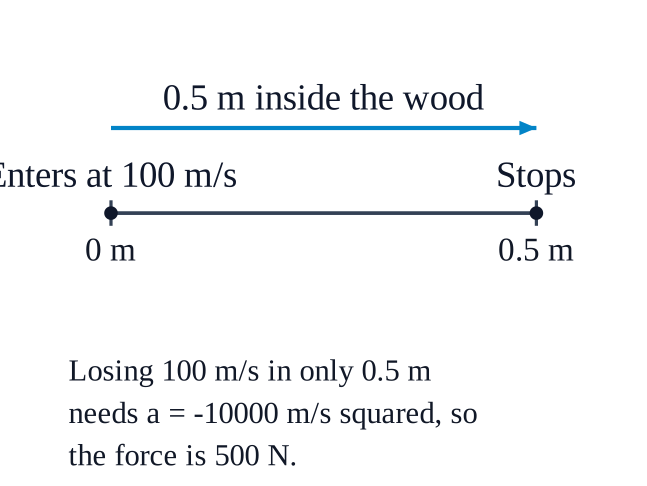
    Convert to SI units: \(\displaystyle m = 50\ \text{g} = 0.05\ \text{kg} \), \(\displaystyle s = 50\ \text{cm} = 0.5\ \text{m} \), \(\displaystyle u = 100\ \text{m s}^{-1} \), \(\displaystyle v = 0\ \text{m s}^{-1} \).
    Find the acceleration from the kinematic equation \(\displaystyle v^{2} = u^{2} + 2as \):
    \(\displaystyle 0 = (100\ \text{m s}^{-1})^{2} + 2 \times a \times 0.5\ \text{m} \)
    \(\displaystyle a = -\dfrac{10000\ \text{m}^{2}\text{s}^{-2}}{1\ \text{m}} = -10000\ \text{m s}^{-2} \)
    Now use Newton's second law:
    \(\displaystyle F = ma = 0.05\ \text{kg} \times (-10000\ \text{m s}^{-2}) = -500\ \text{N} \)
    The negative sign shows the force is directed opposite to the motion — it is the wooden block resisting the bullet. Its magnitude is \(\displaystyle 500\ \text{N} \).
  3. Exercise 6.13

    An ace footballer converted a penalty shot by kicking the football with a speed of 108\displaystyle 108 km h1\displaystyle h^{-1}. The estimated force they imparted was 800\displaystyle 800 N. The mass of the football was 0.4\displaystyle 0.4 kg. Calculate the time of contact between their foot and the ball.
    NCERT’s answer
    0.$\displaystyle 015$ s
    The time of contact is $\displaystyle 0.015$ s.
    NCERT_Solution_Class9_Science_Ch6_RRR_Q6-13
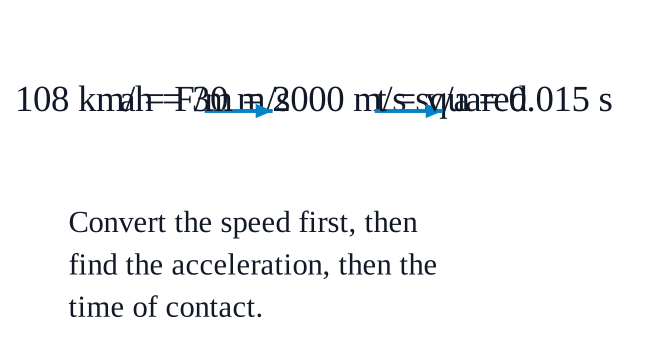
    Convert the speed to SI units: \(\displaystyle 108\ \text{km h}^{-1} = 108 \times \dfrac{1000\ \text{m}}{3600\ \text{s}} = 30\ \text{m s}^{-1} \).
    Find the acceleration of the ball from Newton's second law:
    \(\displaystyle a = \dfrac{F}{m} = \dfrac{800\ \text{N}}{0.4\ \text{kg}} = 2000\ \text{m s}^{-2} \)
    The ball starts from rest, \(\displaystyle u = 0\ \text{m s}^{-1} \), and reaches \(\displaystyle v = 30\ \text{m s}^{-1} \). Using \(\displaystyle v = u + at \):
    \(\displaystyle 30\ \text{m s}^{-1} = 0 + (2000\ \text{m s}^{-2}) \times t \)
    \(\displaystyle t = \dfrac{30}{2000}\ \text{s} = 0.015\ \text{s} \)
  4. Exercise 6.14

    An object of mass 2\displaystyle 2 kg moving with a constant velocity of 10\displaystyle 10 m s1\displaystyle s^{-1} encounters a rough patch where the force of friction on the object is 7\displaystyle 7 N. At the same time, an additional constant force of 3\displaystyle 3 N opposing the motion is applied on the object. After entering the rough patch, how much distance does the object travel before coming to rest?
    NCERT’s answer
    $\displaystyle 10$ m a a
    The object travels $\displaystyle 10$ m before coming to rest.
    NCERT_Solution_Class9_Science_Ch6_RRR_Q6-14
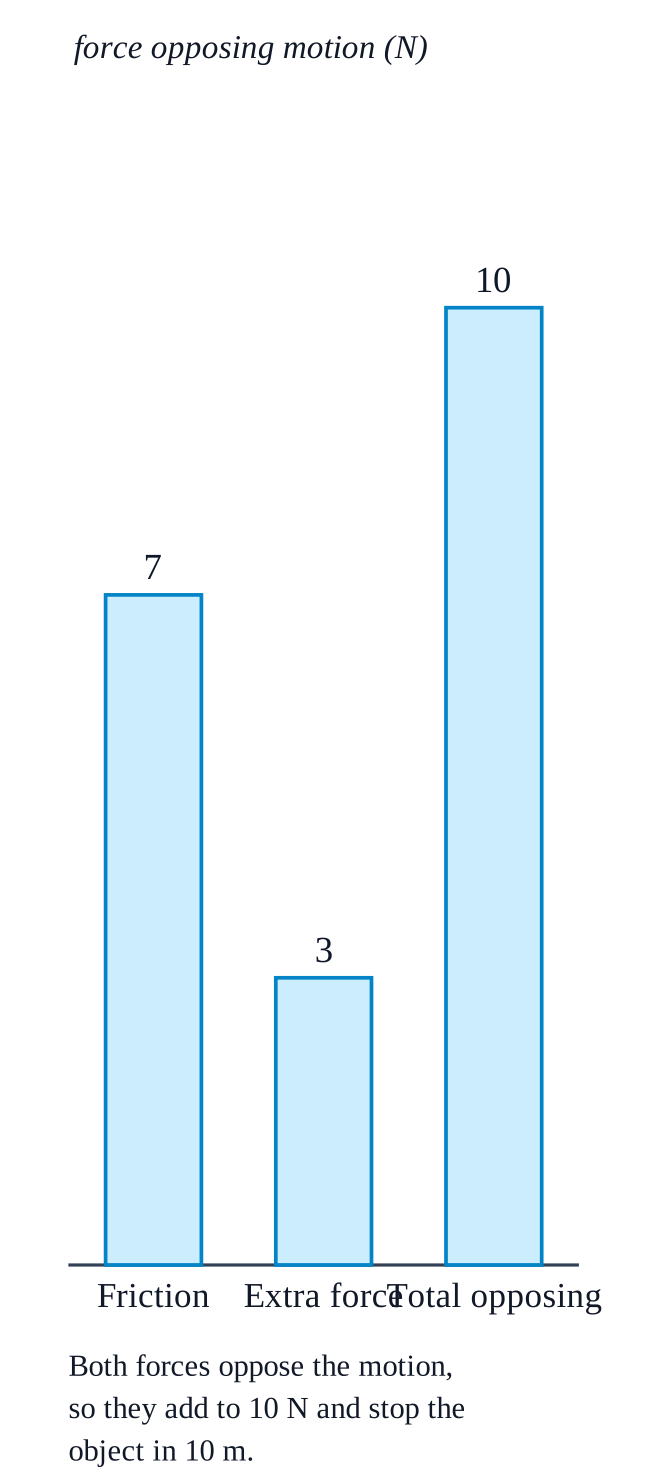
    Both the friction and the extra applied force oppose the motion, so they act in the same direction and add:
    \(\displaystyle F_{\text{net}} = 7\ \text{N} + 3\ \text{N} = 10\ \text{N} \), directed opposite to the motion.
    Acceleration from Newton's second law:
    \(\displaystyle a = \dfrac{F}{m} = \dfrac{-10\ \text{N}}{2\ \text{kg}} = -5\ \text{m s}^{-2} \) (negative because it opposes the motion, i.e. a retardation)
    With \(\displaystyle u = 10\ \text{m s}^{-1} \) and \(\displaystyle v = 0\ \text{m s}^{-1} \), use \(\displaystyle v^{2} = u^{2} + 2as \):
    \(\displaystyle 0 = (10\ \text{m s}^{-1})^{2} + 2 \times (-5\ \text{m s}^{-2}) \times s \)
    \(\displaystyle s = \dfrac{100}{10}\ \text{m} = 10\ \text{m} \)
  5. Exercise 6.15

    A tractor pulls a harrow (a ploughing tool) of mass m1\displaystyle m_{1} with a net force F resulting in an acceleration of a1\displaystyle a_{1}. The same tractor pulls a trolley of mass m2\displaystyle m_{2} with a force F producing an acceleration of a2\displaystyle a_{2}. If the tractor now pulls the trolley with the harrow placed on it (with the same force F ), then obtain an expression for the resulting acceleration in terms of a1\displaystyle a_{1} and a2\displaystyle a_{2}. Ignore friction.
    NCERT’s answer
    $\displaystyle 1$ $\displaystyle 2$ + a a $\displaystyle 1$ $\displaystyle 2$
    The resulting acceleration is \(\displaystyle a = \dfrac{a_{1}a_{2}}{a_{1}+a_{2}} \).
    NCERT_Solution_Class9_Science_Ch6_RRR_Q6-15
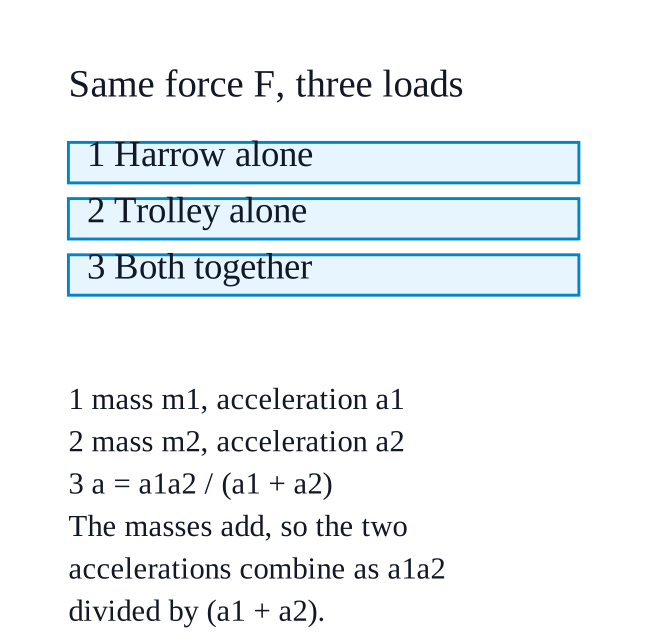
    From Newton's second law applied to the harrow alone: \(\displaystyle F = m_{1}a_{1} \), so \(\displaystyle m_{1} = \dfrac{F}{a_{1}} \).
    For the trolley alone: \(\displaystyle F = m_{2}a_{2} \), so \(\displaystyle m_{2} = \dfrac{F}{a_{2}} \).
    With the harrow placed on the trolley, treat the two as a single system of mass \(\displaystyle m_{1} + m_{2} \) pulled by the same external force \(\displaystyle F \):
    \(\displaystyle a = \dfrac{F}{m_{1}+m_{2}} = \dfrac{F}{\dfrac{F}{a_{1}} + \dfrac{F}{a_{2}}} \)
    Cancelling \(\displaystyle F \): \(\displaystyle a = \dfrac{1}{\dfrac{1}{a_{1}} + \dfrac{1}{a_{2}}} = \dfrac{a_{1}a_{2}}{a_{1}+a_{2}} \)
    Check: if \(\displaystyle a_{1} = a_{2} = a_{0} \) (equal masses), then \(\displaystyle a = \dfrac{a_{0}^{2}}{2a_{0}} = \dfrac{a_{0}}{2} \) — half the acceleration for twice the mass, as expected.
  6. Exercise 6.16

    When the pole of a bar magnet is brought close to a magnetic compass, the bar magnet and the compass needle (which is also a magnet) exert a magnetic force on each other. As per Newton’s third law of motion, both the forces are equal in magnitude and opposite in direction. However, the compass needle moves, whereas the bar magnet does not move (Fig. 6.42\displaystyle 6.42). Explain why.NCERT_Question_Class9_Science_Ch6_RRR_Q6-16

    Not cross-checked

    NCERT prints no numerical answer for this exercise, so this working has not been cross-checked against the book.

    Because equal forces do not produce equal accelerations when the masses differ — and because the bar magnet is also held back by friction.
    Newton's third law fixes only the forces: the magnet pulls the needle and the needle pulls the magnet with forces equal in magnitude, \(\displaystyle F \).
    The acceleration each one gets follows from Newton's second law, \(\displaystyle a = \dfrac{F}{m} \), so it depends on mass.
    The compass needle is a very light, thin magnet balanced on a nearly frictionless pivot, so the small force \(\displaystyle F \) gives it a large acceleration and it swings visibly.
    The bar magnet is much more massive, so the same \(\displaystyle F \) gives it an extremely small acceleration; in addition it rests on a surface, where friction easily balances such a small force, so it stays put.
    This is the same reasoning as Example $\displaystyle 6.7$: the fruit falls to the Earth while the Earth's motion towards the fruit is far too small to notice.