SolveItClass 9 · NCERT

NCERT Solutions · Class 9 Science How Forces Affect Motion

26 questions · 19 still being checked

Revise, Reflect, Refine 6.1–6.10 (part 2 of 3)

  1. Exercise 6.1

    Using a horizontal force F, a table is moved across the floor at a constant velocity. How much is the frictional force exerted by the floor on the table?

    Not cross-checked

    NCERT prints no numerical answer for this exercise, so this working has not been cross-checked against the book.

    NCERT’s answer
    F in the direction opposite to the applied force.
    The frictional force is \(\displaystyle F \), acting in the direction opposite to the applied force.
    NCERT_Solution_Class9_Science_Ch6_RRR_Q6-1
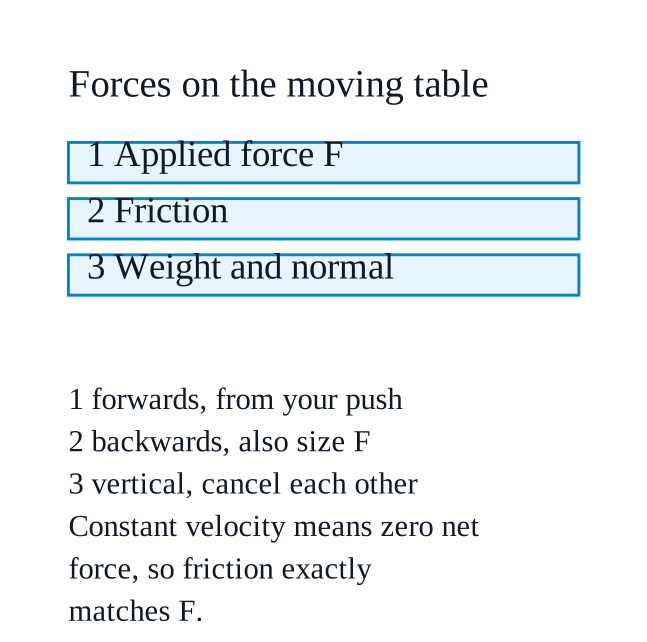
    The table moves at constant velocity, so its acceleration is zero.
    By Newton's first law, zero acceleration means the net force on the table is zero.
    Only two horizontal forces act — the applied force \(\displaystyle F \) forwards and friction backwards — so they must be balanced.
    Hence force of friction \(\displaystyle = F \), directed backwards, opposite to the motion.
    (The weight and the normal force are vertical and balance each other separately.)
  2. Exercise 6.2

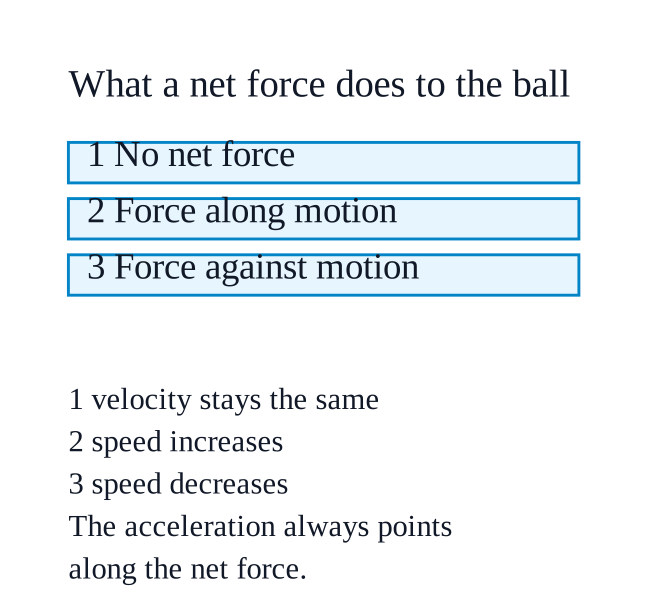
    For a ball moving on a smooth frictionless surface, choose the appropriate option that will make the following statements physically correct. (i) If no net force is applied on the ball, the velocity of the ball will remain the same/increase/decrease. (ii) If a net force is applied on the ball in the direction of its motion, the magnitude of the velocity of the ball will remain the same/ increase/decrease. (iii) If a net force is applied on the ball in a direction opposite to the direction of its motion, the magnitude of the velocity of the ball will remain the same/increase/decrease.

    Not cross-checked

    NCERT prints no numerical answer for this exercise, so this working has not been cross-checked against the book.

    NCERT’s answer
    (i)
    same (ii) increase (iii) decrease
    (i) remain the same. With no net force, Newton's first law says the ball keeps moving with a constant velocity.
    NCERT_Solution_Class9_Science_Ch6_RRR_Q6-2
    (ii) increase. The acceleration is along the net force, i.e. along the motion, so the velocity grows in magnitude.
    (iii) decrease. The acceleration is opposite to the motion, so the velocity falls in magnitude (the ball slows down).
  3. Exercise 6.3

    Two blocks P and Q on a smooth horizontal surface are shown in acting in opposite directions on block P, while block Q is moving with a constant velocity. Which of the following statement is correct? (i) P experiences a net force and Q does not experience a net force. (ii) P does not experience a net force and Q experiences a net force. (iii) Both P and Q experience a net force. (iv) Neither P nor Q experiences a net force.

    Not cross-checked

    NCERT prints no numerical answer for this exercise, so this working has not been cross-checked against the book.

    NCERT’s answer
    (i)
    Correct statement: (i) P experiences a net force and Q does not experience a net force.
    NCERT_Solution_Class9_Science_Ch6_RRR_Q6-3
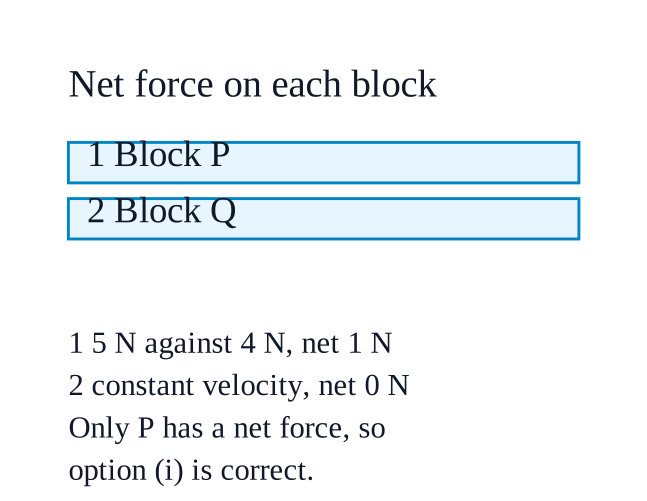
    On P the two forces are opposite and unequal, so the net force is the difference of their magnitudes: \(\displaystyle 5\ \text{N} - 4\ \text{N} = 1\ \text{N} \), directed along the $\displaystyle 5$ N force.
    A non-zero net force means P is accelerating.
    Q moves with a constant velocity, so its acceleration is zero and by Newton's first law the net force on Q is \(\displaystyle 0\ \text{N} \).
    Hence P has a net force, Q does not — option (i).
  4. Exercise 6.4

    While practising for the snake boat race (Vallum kalli in Kerala), 100\displaystyle 100 oarsmen are rowing a boat together. Out of these, 95\displaystyle 95 row backwards to propel the boat forward. But by mistake, 5\displaystyle 5 oarsmen row in the opposite direction. If each oarsman applies a horizontal force of 200\displaystyle 200 N, what is the net force on the snake boat? (Ignore drag forces, air friction, etc.)
    NCERT’s answer
    $\displaystyle 18,000$ N in the forward direction
    Net force \(\displaystyle = \) $\displaystyle 18,000$ N in the forward direction.
    NCERT_Solution_Class9_Science_Ch6_RRR_Q6-4
    The $\displaystyle 95$ oarsmen rowing correctly push the boat forward with a total force \(\displaystyle = 95 \times 200\ \text{N} = 19{,}000\ \text{N} \).
    The $\displaystyle 5$ oarsmen rowing the wrong way push it backward with \(\displaystyle 5 \times 200\ \text{N} = 1{,}000\ \text{N} \).
    These are opposite in direction, so the net force is their difference, along the larger force:
    \(\displaystyle F_{\text{net}} = 19{,}000\ \text{N} - 1{,}000\ \text{N} = 18{,}000\ \text{N} \), forward.
  5. Exercise 6.5

    When a net force acts on an object, we observe that the object accelerates: (i) opposite to the direction of force, with acceleration proportional to the force acting on the object. (ii) opposite to the direction of force, with acceleration proportional to the mass of the object. (iii) in the direction of force, with acceleration inversely proportional to the force acting on the object. (iv) in the direction of force, with acceleration proportional to the force acting on the object.

    Not cross-checked

    NCERT prints no numerical answer for this exercise, so this working has not been cross-checked against the book.

    NCERT’s answer
    (iv)
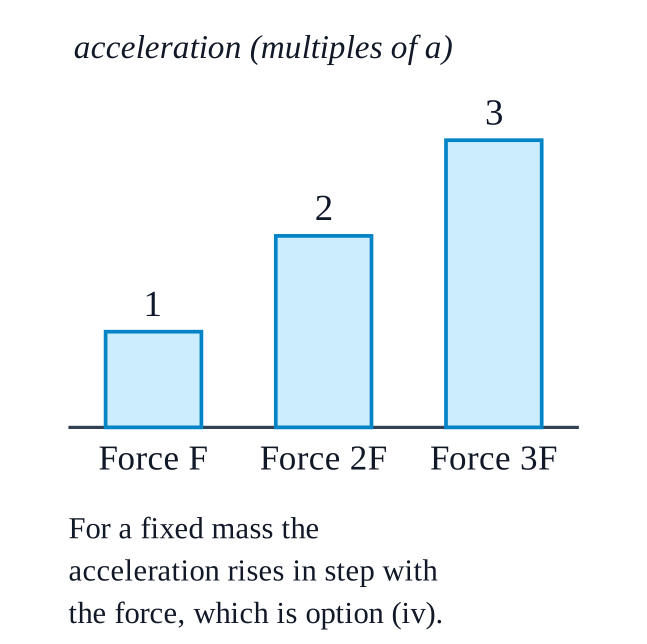
    Correct option: (iv) in the direction of force, with acceleration proportional to the force acting on the object.
    NCERT_Solution_Class9_Science_Ch6_RRR_Q6-5
    Newton's second law: the object accelerates in the direction of the net force, which rules out (i) and (ii).
    The magnitude of the acceleration is proportional to the net force, \(\displaystyle a \propto F \), which rules out (iii)'s "inversely proportional to the force".
    It is the mass that appears inversely, \(\displaystyle a = \dfrac{F}{m} \).
  6. Exercise 6.6

    The position-time graph for four objects A, B, C and D moving along a straight line are given in Fig. 6.37. A net force acts on: (i) Object A (ii) Object B (iii) Object C (iv) Object D Position 0\displaystyle 0 Time Object ANCERT_Question_Class9_Science_Ch6_RRR_Q6-6

    Not cross-checked

    NCERT prints no numerical answer for this exercise, so this working has not been cross-checked against the book.

    NCERT’s answer
    (iii)
    A net force acts on (iii) Object C.
    On a position-time graph, the slope is the velocity.
    A straight line means the slope, and hence the velocity, is constant — a horizontal line means the object is at rest, a sloping line means constant velocity. In both cases the acceleration is zero, so by Newton's first law the net force is zero (this is exactly Fig. 6.15a and Fig. 6.16a).
    A curved line means the slope keeps changing, so the velocity is changing, the object is accelerating and a net force must be acting.
    In Fig. $\displaystyle 6.37$ only the graph of Object C is curved, so C is the one experiencing a net force.
  7. Exercise 6.7

    A sailor jumps out from a small boat to the shore (Fig. 6.38\displaystyle 6.38). As the sailor jumps forward, will the boat move? If yes, in which direction and why.NCERT_Question_Class9_Science_Ch6_RRR_Q6-7

    Not cross-checked

    NCERT prints no numerical answer for this exercise, so this working has not been cross-checked against the book.

    Yes, the boat moves — backwards, i.e. away from the shore, opposite to the sailor's jump.
    To jump forward the sailor's feet push backwards on the boat.
    By Newton's third law, the boat simultaneously pushes the sailor forward with an equal and opposite force, which is what launches him towards the shore.
    The two forces of this pair act on different objects — one on the boat, one on the sailor — so they do not cancel each other.
    The backward force on the boat is a net force on it (water offers little resistance), so by \(\displaystyle F = ma \) the boat accelerates backwards.
    Because the boat is small, its mass is not very large, so the backward push gives it a noticeable acceleration — which is why jumping from a small boat is tricky.
  8. Exercise 6.8

    During a high jump event, a landing mat or sand bed is placed for the athlete to fall upon (Fig. 6.39\displaystyle 6.39). Explain the reason behind it.NCERT_Question_Class9_Science_Ch6_RRR_Q6-8

    Not cross-checked

    NCERT prints no numerical answer for this exercise, so this working has not been cross-checked against the book.

    The mat or sand bed increases the time taken to bring the athlete to rest, which reduces the force acting on them.
    On landing, the athlete's downward velocity must fall to zero.
    A soft mat or sand compresses under the athlete, so this change of velocity is spread over a longer time interval.
    A longer time for the same change in velocity means a smaller magnitude of acceleration.
    By Newton's second law \(\displaystyle F = ma \), a smaller acceleration means a smaller force on the athlete's body, so the risk of injury drops.
    On hard ground the stop would be almost instant, the acceleration huge and the force large enough to cause injury — the same reasoning as for airbags in vehicles (Fig. $\displaystyle 6.19$).
  9. Exercise 6.9

    A hand cart loaded with vegetables collides with an identical but empty hand cart. During the collision: (i) the loaded cart exerts a force of larger magnitude on the empty cart. (ii) the empty cart exerts a force of larger magnitude on the loaded cart. (iii) neither cart exerts a force on the other. (iv) the loaded cart and the empty cart, both exert an equal magnitude of force on each other.

    Not cross-checked

    NCERT prints no numerical answer for this exercise, so this working has not been cross-checked against the book.

    NCERT’s answer
    (iv)
    Correct option: (iv) the loaded cart and the empty cart both exert an equal magnitude of force on each other.
    NCERT_Solution_Class9_Science_Ch6_RRR_Q6-9
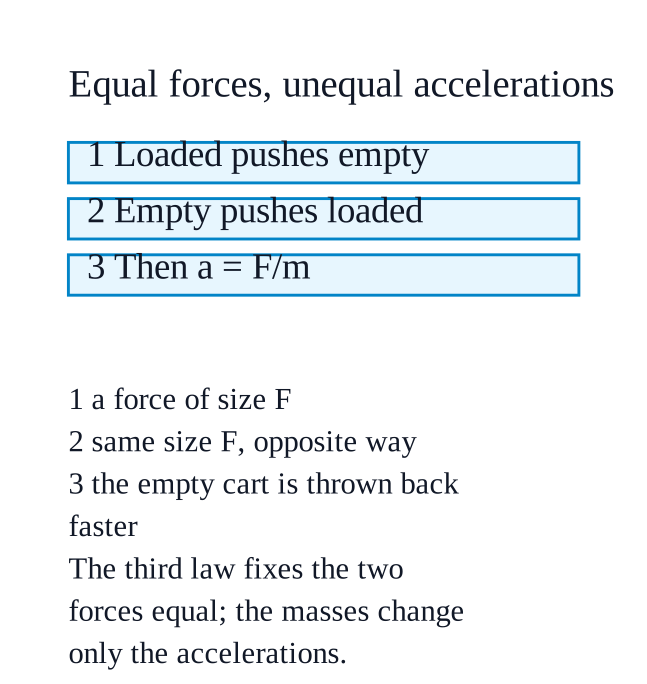
    By Newton's third law, whenever one object exerts a force on a second object, the second exerts an equal and opposite force on the first.
    This holds no matter how the masses differ — the loading of the cart does not change the size of either force.
    What the masses do change is the acceleration: from \(\displaystyle a = \dfrac{F}{m} \), the lighter empty cart is thrown back much faster than the loaded one, even though the forces are equal (the same point as Example $\displaystyle 6.7$ and Example $\displaystyle 6.8$).
  10. Exercise 6.10

    The acceleration-mass graph for the acceleration produced by a force on objects of different masses is plotted in Fig. 6.40. Plot the force-mass graph for this case. Acceleration (m s2\displaystyle s^{-2}) 10.0\displaystyle 10.0NCERT_Question_Class9_Science_Ch6_RRR_Q6-10

    Not cross-checked

    NCERT prints no numerical answer for this exercise, so this working has not been cross-checked against the book.

    The force-mass graph is a straight line parallel to the mass axis at the constant value \(\displaystyle F = 10\ \text{N} \).
    The same force acts on every object, so from Newton's second law \(\displaystyle F = ma \) the product of mass and acceleration is the same for all the points on Fig. 6.40.
    Reading the graph: at \(\displaystyle m = 1\ \text{kg} \), \(\displaystyle a = 10\ \text{m s}^{-2} \), so \(\displaystyle F = 1\ \text{kg} \times 10\ \text{m s}^{-2} = 10\ \text{N} \).
    Check another point: at \(\displaystyle m = 2\ \text{kg} \), \(\displaystyle a = 5\ \text{m s}^{-2} \), giving \(\displaystyle F = 2 \times 5 = 10\ \text{N} \); and at \(\displaystyle m = 4\ \text{kg} \), \(\displaystyle a = 2.5\ \text{m s}^{-2} \), giving \(\displaystyle F = 4 \times 2.5 = 10\ \text{N} \).
    What to draw: mark Mass (kg) on the horizontal axis from $\displaystyle 0$ to $\displaystyle 5$ and Force (N) on the vertical axis from $\displaystyle 0$ to about 15. Plot the points $\displaystyle (1, 10)$, $\displaystyle (2, 10)$, $\displaystyle (3, 10)$, $\displaystyle (4, 10)$ and $\displaystyle (5, 10)$ and join them with a straight horizontal line. Label the line \(\displaystyle F = 10\ \text{N} \).
    The graph is horizontal because the force is the same whatever the mass — the acceleration-mass curve falls as \(\displaystyle a = \dfrac{10}{m} \) precisely so that \(\displaystyle ma \) stays fixed.