SolveItClass 9 · NCERT

NCERT Solutions · Class 9 Science How Forces Affect Motion

26 questions · 19 still being checked

Pause and Ponder 6.1–6.10 (part 1 of 3)

  1. Exercise 6.1

    A weightlifter lifts a barbell (Fig. 6.8\displaystyle 6.8). List two forces that are acting on the barbell. Are these forces balanced if the weightlifter keeps the barbell steady?NCERT_Question_Class9_Science_Ch6_PP_Q6-1

    Not cross-checked

    NCERT prints no numerical answer for this exercise, so this working has not been cross-checked against the book.

    The two forces on the barbell are the gravitational force (its weight), acting downwards, and the upward force applied by the weightlifter's hands.
    Yes — if the barbell is held steady, these two forces are balanced.
    Steady means the barbell is at rest: its velocity is zero and unchanging, so by Newton's first law the net force on it must be zero.
    Two forces balance when they are equal in magnitude and opposite in direction, so the lifter's upward push exactly equals the weight.
    For the barbell of Example $\displaystyle 6.4$ (total mass $\displaystyle 30$ kg), the weight is \(\displaystyle F = mg = 30\ \text{kg} \times 9.8\ \text{m s}^{-2} = 294\ \text{N} \) downwards, so the lifter applies \(\displaystyle 294\ \text{N} \) upwards.
  2. Exercise 6.2

    Two players R and S are participating in an arm-wrestling match (Fig. 6.9\displaystyle 6.9). At the instant, when the arms tilt to the front direction (out of the page towards you), are the forces exerted by the players balanced? If not, which player exerted the larger force? It is due to the force of friction arising between the Ready to Go Beyond For an object being pushed, apart from the applied force and the force of friction, some other forces may also be acting on it (Fig. 6.11\displaystyle 6.11). One of these is the gravitational force (weight) and the other is the force exerted by the surface on which it is placed called the normal force. The weight acts in the downwards direction, whereas the normal force acts in the upward direction perpendicular to the surface. However, the two forces are balanced. Air around the object also exerts a force of friction on the box when the box moves through the air, but in many cases its magnitude is so small that it can be neglected. For the situation shown in Fig. 6.10\displaystyle 6.10, once the box starts moving and youNCERT_Question_Class9_Science_Ch6_PP_Q6-2NCERT_Question_Class9_Science_Ch6_PP_Q6-2-2

    Not cross-checked

    NCERT prints no numerical answer for this exercise, so this working has not been cross-checked against the book.

    NCERT’s answer
    No; S
    No, the forces are not balanced — player S exerted the larger force.
    If the two players pushed with equal and opposite forces, the net force on the joined arms would be zero and the arms would stay put.
    The arms do move, so a non-zero net force acts on them.
    When two opposite forces are unequal, the net force equals the difference of their magnitudes and points along the larger force.
    The arms tilt out of the page towards you, so the larger force is the one pushing in that direction — in Fig. $\displaystyle 6.9$ that is S.
  3. Exercise 6.3

    Hold the rubber band slightly stretched between your forefinger and thumb on the wooden table top (Fig. 6.12a). Mark points A and B at its ends as shown in Fig. 6.12b. Make another mark C up to which you will stretch the rubber band. (a) on the surface, and (c) rubber band stretched back to point C with stack of 4\displaystyle 4 coinsNCERT_Question_Class9_Science_Ch6_PP_Q6-3

    Not cross-checked

    NCERT prints no numerical answer for this exercise, so this working has not been cross-checked against the book.

    NCERT’s answer
    No
    No — no net force acts on it.
    Constant velocity means the magnitude and direction of the velocity are both unchanging, so the acceleration is zero.
    Newton's first law: an object in motion continues to move with a constant velocity unless a net force acts upon it.
    Individual forces may well be acting (weight, normal force, friction, an applied push), but they cancel out, so the net force is \(\displaystyle 0\ \text{N} \).
  4. Exercise 6.4

    Holding the ends of the rubber band at A and B, place the stack of coins near the middle of A and B. Now, using a finger of your other hand, push back the stack of coins till the rubber band is pulled back to the mark C (Fig. 6.12c). Then, release the stack of coins and observe its motion. Do you find that after losing contact with the rubber band, the velocity of the stack of coins decreases gradually and it comes to rest after travelling some distance? Measure the distance travelled from C and record it. Repeat this step twice.NCERT_Question_Class9_Science_Ch6_PP_Q6-4

    Not cross-checked

    NCERT prints no numerical answer for this exercise, so this working has not been cross-checked against the book.

    NCERT’s answer
    (i)
    ; (ii)
    (i) and (ii) are possible; (iii) is not.
    (i) Possible — with zero net force an object at rest stays at rest (Newton's first law).
    (ii) Possible — an object already moving keeps moving with the same constant velocity.
    (iii) Not possible — constant acceleration \(\displaystyle a \) needs a net force \(\displaystyle F = ma \), and with \(\displaystyle F = 0\ \text{N} \) we get \(\displaystyle a = 0\ \text{m s}^{-2} \), so the object cannot be accelerating.
  5. Exercise 6.5

    Repeat steps 3\displaystyle 3 and 4\displaystyle 4 for laminated table top while ensuring that the points A, B and C are marked at the same distances as earlier. Does the stack of coins travel a larger distance than it did on the wooden table top before coming to rest? Does its velocity decrease more slowly now?

    Not cross-checked

    NCERT prints no numerical answer for this exercise, so this working has not been cross-checked against the book.

    Example: pushing a box across the floor so that it moves with a constant velocity.
    Four forces act on the box — the applied push forwards, the force of friction backwards, the weight downwards and the normal force from the floor upwards.
    The weight and the normal force are already balanced (Fig. $\displaystyle 6.11$).
    If you now push with a force exactly equal in magnitude to the force of friction, those two also balance, so the net force becomes zero even though four forces are acting.
    The box then keeps moving with constant velocity, as in Example 6.2.
    Another everyday case: a weightlifter holding a barbell steady — the upward push she adds makes the net force on the barbell zero.
    NCERT_Solution_Class9_Science_Ch6_PP_Q6-5
  6. Exercise 6.6

    Next, repeat step 5\displaystyle 5 on a horizontal polished marble or tile floor. Does the stack of coins travel an even larger distance and its velocity decrease even more slowly? What conclusion do you draw from your observations? Before you release the stack of coins, it is stationary. It means that the forces acting upon it are balanced. Upon release, the force applied by you
    NCERT’s answer
    $\displaystyle 0$ N
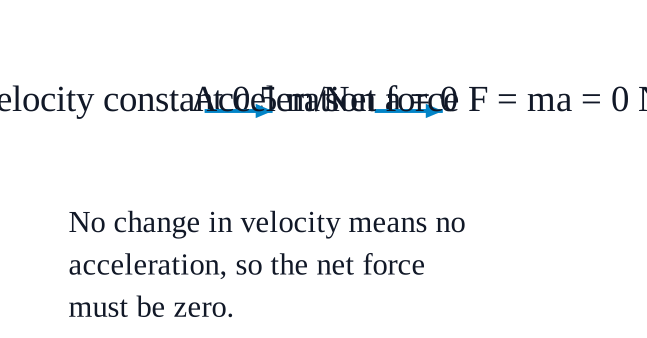
    The net force is zero, \(\displaystyle 0\ \text{N} \).
    NCERT_Solution_Class9_Science_Ch6_PP_Q6-6
    Mass \(\displaystyle m = 100\ \text{g} = 0.1\ \text{kg} \), and the velocity is constant at \(\displaystyle 0.5\ \text{m s}^{-1} \).
    Constant velocity means no change in velocity, so \(\displaystyle a = 0\ \text{m s}^{-2} \).
    By Newton's second law, \(\displaystyle F = ma = 0.1\ \text{kg} \times 0\ \text{m s}^{-2} = 0\ \text{N} \).
  7. Exercise 6.7

    Now double the mass of the cup with the objects inside it, and repeat steps 5\displaystyle 5 and 6\displaystyle 6 to record the time difference T2\displaystyle T_{2}. Using the values of the time measured, let us do some analysis. For both cases, the cart starts with zero velocity u = 0\displaystyle 0 and travels the same distance s. If a1\displaystyle a_{1} and a2\displaystyle a_{2} are the accelerations in the two cases respectively, using kinematic equation, we obtain Equating the two equations, we obtain Substituting the values of T1\displaystyle T_{1} and T2\displaystyle T_{2} , you find that when you increased the force for the same mass of the cart, the acceleration increased. You may conclude that the acceleration of an object of fixed mass increases as the net force applied on it increases. Think as a Scientist Apart from force, does acceleration depends on any other factor? From everyday experiences, you know that with the same magnitude of force, it is easier to set lighter objects in motion than heavier ones. This leads to a second hypothesis, that for the same force, a smaller mass has a larger acceleration (or a larger mass has a smaller acceleration). Now how can you test your second hypothesis? Activity 6.4\displaystyle 6.4: Let us experiment (Demonstration activity) This activity is recommended to be performed as a classroom group activity facilitated by the teacher. 1. Repeat Activity 6.3\displaystyle 6.3 with a variation. Keep the mass of the cup and objects inside it constant. Double the mass of the cart by adding more objects in it. 2. Measure the mass of the cart along with the objects inside it with a weighing scale. 3. Carry out steps 5\displaystyle 5 and 6\displaystyle 6 of Activity 6.3. Using the values of time measured, find the ratio of acceleration for these two cases. Do you find that for the same force, when you increased the mass of the cart, the acceleration decreased? This means that for a given magnitude of a force, the acceleration produced is inversely related to the mass of the object. The relation between force, mass and acceleration is expressed in the Newton’s second law, one of the most fundamental ideas in all of science. Newton’s second law of motion can be stated as: When a net force acts on an object, the object accelerates in the direction of the net force. The magnitude of the acceleration is proportional to the magnitude of the net force and is inversely proportional to the mass of the object.

    Not cross-checked

    NCERT prints no numerical answer for this exercise, so this working has not been cross-checked against the book.

    A larger force is needed for the heavier child (the one of greater mass).
    NCERT_Solution_Class9_Science_Ch6_PP_Q6-7
    Newton's second law gives \(\displaystyle F = ma \), so for the same acceleration \(\displaystyle a \) the force needed is directly proportional to the mass.
    If one child has mass \(\displaystyle m_1 \) and the other \(\displaystyle m_2 \) with \(\displaystyle m_2 > m_1 \), then \(\displaystyle F_2 = m_2 a > m_1 a = F_1 \).
    For example, to give an acceleration of \(\displaystyle 2\ \text{m s}^{-2} \) a $\displaystyle 20$ kg child needs \(\displaystyle 20 \times 2 = 40\ \text{N} \), while a $\displaystyle 40$ kg child needs \(\displaystyle 40 \times 2 = 80\ \text{N} \).
  8. Exercise 6.8

    How are glass items packed for transportation using a bubble wrap or hay protected from damage?

    Not cross-checked

    NCERT prints no numerical answer for this exercise, so this working has not been cross-checked against the book.

    Bubble wrap and hay protect glass by increasing the time over which a jolt changes the item's velocity, which reduces the force on it.
    During transport a glass item that is jolted or dropped has to be brought to rest.
    A soft, compressible packing squashes as the item pushes into it, so the velocity falls to zero over a longer time interval instead of instantly.
    A longer stopping time means a smaller magnitude of acceleration, and by \(\displaystyle F = ma \) a smaller force acts on the glass.
    Hitting a hard crate wall directly would stop the item in a very short time, needing a very large force — enough to crack it, just as the ground's large force cracks a coconut (Fig. $\displaystyle 6.20$).
    This is the same principle as a cricketer drawing their hands back while catching, and as a vehicle airbag.
    NCERT_Solution_Class9_Science_Ch6_PP_Q6-8
  9. Exercise 6.9

    Why does a fireperson sometimes struggle when holding the pipe issuing water?

    Not cross-checked

    NCERT prints no numerical answer for this exercise, so this working has not been cross-checked against the book.

    Because of Newton's third law — the pipe pushes the water forward, so the water pushes the pipe backward with an equal force.
    The hose forces a large amount of water out of the nozzle at high velocity, i.e. it exerts a large forward force on the water.
    Simultaneously the water exerts an equal and opposite force on the pipe, directed backwards.
    This backward (recoil) force tends to push the pipe out of the fireperson's hands, so they must apply a large force to hold it steady — which is a struggle.
    It is the same effect that drives the balloon in Activity $\displaystyle 6.7$ and lifts a rocket (Fig. $\displaystyle 6.30$).
    NCERT_Solution_Class9_Science_Ch6_PP_Q6-9
  10. Exercise 6.10

    Suppose a spacecraft is moving in a region of space where the gravitational force acting upon it is negligible. Suggest how can it change its velocity. You have learnt about contact and non-contact forces earlier. Is From the Newton’s second law of motion, the initial magnitudes of force = mass of gun While the initial acceleration of bullet force = mass of bullet Even though the pair of forces are equal in magnitude, the

    Not cross-checked

    NCERT prints no numerical answer for this exercise, so this working has not been cross-checked against the book.

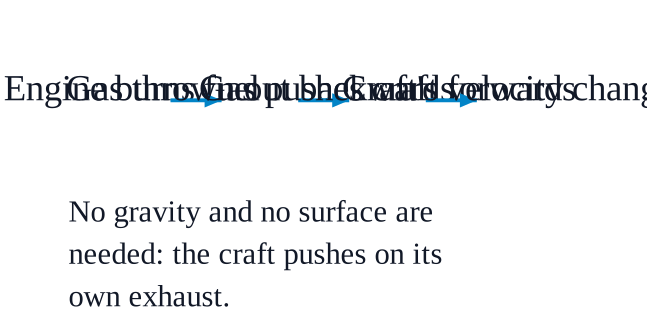
    It can change its velocity by firing its engine to expel gas, using Newton's third law.
    NCERT_Solution_Class9_Science_Ch6_PP_Q6-10
    The engine pushes exhaust gas out in one direction with a large force.
    The gas simultaneously pushes the spacecraft with an equal force in the opposite direction.
    This is an external force on the spacecraft, so by \(\displaystyle F = ma \) it produces an acceleration and the velocity changes.
    Firing the gas backwards speeds the craft up; firing it in the direction of motion slows it down — exactly what the Vikram lander of Chandrayaan-$\displaystyle 3$ did to slow for its soft landing near the Moon's south pole.
    Note that no gravitational force or contact with any surface is needed: the craft pushes on its own exhaust.