Exercise 5.2
Choose the correct options, and explain the reason for the correct and incorrect options. Which among the following mixtures show the Tyndall Effect? A mixture of: (a) air and dust particles (b) copper sulfate and water (c) starch and water (d) acetone and water (i) a and b
Not cross-checked
NCERT prints no numerical answer for this exercise, so this working has not been cross-checked against the book.
NCERT’s answer
(iii)
Option (iii) — a and c.
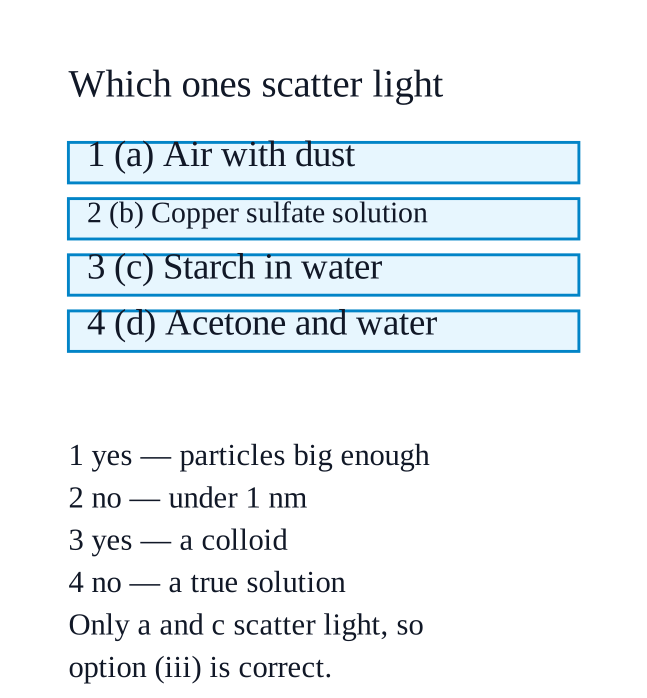
(a) Air and dust particles — shows the effect. The dust particles are large enough to scatter light, which is why a beam entering a dark room, or a stadium floodlight, becomes visible.
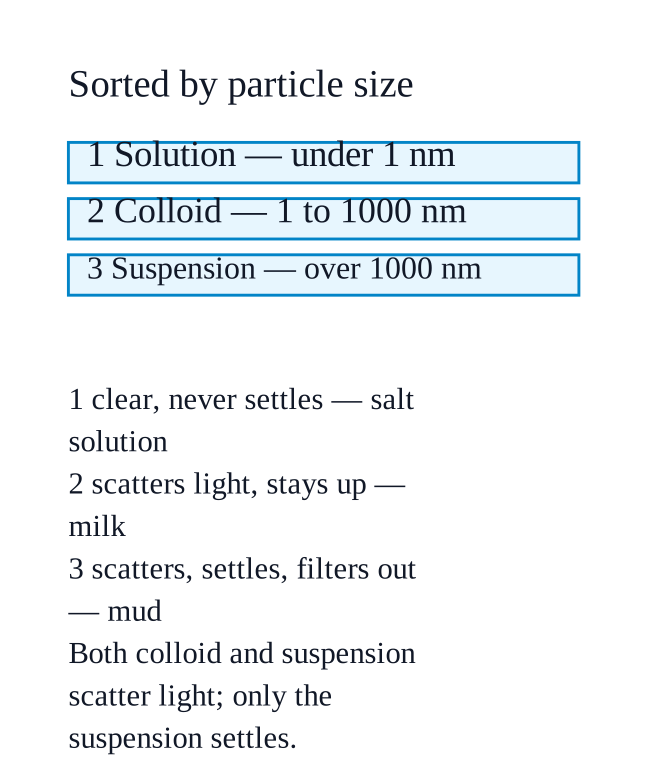
(c) Starch and water — shows the effect. Starch does not dissolve into particles smaller than $\displaystyle 1$ nm; it forms a colloid with particles in the $\displaystyle 1$–$\displaystyle 1000$ nm range, and colloidal particles scatter light.
(b) Copper sulfate and water — does not. It is a true solution with solute particles smaller than $\displaystyle 1$ nm, too small to scatter light, exactly like beaker A in Activity $\displaystyle 5.1$ where the laser path was invisible.
(d) Acetone and water — does not. These are two miscible liquids, so the mixture is a homogeneous solution and the light passes straight through.
So options (i), (ii) and (iv) all fail because each of them includes a true solution, and scattering happens in colloids and suspensions but not in transparent solutions.