Exercise 5.3
Vinegar, used as a food preservative and additive, contains % v/v acetic acid. Glacial acetic acid is a liquid, i.e., % acetic acid. If you want to make vinegar from glacial acetic acid, how would you proceed? Grade Curiosity Chapter Exploration|Grade
Not cross-checked
NCERT prints no numerical answer for this exercise, so this working has not been cross-checked against the book.
Dilute the glacial acetic acid $\displaystyle 20$ times with water — $\displaystyle 5$ mL of glacial acetic acid made up to $\displaystyle 100$ mL of solution gives $\displaystyle 5$ % v/v vinegar.
Vinegar must be $\displaystyle 5$ % v/v, i.e. \(\displaystyle \dfrac{\text{Volume of acetic acid}}{\text{Volume of solution}} \times 100 = 5 \).
For $\displaystyle 100$ mL of vinegar: \(\displaystyle \text{Volume of acetic acid} = \dfrac{5 \times 100}{100} = 5\ \text{mL} \)
For $\displaystyle 1$ litre of vinegar: \(\displaystyle \dfrac{5 \times 1000}{100} = 50\ \text{mL} \) of glacial acetic acid, water added up to the $\displaystyle 1000$ mL mark.
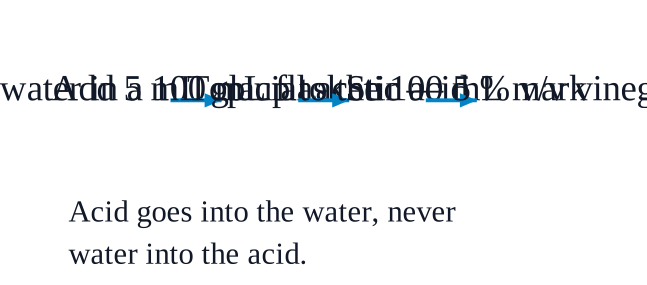
Steps: take some water in a $\displaystyle 100$ mL measuring flask, add $\displaystyle 5$ mL of glacial acetic acid to it, then add water up to the $\displaystyle 100$ mL mark and stir.
Safety first: glacial acetic acid is corrosive — measure and add it only under your teacher's supervision, and always add the acid to the water, never water to the acid.
