SolveItClass 9 · NCERT

NCERT Solutions · Class 9 Science Describing Motion Around Us

23 questions · 13 still being checked

Revise, Reflect, Refine 4.11–4.16 (part 3 of 3)

  1. Exercise 4.11

    A student said, “The Earth moves around the Sun”. In this context, discuss whether an object kept on the Earth can be considered to be at rest.

    Not cross-checked

    NCERT prints no numerical answer for this exercise, so this working has not been cross-checked against the book.

    It depends entirely on the reference point chosen — the object can be called at rest and in motion at the same time, and neither answer is wrong.
    NCERT_Solution_Class9_Science_Ch4_RRR_Q4-11
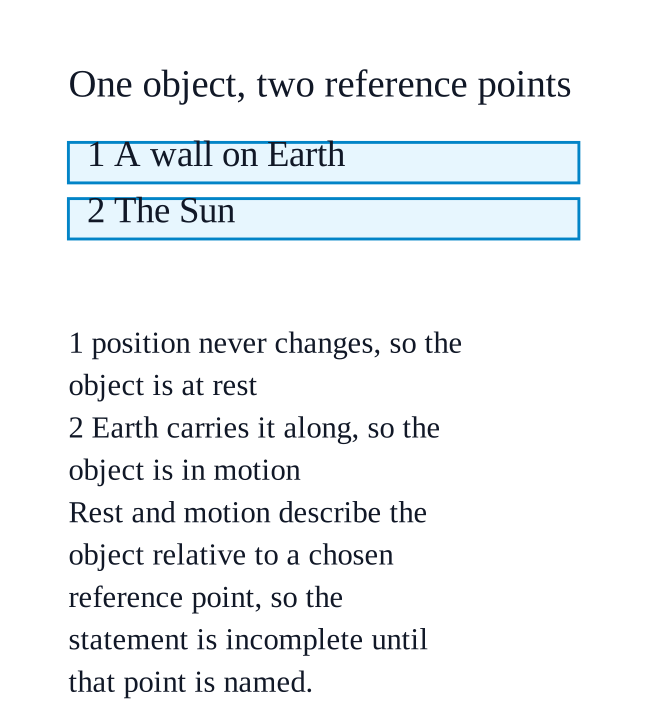
    The chapter's definition: an object is at rest if its position with respect to a chosen reference point does not change with time, and in motion if that position changes.
    Take a reference point fixed on the Earth — a wall, a tree, the ground. The object's distance and direction from it stay the same, so with respect to the Earth the object is at rest.
    Take the Sun as the reference point. The Earth carries the object along as it revolves, so the object's position with respect to the Sun changes continuously, and it is in motion — very fast motion at that.
    The lesson: rest and motion are not absolute. A statement like "the object is at rest" is incomplete until the reference point is named.
  2. Exercise 4.12

    The velocity-time graph from 0\displaystyle 0 s to 120\displaystyle 120 s for a cyclist is shown in Fig. 4.30. Shade the areas (in different colours) representing the displacement of the cyclist (i) while cyclist is moving with constant velocity. (ii) when the velocity of cyclist is decreasing. Also, calculate the displacement and average acceleration in the 120\displaystyle 120 s time interval. 6\displaystyle 6 Velocity (m s1\displaystyle s^{-1}) 5\displaystyle 5 4\displaystyle 4 3\displaystyle 3 2\displaystyle 2 1\displaystyle 1 0\displaystyle 0 20\displaystyle 20NCERT_Question_Class9_Science_Ch4_RRR_Q4-12

    Disagrees with the book

    This working does not reach the answer printed in NCERT. One of the two is wrong and it has not yet been settled which — check it before you rely on it.

    NCERT’s answer
    $\displaystyle 320$ m; -$\displaystyle 2$ $\displaystyle 60$
    Displacement in $\displaystyle 120$ s \(\displaystyle = 320\ \text{m} \); average acceleration \(\displaystyle = -\frac{1}{30}\ \text{m s}^{-2} \approx -0.03\ \text{m s}^{-2} \).
    Reading Fig. $\displaystyle 4.30$: the cyclist's velocity stays constant at \(\displaystyle 4\ \text{m s}^{-1} \) from \(\displaystyle 0\ \text{s} \) to \(\displaystyle 40\ \text{s} \), then falls uniformly to \(\displaystyle 0\ \text{m s}^{-1} \) at \(\displaystyle 120\ \text{s} \).
    (i) In one colour, shade the rectangle between the flat part of the line and the time axis — from \(\displaystyle t = 0 \) to \(\displaystyle t = 40\ \text{s} \), of height \(\displaystyle 4\ \text{m s}^{-1} \).
    (ii) In a second colour, shade the triangle between the sloping part of the line and the time axis — from \(\displaystyle t = 40\ \text{s} \) to \(\displaystyle t = 120\ \text{s} \), of base \(\displaystyle 80\ \text{s} \) and height \(\displaystyle 4\ \text{m s}^{-1} \).
    Displacement is the total area under the graph: \(\displaystyle (4\ \text{m s}^{-1} \times 40\ \text{s}) + \left(\frac{1}{2} \times 80\ \text{s} \times 4\ \text{m s}^{-1}\right) = 160\ \text{m} + 160\ \text{m} = 320\ \text{m} \).
    Average acceleration over the whole interval: \(\displaystyle a = \frac{v - u}{t} = \frac{0\ \text{m s}^{-1} - 4\ \text{m s}^{-1}}{120\ \text{s}} = -\frac{1}{30}\ \text{m s}^{-2} \); the minus sign means it is directed opposite to the direction of motion.
  3. Exercise 4.13

    A girl is preparing for her first marathon by running on a straight road. She uses a smartwatch to calculate her running speed at different intervals. The graph (Fig. 4.31\displaystyle 4.31) depicts her velocity versus time. Estimate the distance she ran based on the graph.NCERT_Question_Class9_Science_Ch4_RRR_Q4-13

    Not cross-checked

    NCERT prints no numerical answer for this exercise, so this working has not been cross-checked against the book.

    She ran about \(\displaystyle 47\ \text{km} \) — the area between the velocity-time line of Fig. $\displaystyle 4.31$ and the time axis, which the chapter shows is the displacement over that interval; her velocity stays positive throughout, so on a straight road that area is also the distance run.
    Reading Fig. $\displaystyle 4.31$ off its grid (one large square is \(\displaystyle 1\ \text{h} \) wide and \(\displaystyle 1.25\ \text{km h}^{-1} \) tall, each small square \(\displaystyle 0.2\ \text{h} \) by \(\displaystyle 0.25\ \text{km h}^{-1} \)), the marked points, in \(\displaystyle \text{h} \) and \(\displaystyle \text{km h}^{-1} \), are \(\displaystyle (0,\ 7.0) \), \(\displaystyle (0.6,\ 7.0) \), \(\displaystyle (1.6,\ 7.5) \), \(\displaystyle (3.0,\ 7.5) \), \(\displaystyle (4.6,\ 7.0) \), \(\displaystyle (5.6,\ 6.5) \) and \(\displaystyle (6.6,\ 6.5) \).
    A flat stretch encloses a rectangle, area \(\displaystyle = v \times t \); a sloping stretch encloses a trapezium, area \(\displaystyle = \frac{v_{1} + v_{2}}{2} \times t \). No unit conversion is needed, since \(\displaystyle \text{km h}^{-1} \times \text{h} = \text{km} \).
    \(\displaystyle 0 \) to \(\displaystyle 0.6\ \text{h} \): \(\displaystyle 7.0\ \text{km h}^{-1} \times 0.6\ \text{h} = 4.2\ \text{km} \)
    \(\displaystyle 0.6 \) to \(\displaystyle 1.6\ \text{h} \): \(\displaystyle \frac{7.0 + 7.5}{2}\ \text{km h}^{-1} \times 1.0\ \text{h} = 7.25\ \text{km} \)
    \(\displaystyle 1.6 \) to \(\displaystyle 3.0\ \text{h} \): \(\displaystyle 7.5\ \text{km h}^{-1} \times 1.4\ \text{h} = 10.5\ \text{km} \)
    \(\displaystyle 3.0 \) to \(\displaystyle 4.6\ \text{h} \): \(\displaystyle \frac{7.5 + 7.0}{2}\ \text{km h}^{-1} \times 1.6\ \text{h} = 11.6\ \text{km} \)
    \(\displaystyle 4.6 \) to \(\displaystyle 5.6\ \text{h} \): \(\displaystyle \frac{7.0 + 6.5}{2}\ \text{km h}^{-1} \times 1.0\ \text{h} = 6.75\ \text{km} \)
    \(\displaystyle 5.6 \) to \(\displaystyle 6.6\ \text{h} \): \(\displaystyle 6.5\ \text{km h}^{-1} \times 1.0\ \text{h} = 6.5\ \text{km} \)
    Adding the six pieces: \(\displaystyle 4.2 + 7.25 + 10.5 + 11.6 + 6.75 + 6.5 = 46.8\ \text{km} \), i.e. \(\displaystyle \approx 47\ \text{km} \). It is an estimate because each point is read to the nearest small square.
    Check on the size: her velocity never leaves the band \(\displaystyle 6.5 \) to \(\displaystyle 7.5\ \text{km h}^{-1} \) over the \(\displaystyle 6.6\ \text{h} \) she runs, so the distance had to fall between \(\displaystyle 6.5\ \text{km h}^{-1} \times 6.6\ \text{h} = 42.9\ \text{km} \) and \(\displaystyle 7.5\ \text{km h}^{-1} \times 6.6\ \text{h} = 49.5\ \text{km} \), and \(\displaystyle 46.8\ \text{km} \) sits inside it.
  4. Exercise 4.14

    On entering a state highway, a car continues to move with a constant velocity of 6\displaystyle 6 m s1\displaystyle s^{-1} for 2\displaystyle 2 minutes and then accelerates with a constant acceleration 1\displaystyle 1 m s2\displaystyle s^{-2} for 6\displaystyle 6 seconds. Find the displacement of the car on the state highway in the 2\displaystyle 2 min 6\displaystyle 6 s time interval by drawing a velocity-time graph for its motion.
    NCERT’s answer
    $\displaystyle 774$ m
    Displacement in the $\displaystyle 2$ min $\displaystyle 6$ s \(\displaystyle = 774\ \text{m} \).
    NCERT_Solution_Class9_Science_Ch4_RRR_Q4-14
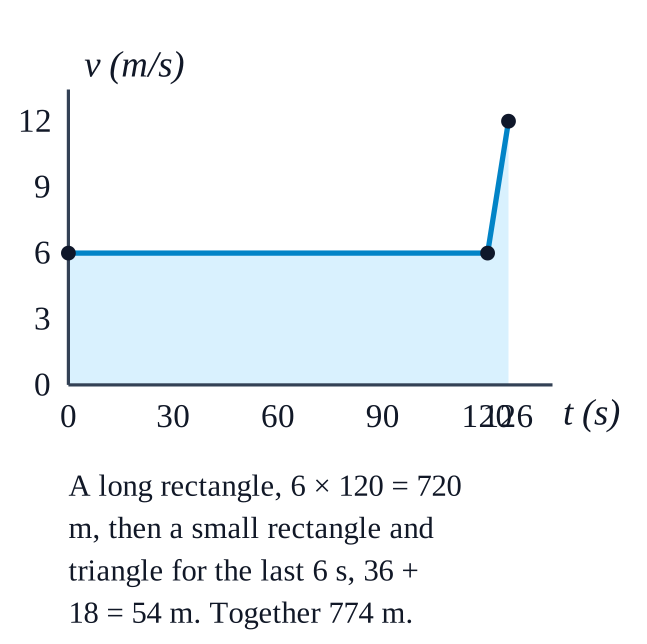
    The graph to draw: velocity (m s⁻¹) on the Y-axis, time (s) on the X-axis. Draw a horizontal line at \(\displaystyle 6\ \text{m s}^{-1} \) from \(\displaystyle t = 0 \) to \(\displaystyle t = 120\ \text{s} \); then from \(\displaystyle 120\ \text{s} \) to \(\displaystyle 126\ \text{s} \) draw a straight line rising to the final velocity \(\displaystyle v = u + at = 6 + 1 \times 6 = 12\ \text{m s}^{-1} \).
    Displacement is the area enclosed between this line and the time axis.
    Rectangle, $\displaystyle 0$ to $\displaystyle 120$ s: \(\displaystyle 6\ \text{m s}^{-1} \times 120\ \text{s} = 720\ \text{m} \).
    Trapezium, $\displaystyle 120$ s to $\displaystyle 126$ s: \(\displaystyle \frac{1}{2}(6 + 12)\ \text{m s}^{-1} \times 6\ \text{s} = 54\ \text{m} \).
    \(\displaystyle \text{total displacement} = 720\ \text{m} + 54\ \text{m} = 774\ \text{m} \)
    Check on the second stretch with Eq. (4.4b): \(\displaystyle s = 6 \times 6 + \frac{1}{2} \times 1 \times (6)^{2} = 36 + 18 = 54\ \text{m} \), as the graph gave.
  5. Exercise 4.15

    Two cars A and B start moving with a constant acceleration from rest, in a straight line. Car A attains a velocity of 5\displaystyle 5 m s1\displaystyle s^{-1} in 5\displaystyle 5 s. Car B attains a velocity of 3\displaystyle 3 m s1\displaystyle s^{-1} in 10\displaystyle 10 s. Plot the velocity-time graphs for both the cars in the same graph. Using the graph, calculate the displacement in the two time intervals mentioned (Hint: Calculate the acceleration in both cases. Then calculate their velocities at five instants of time to plot the graph).
    NCERT’s answer
    12.$\displaystyle 5$ m; $\displaystyle 15$ m
    Car A travels \(\displaystyle 12.5\ \text{m} \) in its $\displaystyle 5$ s; car B travels \(\displaystyle 15\ \text{m} \) in its $\displaystyle 10$ s.
    NCERT_Solution_Class9_Science_Ch4_RRR_Q4-15
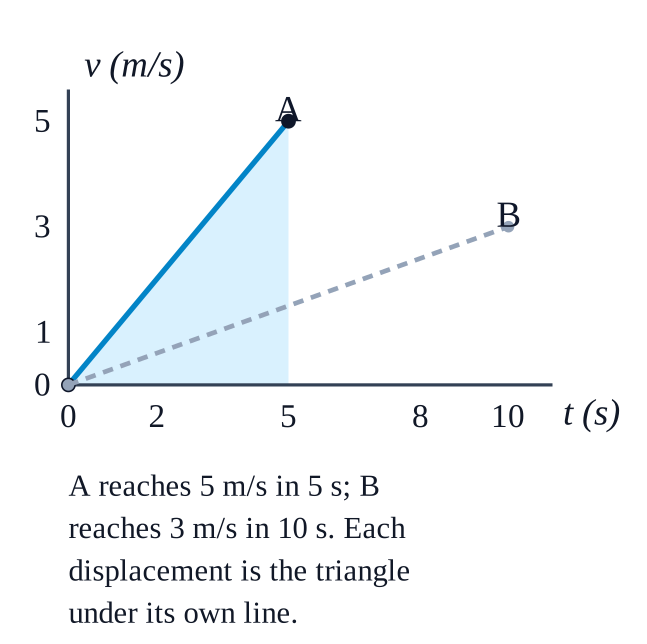
    Accelerations first: \(\displaystyle a_{A} = \frac{5 - 0}{5} = 1\ \text{m s}^{-2} \) and \(\displaystyle a_{B} = \frac{3 - 0}{10} = 0.3\ \text{m s}^{-2} \).
    Velocities to plot for A (\(\displaystyle v = at \)): \(\displaystyle (0\ \text{s},\ 0),\ (1,\ 1),\ (2,\ 2),\ (3,\ 3),\ (4,\ 4),\ (5\ \text{s},\ 5\ \text{m s}^{-1}) \).
    Velocities to plot for B: \(\displaystyle (0\ \text{s},\ 0),\ (2,\ 0.6),\ (4,\ 1.2),\ (6,\ 1.8),\ (8,\ 2.4),\ (10\ \text{s},\ 3.0\ \text{m s}^{-1}) \).
    The graph: one pair of axes, velocity (m s⁻¹) on Y and time (s) on X; both cars start from rest so both lines are straight and start at the origin. A is the steeper line, ending at ($\displaystyle 5$ s, $\displaystyle 5$ m s⁻¹); B is the gentler line, ending at ($\displaystyle 10$ s, $\displaystyle 3$ m s⁻¹).
    Displacement is the area of the triangle under each line: \(\displaystyle s_{A} = \frac{1}{2} \times 5\ \text{s} \times 5\ \text{m s}^{-1} = 12.5\ \text{m} \) and \(\displaystyle s_{B} = \frac{1}{2} \times 10\ \text{s} \times 3\ \text{m s}^{-1} = 15\ \text{m} \).
    B is the slower and less strongly accelerated car, yet it covers more ground — because it is given twice as long.
  6. Exercise 4.16

    Rohan studies science from 6\displaystyle 6 PM to 7\displaystyle 7:30\displaystyle 30 PM at home. Consider the tip of the minute’s hand of the wall clock. During the given time interval, what is its: (i) distance travelled, (ii) displacement, (iii) speed, and (iv) velocity. The length of the minute’s hand is 7\displaystyle 7 cm (Fig. 4.32\displaystyle 4.32).NCERT_Question_Class9_Science_Ch4_RRR_Q4-16
    NCERT’s answer
    (i)
    $\displaystyle 66$ cm (ii) $\displaystyle 14$ cm $\displaystyle 7$ $\displaystyle 11$ cm s -$\displaystyle 1$ cm s (iii) (iv) -$\displaystyle 1$ $\displaystyle 2700$ $\displaystyle 900$
    $\displaystyle 6$ PM to $\displaystyle 7$:$\displaystyle 30$ PM is \(\displaystyle 90 \) minutes, so the minute's hand makes \(\displaystyle \frac{90}{60} = 1.5 \) revolutions, and \(\displaystyle t = 90 \times 60 = 5400\ \text{s} \). One revolution of the tip covers the circumference \(\displaystyle 2\pi R = 2 \times \frac{22}{7} \times 7\ \text{cm} = 44\ \text{cm} \).
    (i) Distance travelled \(\displaystyle = 66\ \text{cm} \): \(\displaystyle 1.5 \times 44\ \text{cm} = 66\ \text{cm} \).
    (ii) Displacement \(\displaystyle = 14\ \text{cm} \), directed from the $\displaystyle 12$-mark straight across to the $\displaystyle 6$-mark (vertically downward). After one and a half revolutions the tip ends diametrically opposite its starting point, so the net change in position is the diameter, \(\displaystyle 2 \times 7\ \text{cm} = 14\ \text{cm} \).
    (iii) Average speed \(\displaystyle = \frac{66\ \text{cm}}{5400\ \text{s}} = \frac{11}{900}\ \text{cm s}^{-1} \approx 0.012\ \text{cm s}^{-1} \).
    (iv) Average velocity \(\displaystyle = \frac{14\ \text{cm}}{5400\ \text{s}} = \frac{7}{2700}\ \text{cm s}^{-1} \approx 0.0026\ \text{cm s}^{-1} \), in the same direction as the displacement — from the $\displaystyle 12$-mark towards the $\displaystyle 6$-mark.
    The speed is much the larger of the two because the tip travels the whole curved path, while the velocity counts only the straight $\displaystyle 14$ cm between where it began and where it ended.