SolveItClass 9 · NCERT

NCERT Solutions · Class 9 Science Describing Motion Around Us

23 questions · 13 still being checked

Revise, Reflect, Refine 4.1–4.10 (part 2 of 3)

  1. Exercise 4.1

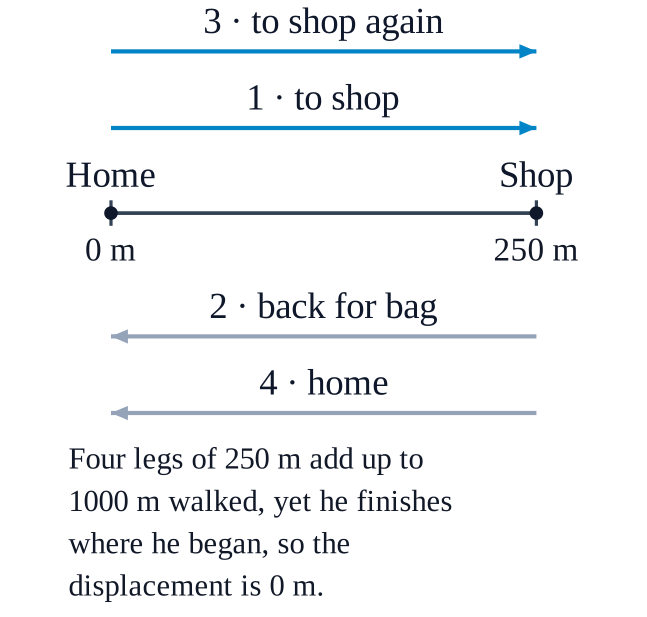
    My father went to a shop from home which is located at a distance of 250\displaystyle 250 m on a straight road. On reaching there, he discovered that he forgot to carry a cloth bag. He came home to take it, went to the shop again, bought provisions and came back home. How much was the total distance travelled by him? What was his displacement from home?
    NCERT’s answer
    $\displaystyle 1000$ m; $\displaystyle 0$ m
    Total distance travelled \(\displaystyle = 1000\ \text{m} \); displacement \(\displaystyle = 0\ \text{m} \).
    NCERT_Solution_Class9_Science_Ch4_RRR_Q4-1
    His journey has four legs, each of \(\displaystyle 250\ \text{m} \): home → shop, shop → home (for the bag), home → shop again, shop → home.
    \(\displaystyle \text{total distance} = 4 \times 250\ \text{m} = 1000\ \text{m} \)
    He finishes exactly where he began, so the net change in position is zero: \(\displaystyle s = 0\ \text{m} \).
    This is the standard case of a large distance with zero displacement.
  2. Exercise 4.2

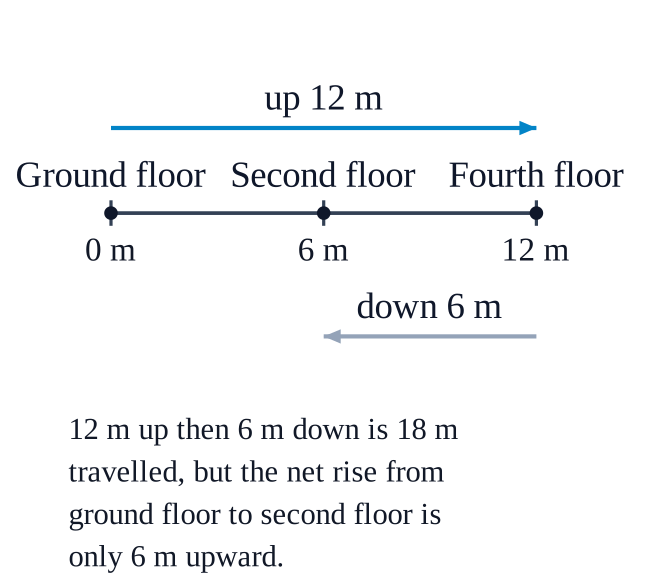
    A student runs from the ground floor to the fourth floor of a school building to collect a book and then comes down to their classroom on the second floor. If the height of each floor is 3\displaystyle 3 m, find: (i) the total vertical distance travelled, and (ii) their displacement from the starting point.
    NCERT’s answer
    (i)
    $\displaystyle 18$ m (ii) $\displaystyle 6$ m in upward direction
    (i) Total vertical distance travelled \(\displaystyle = 18\ \text{m} \).
    NCERT_Solution_Class9_Science_Ch4_RRR_Q4-2
    Going up, ground floor to fourth floor is $\displaystyle 4$ floors: \(\displaystyle 4 \times 3\ \text{m} = 12\ \text{m} \).
    Coming down, fourth floor to second floor is $\displaystyle 2$ floors: \(\displaystyle 2 \times 3\ \text{m} = 6\ \text{m} \).
    \(\displaystyle \text{total distance} = 12\ \text{m} + 6\ \text{m} = 18\ \text{m} \)
    (ii) Displacement \(\displaystyle = 6\ \text{m} \), in the upward direction.
    The student starts on the ground floor and ends on the second floor, a net rise of \(\displaystyle 2 \times 3\ \text{m} = 6\ \text{m} \); the trip up to the fourth floor and back does not add to it.
  3. Exercise 4.3

    A girl is riding her scooter and finds that its speedometer reading is constant. Is it possible for her scooter to be accelerating and if so, how?

    Check this one against your book

    NCERT’s printed answer for this exercise does not match its own question. This working follows the question as printed.

    Yes — her scooter can be accelerating, and it is accelerating whenever she is turning. A speedometer reports only the magnitude of her velocity; the direction of that velocity can be changing all the while, and a change in direction alone is already a change in velocity.
    What a steady needle actually fixes — the Threads of Curiosity box beside Section $\displaystyle 4.1.4$ (the Average acceleration page) says the speedometer reading is nearly, though not exactly, the magnitude of the velocity at that instant, while it is the way the tyres are pointing that gives the direction of the velocity. So the needle pins down one half of the velocity and says nothing at all about the other half.
    Why half is not enough — Eq. (4.3a) defines \(\displaystyle \text{average acceleration} = \frac{\text{change in velocity}}{\text{time interval}} \), and Section $\displaystyle 4.1.4$ states in as many words that this change can come from the magnitude of the velocity, from its direction, or from both. That same paragraph forward-refers to Section $\displaystyle 4.4$ for an example in which the speed stays constant and only the direction changes — which is precisely the situation this question describes.
    How, concretely: she must be riding along a curve — a bend in the road, a roundabout, a circular turn, i.e. uniform circular motion. Section $\displaystyle 4.4.1$ reaches it by counting turns: an athlete on a rectangular track changes direction $\displaystyle 4$ times per lap (Fig. 4.23a), on a hexagonal track $\displaystyle 6$ times (Fig. 4.23b), and as the number of sides is increased without limit the track becomes a circle and the direction of the velocity changes continuously (Fig. 4.23c). At each point the velocity lies along the tangent to the path (Fig. $\displaystyle 4.25$), so it points a new way at every instant while its magnitude never moves.
    Section $\displaystyle 4.4.1$ then states the conclusion the question is built on: uniform circular motion is accelerated motion, for the single reason that the direction of the velocity keeps changing; and the Note beside it adds that in everyday life we call a vehicle "accelerating" only when its speed changes and routinely fail to notice acceleration that is a change of direction alone. Her scooter is exactly the case that Note is about.
    When she would not be accelerating — only if the road is straight as well as her speed steady. Then the initial and final velocities agree in magnitude and direction, and Eq. (4.3c) gives \(\displaystyle a = \frac{v - u}{t} = \frac{10\ \mathrm{m\ s^{-1}} - 10\ \mathrm{m\ s^{-1}}}{t} = 0\ \mathrm{m\ s^{-2}} \) for any time interval (the \(\displaystyle 10\ \mathrm{m\ s^{-1}} \) is only there to show the substitution; any steady reading gives the same zero). The Note in Section $\displaystyle 4.1.4$ makes the same point with a bus on a straight highway — moving fast, yet with zero acceleration.
    Marked as reasoning rather than the book's content: the chapter establishes only that this acceleration is non-zero; it never says which way it points, and nothing in Chapter $\displaystyle 4$ mentions an acceleration directed towards the centre of the circle — so a Grade $\displaystyle 9$ answer should not supply a direction here. Similarly, the speedometer box's "nearly, but not exactly" means a perfectly steady needle is a very good indicator of constant speed rather than a strict guarantee of it.
    The printed key does not fit this question. The book's Answer Key gives, under Chapter $\displaystyle 4$ → Revise, Reflect, Refine, item 3. Yes, Yes, different — three answers. Question $\displaystyle 3$ as printed is one sentence: a single yes/no ("Is it possible for her scooter to be accelerating") followed by "if so, how?". A how cannot be answered "Yes", and there is nothing in the question that can be answered "different". A three-part entry of exactly that shape does fit Pause and Ponder question $\displaystyle 3$ of the same chapter — the ball on the inclined track of Fig. $\displaystyle 4.6$ — which asks three things in a row: is the motion straight-line motion, can it be depicted on a horizontal line as in Fig. $\displaystyle 4.3$, and are the total distance travelled and the magnitude of displacement equal or different. The Answer Key's Pause and Ponder list for Chapter $\displaystyle 4$ prints only item $\displaystyle 4$, with no item $\displaystyle 3$; and the key does print yes/no answers to Pause and Ponder items in other chapters (Chapter $\displaystyle 7$'s list opens "1. No"), so that gap is not a policy of skipping non-numerical answers. The entry looks set against the wrong list.
    So, plainly: the book's printed Answer Key gives "Yes, Yes, different" for this question, which does not agree with the question as printed on the Revise, Reflect, Refine page or with Section $\displaystyle 4.4.1$ read as an answer to it. The chapter's own text settles it the other way — Section $\displaystyle 4.1.4$ counts a change of direction as a change of velocity, and Section $\displaystyle 4.4.1$ declares uniform circular motion accelerated for that reason alone — so the answer is Yes: a scooter held at a constant speedometer reading is accelerating whenever it is going round a bend, and is not accelerating only if it is also going straight. Of the key's three words, only the first one survives.
    NCERT_Solution_Class9_Science_Ch4_RRR_Q4-3NCERT_Solution_Class9_Science_Ch4_RRR_Q4-3-2
  4. Exercise 4.4

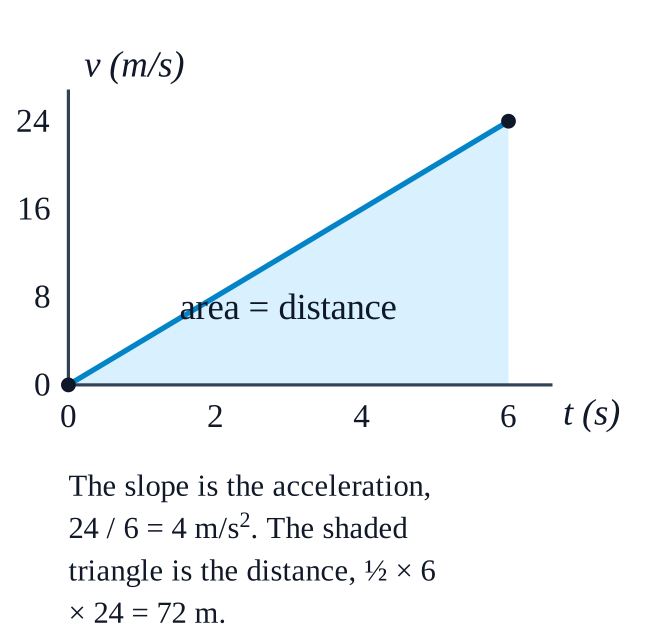
    A car starts from rest and its velocity reaches 24\displaystyle 24 m s1\displaystyle s^{-1} in 6\displaystyle 6 s. Find the average acceleration and the distance travelled in these 6\displaystyle 6 s.
    NCERT’s answer
    $\displaystyle 4$ m \(\displaystyle s^{- 2}\) in the direction of velocity, $\displaystyle 72$ m
    Average acceleration \(\displaystyle = 4\ \text{m s}^{-2} \), in the direction of the velocity; distance travelled \(\displaystyle = 72\ \text{m} \).
    NCERT_Solution_Class9_Science_Ch4_RRR_Q4-4
    Given: \(\displaystyle u = 0\ \text{m s}^{-1} \) (starts from rest), \(\displaystyle v = 24\ \text{m s}^{-1} \), \(\displaystyle t = 6\ \text{s} \).
    Using Eq. (4.3c): \(\displaystyle a = \frac{v - u}{t} = \frac{24\ \text{m s}^{-1} - 0\ \text{m s}^{-1}}{6\ \text{s}} = 4\ \text{m s}^{-2} \)
    The magnitude of velocity is increasing, so the acceleration acts along the direction of motion.
    Using Eq. (4.4b): \(\displaystyle s = ut + \frac{1}{2}at^{2} = 0 + \frac{1}{2} \times 4\ \text{m s}^{-2} \times (6\ \text{s})^{2} = 72\ \text{m} \)
  5. Exercise 4.5

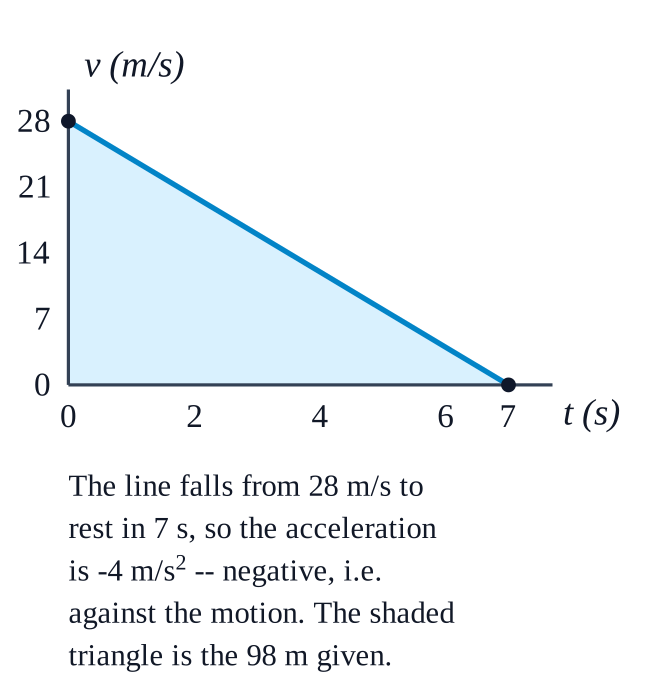
    A motorbike moving with initial velocity 28\displaystyle 28 m s1\displaystyle s^{-1} and constant acceleration stops after travelling 98\displaystyle 98 m. Find the acceleration of the motorbike and the time taken to come to a stop.
    NCERT’s answer
    $\displaystyle 4$ m \(\displaystyle s^{- 2}\) in the direction opposite to the velocity; $\displaystyle 7$ s
    Acceleration \(\displaystyle = -4\ \text{m s}^{-2} \) (opposite to the direction of velocity); time taken \(\displaystyle = 7\ \text{s} \).
    NCERT_Solution_Class9_Science_Ch4_RRR_Q4-5
    Given: \(\displaystyle u = 28\ \text{m s}^{-1} \), \(\displaystyle v = 0\ \text{m s}^{-1} \) (it stops), \(\displaystyle s = 98\ \text{m} \).
    Using Eq. (4.4c): \(\displaystyle v^{2} = u^{2} + 2as \Rightarrow 0 = (28\ \text{m s}^{-1})^{2} + 2 \times a \times 98\ \text{m} \)
    \(\displaystyle a = \frac{-784\ \text{m}^{2}\text{s}^{-2}}{196\ \text{m}} = -4\ \text{m s}^{-2} \)
    The minus sign says the acceleration is directed opposite to the velocity — the motorbike is slowing down.
    Using Eq. (4.4a): \(\displaystyle 0 = 28\ \text{m s}^{-1} + (-4\ \text{m s}^{-2}) \times t \Rightarrow t = \frac{28}{4}\ \text{s} = 7\ \text{s} \)
  6. Exercise 4.6

    Fig. 4.27\displaystyle 4.27 shows a position-time graph of two objects A and B that are moving along the parallel tracks in the same direction. Do objects A and B ever have equal velocity? Justify your answer. Position (m) 0\displaystyle 0NCERT_Question_Class9_Science_Ch4_RRR_Q4-6

    Not cross-checked

    NCERT prints no numerical answer for this exercise, so this working has not been cross-checked against the book.

    NCERT’s answer
    No
    No — A and B never have equal velocity.
    Both graphs in Fig. $\displaystyle 4.27$ are straight lines, so each object moves with its own constant velocity throughout the motion.
    On a position-time graph the velocity is the slope of the line. The two lines have visibly different steepness, so the two constant velocities are different numbers — and being constant, they stay different at every instant.
    Where the two lines meet, A and B have the same position, i.e. they are side by side on their parallel tracks and one overtakes the other. Equal position is not equal velocity.
  7. Exercise 4.7

    A graph in Fig. 4.28\displaystyle 4.28 shows the change in position with time for two objects A and B moving in a straight line from 0\displaystyle 0 to 10\displaystyle 10 seconds. Choose the correct option(s). (i) The average velocity of both over the 10\displaystyle 10 s time interval is equal since they have the same initial and final positions. (ii) The average speeds of both over the 10\displaystyle 10 s time interval are equal since both cover equal distance in equal time. (iii) The average speed of A over the 10\displaystyle 10 s time interval is lower than that of B since it covers a shorter distance than B in 10\displaystyle 10 seconds. (iv) The average speed of A over the 10\displaystyle 10 s time interval is greater than that of B since B’s speed is lower than A’s in some segments.NCERT_Question_Class9_Science_Ch4_RRR_Q4-7

    Not cross-checked

    NCERT prints no numerical answer for this exercise, so this working has not been cross-checked against the book.

    NCERT’s answer
    (i)
    ; (ii)
    Correct options: (i) and (ii).
    (i) is true: both objects have the same initial position and the same final position, so both have the same displacement over the same \(\displaystyle 10\ \text{s} \); reading the graph, \(\displaystyle v_{av} = \frac{10\ \text{m}}{10\ \text{s}} = 1\ \text{m s}^{-1} \) for each.
    (ii) is true: neither graph ever falls, so neither object turns back. For one-way motion the distance travelled equals the magnitude of displacement, so each covers \(\displaystyle 10\ \text{m} \) and \(\displaystyle \text{average speed} = \frac{10\ \text{m}}{10\ \text{s}} = 1\ \text{m s}^{-1} \) for both.
    (iii) is false: A does not cover a shorter distance than B — both cover the same \(\displaystyle 10\ \text{m} \).
    (iv) is false: B is indeed slower than A over some stretches, but it is faster over others, and over the full \(\displaystyle 10\ \text{s} \) the two average out to the same speed.
    What really differs between A and B is their velocity at individual instants, not their averages over the whole interval.
  8. Exercise 4.8

    A truck driver driving at the speed of 54\displaystyle 54 km h1\displaystyle h^{-1} notices a road sign with a speed limit of 40\displaystyle 40 km h1\displaystyle h^{-1} (Fig. 4.29\displaystyle 4.29) for trucks. He slows down to 36\displaystyle 36 km h1\displaystyle h^{-1} in 36\displaystyle 36 s. What was the distance travelled by him during this time? Assume the acceleration to be constant while slowing down.NCERT_Question_Class9_Science_Ch4_RRR_Q4-8
    NCERT’s answer
    $\displaystyle 450$ m
    Distance travelled while slowing down \(\displaystyle = 450\ \text{m} \).
    Convert the speeds: \(\displaystyle u = 54\ \text{km h}^{-1} = 54 \times \frac{1000\ \text{m}}{3600\ \text{s}} = 15\ \text{m s}^{-1} \) and \(\displaystyle v = 36\ \text{km h}^{-1} = 10\ \text{m s}^{-1} \), with \(\displaystyle t = 36\ \text{s} \).
    Using Eq. (4.3c): \(\displaystyle a = \frac{10\ \text{m s}^{-1} - 15\ \text{m s}^{-1}}{36\ \text{s}} = -\frac{5}{36}\ \text{m s}^{-2} \approx -0.14\ \text{m s}^{-2} \) — negative, because he is slowing down.
    Using Eq. (4.4b): \(\displaystyle s = ut + \frac{1}{2}at^{2} = 15 \times 36 + \frac{1}{2} \times \left(-\frac{5}{36}\right) \times (36)^{2} \)
    \(\displaystyle s = 540\ \text{m} - 90\ \text{m} = 450\ \text{m} \)
    The \(\displaystyle 40\ \text{km h}^{-1} \) figure on the sign is not used in the calculation — it is only the reason he slows down.
  9. Exercise 4.9

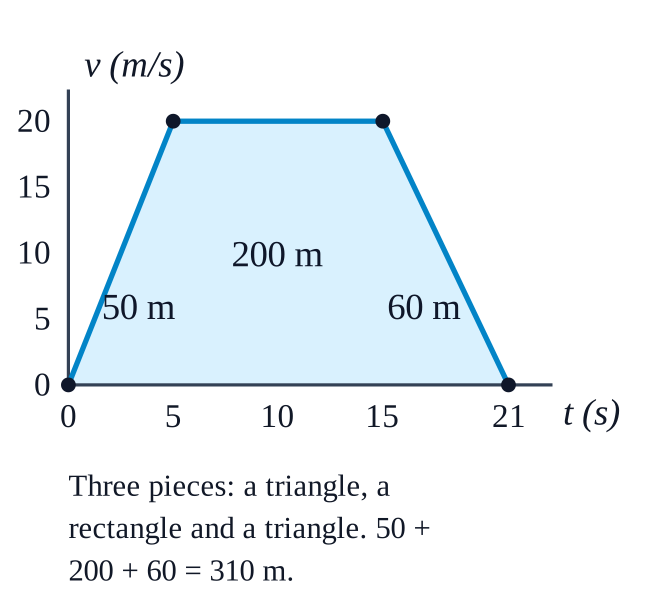
    A car starts from rest and accelerates uniformly to 20\displaystyle 20 m s1\displaystyle s^{-1} in 5\displaystyle 5 seconds. It then travels at 20\displaystyle 20 m s1\displaystyle s^{-1} for 10\displaystyle 10 seconds and finally applies the brake (with uniform acceleration) to stop in 6\displaystyle 6 seconds. Find the total distance travelled.
    NCERT’s answer
    $\displaystyle 310$ m $\displaystyle 1$ m s
    Total distance travelled \(\displaystyle = 310\ \text{m} \). Treat the journey as three stages and add the distances.
    NCERT_Solution_Class9_Science_Ch4_RRR_Q4-9
    Stage $\displaystyle 1$, speeding up: \(\displaystyle u = 0 \), \(\displaystyle v = 20\ \text{m s}^{-1} \), \(\displaystyle t = 5\ \text{s} \), so \(\displaystyle a = \frac{20 - 0}{5} = 4\ \text{m s}^{-2} \) and \(\displaystyle s_{1} = \frac{1}{2} \times 4\ \text{m s}^{-2} \times (5\ \text{s})^{2} = 50\ \text{m} \).
    Stage $\displaystyle 2$, constant velocity: \(\displaystyle s_{2} = 20\ \text{m s}^{-1} \times 10\ \text{s} = 200\ \text{m} \).
    Stage $\displaystyle 3$, braking: \(\displaystyle u = 20\ \text{m s}^{-1} \), \(\displaystyle v = 0 \), \(\displaystyle t = 6\ \text{s} \), so \(\displaystyle a = \frac{0 - 20}{6} = -\frac{10}{3}\ \text{m s}^{-2} \) and \(\displaystyle s_{3} = 20 \times 6 + \frac{1}{2} \times \left(-\frac{10}{3}\right) \times (6)^{2} = 120\ \text{m} - 60\ \text{m} = 60\ \text{m} \).
    \(\displaystyle \text{total} = 50\ \text{m} + 200\ \text{m} + 60\ \text{m} = 310\ \text{m} \)
  10. Exercise 4.10

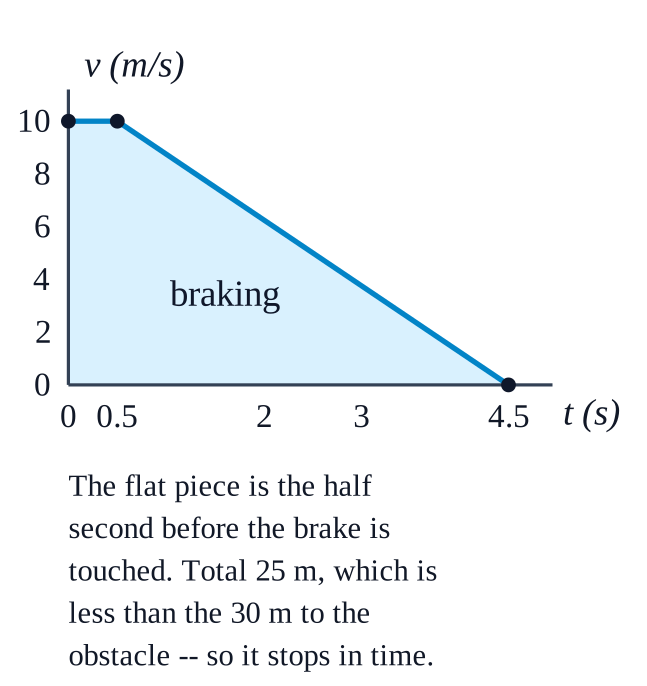
    A bus is travelling at 36\displaystyle 36 km h1\displaystyle h^{-1} when the driver sees an obstacle 30\displaystyle 30 m ahead. The driver takes 0.5\displaystyle 0.5 seconds to react before pressing the brake. Once the brake is applied, the velocity of the bus reduces with constant acceleration of 2.5\displaystyle 2.5 m s2\displaystyle s^{-2}. Will the bus be able to stop before reaching the obstacle?
    NCERT’s answer
    $\displaystyle 25$ m; Yes
    Yes — the bus stops after \(\displaystyle 25\ \text{m} \), which is \(\displaystyle 5\ \text{m} \) short of the obstacle \(\displaystyle 30\ \text{m} \) ahead.
    NCERT_Solution_Class9_Science_Ch4_RRR_Q4-10
    Convert: \(\displaystyle u = 36\ \text{km h}^{-1} = 36 \times \frac{1000\ \text{m}}{3600\ \text{s}} = 10\ \text{m s}^{-1} \).
    Reaction stretch — the brakes are not yet on, so the bus keeps its constant velocity for \(\displaystyle 0.5\ \text{s} \): \(\displaystyle s_{1} = 10\ \text{m s}^{-1} \times 0.5\ \text{s} = 5\ \text{m} \).
    Braking stretch — using Eq. (4.4c) with \(\displaystyle v = 0 \) and \(\displaystyle a = -2.5\ \text{m s}^{-2} \): \(\displaystyle 0 = (10)^{2} + 2 \times (-2.5) \times s_{2} \Rightarrow s_{2} = \frac{100}{5} = 20\ \text{m} \).
    Total stopping distance \(\displaystyle = 5\ \text{m} + 20\ \text{m} = 25\ \text{m} \), and \(\displaystyle 25\ \text{m} < 30\ \text{m} \).
    Note how much the reaction time costs: a fifth of the whole stopping distance is covered before the brake is even touched.