Exercise 2.5
Two students, Renu and Rohit, were having a discussion on the plastids. Renu emphasised that all parts of the plants, even roots, contain plastids. However, Rohit did not agree with the statement and told her that plastids are absent in plant roots since the roots are underground and do not need to perform photosynthesis. Who is correct? Justify your answer.
Not cross-checked
NCERT prints no numerical answer for this exercise, so this working has not been cross-checked against the book.
Renu is correct — plastids are found in all parts of a plant, roots included.
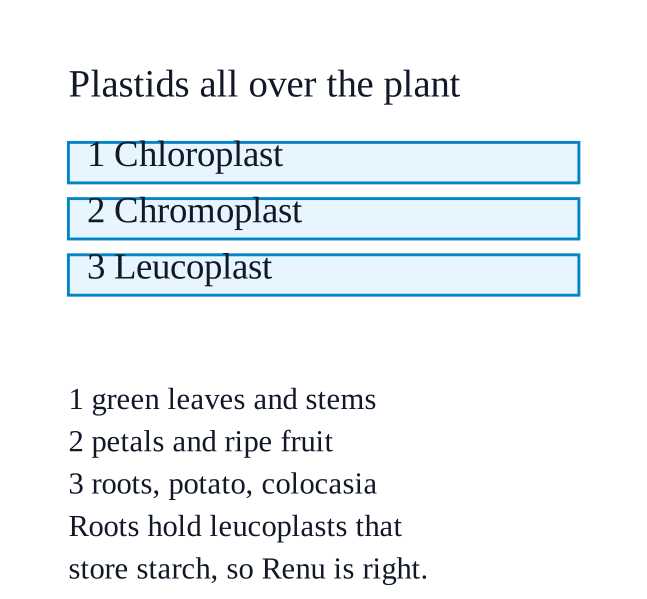
Plastids are not only chloroplasts. The chapter names three kinds: chloroplasts (green, for photosynthesis), chromoplasts (yellow, orange or red, in petals and fruits) and leucoplasts (colourless, for storage).
Non-green parts carry leucoplasts, which store food material such as starch, oils or proteins. The chapter's own examples are the starch-storing cells of potato and taro (Colocasia) — underground parts that never see sunlight.
So a root does not photosynthesise, yet it still needs plastids, because storing the food that the leaves send down is itself a plastid's job.
Rohit's error is treating "plastid" and "chloroplast" as the same word. His reasoning correctly explains why roots have few or no chloroplasts — it does not show that they have no plastids.