SolveItClass 9 · NCERT

NCERT Solutions · Class 9 Science Cell: The Building Block of Life

24 questions · 24 still being checked

Revise, Reflect, Refine 2.9–2.16 (part 14 of 14)

  1. Exercise 2.9

    Indicate the presence or absence of following structures in bacterial and animal cells: Structures in a cell Chromosome Nucleus Mitochondria Golgi complex Chromoplasts

    Not cross-checked

    NCERT prints no numerical answer for this exercise, so this working has not been cross-checked against the book.

    Structure in a cellBacterial cellAnimal cell
    ChromosomePresent (a single circular DNA molecule with proteins, lying in the nucleoid)Present
    NucleusAbsentPresent
    MitochondriaAbsentPresent
    Golgi complexAbsentPresent
    ChromoplastsAbsentAbsent
    A bacterial cell is prokaryotic: no membrane-bound nucleus and no membrane-bound organelles at all. That single fact removes the nucleus, the mitochondria and the Golgi complex together; its cellular activities take place directly in the cytoplasm.
    Chromosome in a bacterium — present. The chapter defines a chromosome as being "composed of DNA and specific proteins", and it describes a prokaryote's genetic material as "a single circular molecule associated with specific proteins". That is DNA plus specific proteins, so the structure itself is there; what the bacterium lacks is the membrane around it. The region holding this single circular chromosome is called the nucleoid, which is why the chromosome row and the nucleus row differ.
    An animal cell is eukaryotic, so the nucleus with its chromosomes, the mitochondria and the Golgi complex are all present. Its chromosomes are visible as rod-shaped bodies only when the cell is about to divide; at other times the same DNA is present as chromatin.
    Chromoplasts are absent from both. Plastids of every kind — chloroplasts, chromoplasts and leucoplasts — occur only in plant cells.
  2. Exercise 2.10

    Carry out the following experiment: Take four peeled potato halves and scoop each one out to make potato cups. One of these potato cups should be made from a boiled potato. Place each of the potato cups in a beaker containing water (Fig. 2.22\displaystyle 2.22). Now, set up the experiment as follows: (a) Keep Cup A empty. (b) Add one teaspoon sugar in Cup B. (c) Add one teaspoon salt in Cup C. (d) Add one teaspoon sugar in the boiled potato in Cup D. Observe the four potato cups at least two hours and answer the following questions: (i) Explain why water gathers in the hollowed portion of Cup B and Cup C. (ii) Why is Cup A necessary for this experiment? (iii) Explain why water does not gather in the hollowed portions of Cups A and D.NCERT_Question_Class9_Science_Ch2_RRR_Q2-10

    Not cross-checked

    NCERT prints no numerical answer for this exercise, so this working has not been cross-checked against the book.

    (i) Why water gathers in Cup B and Cup C
    The sugar in Cup B and the salt in Cup C dissolve in the trace of moisture in the hollow, making the fluid there far more concentrated than the plain water in the beaker.
    The potato between them is living tissue: its cell walls are permeable and its cell membranes are selectively permeable, so water can cross but sugar and salt cannot.
    Water therefore moves by osmosis from the beaker (more water, less solute) through the potato wall into the hollow (less water, more solute), and collects there as a visible pool.
    (ii) Why Cup A is necessary
    Cup A is the control. It is set up in exactly the same way as the others except that nothing is added, so the only difference between A and B or C is the solute.
    Without it you could not rule out the alternatives — that the potato simply leaks, or that water splashed in. Because A stays dry, the sugar and salt must be what causes the pools in B and C.
    (iii) Why no water gathers in Cups A and D
    Cup A — plain water on both sides. There is no concentration difference, so there is no net movement of water in either direction.
    Cup D — the potato was boiled, and boiling kills the cells and destroys their selectively permeable cell membranes. The sugar creates a concentration difference, but there is no longer a living selectively permeable membrane for osmosis to work across, so no water is drawn through.
    Cup D is the second control, and it makes the sharper point of the two: osmosis needs a living membrane, not merely a difference in concentration.
  3. Exercise 2.11

    Identify the pair that incorrectly matches the cell organelle with its function. (i) Ribosome — Protein synthesis (ii) SER — Lipid and cellulose synthesis (iii) Lysosome — Digestion of foreign agents

    Check this one against your book

    NCERT’s printed answer for this exercise does not match its own question. This working follows the question as printed.

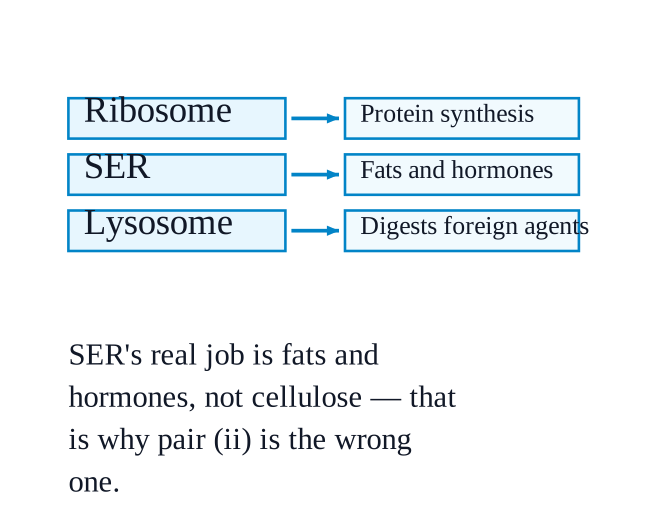
    The incorrectly matched pair is (ii) SER — Lipid and cellulose synthesis. NCERT's printed key gives (iii); that disagreement is set out in the last bullet rather than hidden.
    NCERT_Solution_Class9_Science_Ch2_RRR_Q2-11
    (i) is correctly matched: ribosomes are the sites of protein synthesis.
    (ii) is half right and half wrong. The SER is indeed "involved in the synthesis, and storage of fats and hormones" — but the chapter gives it no role whatever in cellulose. Cellulose is the material of the plant cell wall, a carbohydrate of many glucose units linked together, laid down outside the cell membrane. A pair that carries a false claim is not a correct match.
    (iii) is correctly matched. Lysosomes are "single membrane-bound sacs filled with enzymes" that break down proteins, carbohydrates and fats, and the chapter's own example has the lysosomal enzymes of a sperm breaking down the outer layer of the egg — material that is not the cell's own worn-out waste. Digesting foreign agents is those same enzymes doing that same job, so nothing in the chapter marks this pair as false.
    Weigh the two in the same terms and the choice is forced: the chapter is merely silent about lysosomes and foreign agents, whereas it directly contradicts an SER that makes cellulose. Silence is not a mismatch; a contradiction is. (ii) is therefore the pair to name.
  4. Exercise 2.12

    What outcome do you expect, if all the mitochondria are removed from a eukaryotic cell?

    Not cross-checked

    NCERT prints no numerical answer for this exercise, so this working has not been cross-checked against the book.

    The cell would run out of usable energy and die.
    NCERT_Solution_Class9_Science_Ch2_RRR_Q2-12
    Mitochondria are the site of cellular respiration, where glucose and other molecules are broken down to release energy. Remove them and the cell has no way to get at the energy held in its food.
    Nothing would then be left to store that energy as ATP, the energy currency that pays for almost everything a cell does.
    Without ATP the cell cannot drive substances across its membrane, build proteins and lipids, run its clean-up, or divide. Its activities would slow, then stop altogether.
    A plant cell would be no better off. Its chloroplasts could still trap sunlight and make sugar, but with no mitochondria it could not release the energy locked inside that sugar.
  5. Exercise 2.13

    Which phenomenon inhibits the formation of tumors in the human body? Can plants also develop tumors? Explain.

    Not cross-checked

    NCERT prints no numerical answer for this exercise, so this working has not been cross-checked against the book.

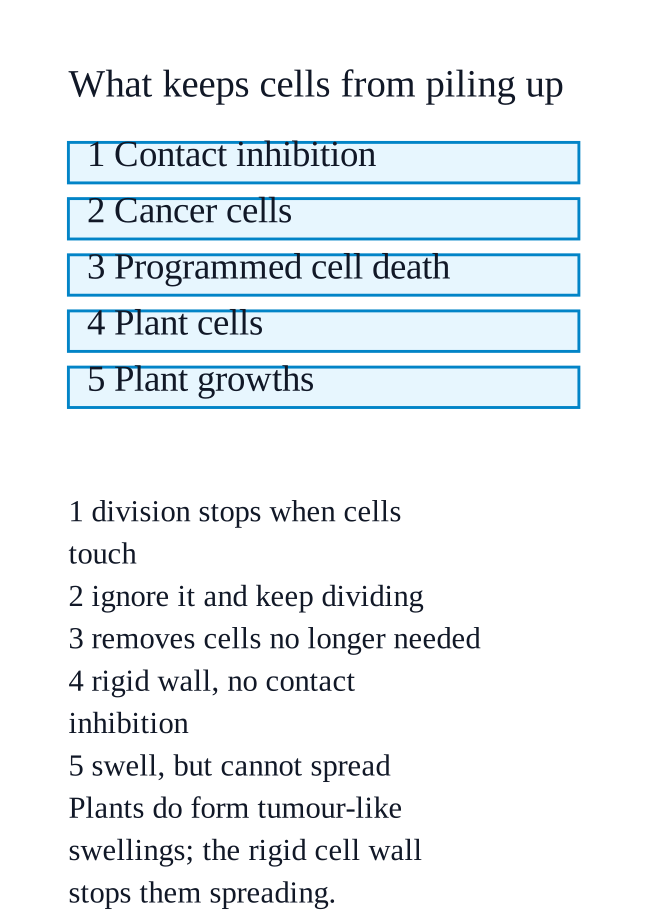
    Contact inhibition. In many animal cells, division stops as soon as a cell comes into contact with its neighbouring cells, so cells do not pile up and no tumour forms.
    NCERT_Solution_Class9_Science_Ch2_RRR_Q2-13
    Cancer cells lose this control and go on dividing uncontrollably, and that is what builds a tumour; cancerous tumours can then invade nearby tissues and even spread to other parts of the body to form new tumours.
    Programmed Cell Death (PCD) works alongside it, a genetically regulated removal of cells that are no longer needed, keeping cell numbers in balance.
    Yes, plants can form tumour-like growths. Because of their rigid cell walls, plant cells do not show contact inhibition at all and follow a different pattern of growth, so nothing switches division off when cells touch, and abnormal swellings can build up.
    But such a growth cannot behave like a malignant animal tumour. The rigid cell wall fixes every plant cell in place, so cells cannot break away, push into neighbouring tissue, or travel to another part of the plant — a plant growth stays where it started.
  6. Exercise 2.14

    The cell membrane of a cell is made up of proteins and lipids. Which cell organelles help in the synthesis of cell membrane? Write the path of these compounds from their site of synthesis to the cell membrane and show this through a labelled diagram.

    Not cross-checked

    NCERT prints no numerical answer for this exercise, so this working has not been cross-checked against the book.

    The ribosomes, the endoplasmic reticulum and the Golgi apparatus, working as a single pathway.
    NCERT_Solution_Class9_Science_Ch2_RRR_Q2-14
    Proteins are made by ribosomes attached to the Rough ER — the RER's stated job is protein synthesis and protein secretion.
    Lipids are made by the Smooth ER, which synthesises and stores fats.
    Both are passed to the Golgi apparatus, which modifies, sorts and packages proteins and lipids into vesicles — the cell's post office.
    The vesicles travel to the cell membrane and fuse with it, delivering their protein and lipid into the membrane itself.
    The path, in order
    Ribosome on RER (protein) and SER (lipid) → transport vesicle → Golgi apparatus (modify, sort, package) → vesicle → cell membrane.
    What your labelled diagram must contain
    The nucleus at one end, with its outer nuclear membrane running straight into the Rough ER — draw them joined, not separate.
    The Rough ER as flattened sheets dotted along the outside with tiny beads; label the beads ribosomes.
    The Smooth ER continuous with it, drawn as smooth undotted tubes.
    Small circles budding off the ER, labelled vesicles, with an arrow pointing to the Golgi.
    The Golgi apparatus as a stack of four or five flattened sacs, receiving on the face nearer the ER and releasing on the face nearer the membrane.
    Further vesicles budding off that far face, with arrows to the plasma membrane and one vesicle drawn part-way through fusing with it.
    A single long arrow running the length of the sequence to show the direction of travel, and a ruled label line to every part named above.
  7. Exercise 2.15

    What would happen if gametes are formed by mitotic divisions?

    Not cross-checked

    NCERT prints no numerical answer for this exercise, so this working has not been cross-checked against the book.

    The chromosome number would double in every generation, and sexual reproduction would stop producing any variation.
    NCERT_Solution_Class9_Science_Ch2_RRR_Q2-15
    Mitosis gives each daughter cell the same number of chromosomes as the parent cell. A gamete made that way would carry the full number, not half.
    At fertilisation two such gametes would fuse, so the zygote would have twice the parent's chromosome number; its own offspring would have twice that again, and so on without limit.
    Meiosis exists to prevent exactly this. It reduces the number to half in the first of its two divisions, so that when gametes from two individuals combine, the original chromosome number is restored.
    Mitosis also produces genetically identical daughter cells. Every gamete an individual made would then be an exact copy of the parent cell, carrying no new combinations, so the variation and diversity that sexual reproduction depends on would be lost — all the children of one couple would be genetically alike, each holding both parents' complete sets, instead of each being a fresh combination.
  8. Exercise 2.16

    A farmer, Deepa, was very happy with the harvest of amla (Indian Gooseberry) and lemons on her farm. However, she could sell only one-fourth of the produce in the local market. Recognising that a significant amount of produce may be lost post-harvest, she employed a traditional yet scientifically sound method to extend the shelf life of amla and lemons. She turned perishable produce into profitable products, such as pickles and sharbat. She used the excess produce to prepare pickles, murabbas, and sharbat by adding appropriate amounts of salt, sugar, or jaggery to small pieces of fruit and their juices. These were then stored in small glass bottles for sale, helping her prevent the wastage of post-harvest produce. This shift from farming to agro-processing would strengthen food security and boost the local economy, creating a sustainable model that cuts waste while increasing her income. Based on the above passage answer the following questions: (i) Which scientific concept has the farmer applied in the preservation of the farm produce? (ii) How does the addition of high concentrations of salt and sugar create an environment that prevents the growth of spoilage-causing bacteria and fungi? (iii) Suggest a healthy recipe of this kind for food preservation. (iv) What are the scientific values addressed in this case? y Use selected software or digital tools to create animations or simulations of cell division and share them in the class. y Create a model of any type of a ‘synthetic cell’ using low-cost eco-friendly material. y Build a mitosis or meiosis model with your classmates for your science project or exhibition. How did teamwork contribute to the success of the activity? Did this activity change your perspective or understanding of the cell division topic in any way? If so, explain how? y Develop a nukkad natak for community awareness in simple dialogues about the different functions of cell organelles. The Quest Continues … What is the future of the development of synthetic cells using non-living chemicals? If a synthetic cell is developed, what may be the related ethical issues?

    Not cross-checked

    NCERT prints no numerical answer for this exercise, so this working has not been cross-checked against the book.

    NCERT’s answer
    (i)
    Osmosis (ii) Concentration of salt or sugar is higher than the cell sap of bacterial or fungal cell, and therefore, water inside the cell comes out due to osmosis.
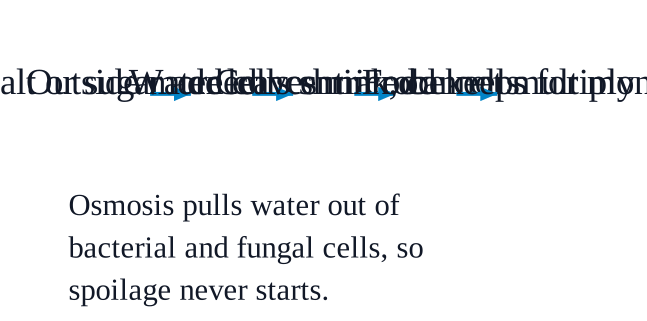
    (i) Osmosis. Deepa is using the movement of water across the selectively permeable membranes of microbial cells to keep her produce from spoiling.
    NCERT_Solution_Class9_Science_Ch2_RRR_Q2-16(ii) How high concentrations of salt and sugar stop spoilage
    The salt, sugar or jaggery makes the liquid around the fruit far more concentrated than the cell sap inside a bacterial or fungal cell — the surroundings become hypertonic.
    Water therefore moves out of those microbial cells, through their selectively permeable membranes, by osmosis, from the dilute inside to the concentrated outside.
    Stripped of water the cells shrink and cannot carry on their activities, grow or multiply, so the spoilage organisms never take hold and the pickle, murabba or sharbat keeps for months.
    The fruit's own cells lose water in the same way, which is why the pieces in a murabba turn firm and translucent.
    (iii) A healthy recipe of the same kind
    Amla murabba with jaggery: prick washed amla all over, steam or boil until just soft, then simmer in a thick jaggery syrup with a little cardamom until the fruit turns translucent; cool completely and bottle in a clean, dry glass jar.
    Jaggery replaces refined sugar and still gives the concentrated syrup that osmosis needs, while keeping the iron and minerals. A salt-and-lemon-juice pickle dried in the sun works the same way with no oil at all.
    (iv) Scientific values addressed
    Applying a scientific principle — osmosis — to solve a real problem instead of accepting the loss.
    Observing carefully and drawing the right inference: three-quarters of the harvest was going to waste, and the cause was perishability, not the market.
    Respecting traditional knowledge while checking that it is scientifically sound.
    Sustainability — cutting waste rather than producing it.
    Contributing to food security and to the local economy.
    Self-reliance and enterprise: acting on what she understood, and turning a loss into an income.