Draw the plant cell — it is the one that shows every clue, including the rod-shaped chloroplasts.
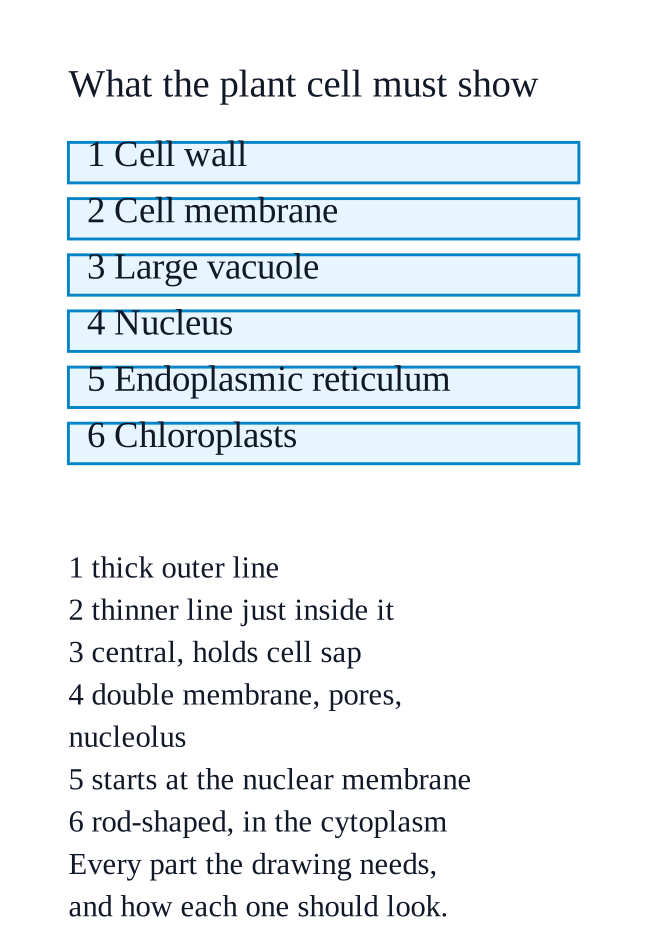
Outline, two lines and not one: a thick outer rectangle with rounded corners for the cell wall, and a thinner line drawn just inside it, following it the whole way round, for the cell membrane.
Vacuole: one large central space filling most of the cell, bounded by a single line and labelled vacuole (cell sap). Everything else goes in the narrow band of cytoplasm between it and the membrane.
Nucleus (clue i): a dark round body pushed to one side. Draw its boundary as two closely spaced lines — the double-layered nuclear membrane — leave two or three gaps in it for the nuclear pores, and put a small solid circle inside for the nucleolus.
Endoplasmic reticulum (clue ii): begin it at the nuclear membrane, so it clearly runs out of the nuclear envelope, and let it spread through the cytoplasm as a branching network of long flattened tubes. Dot one stretch with tiny beads and label it rough ER (ribosomes attached); leave another stretch undotted and label it smooth ER.
Mitochondria (clue iii): two or three rod-shaped bodies, each with a smooth outer line and an inner line thrown into finger-like folds — label those folds cristae.
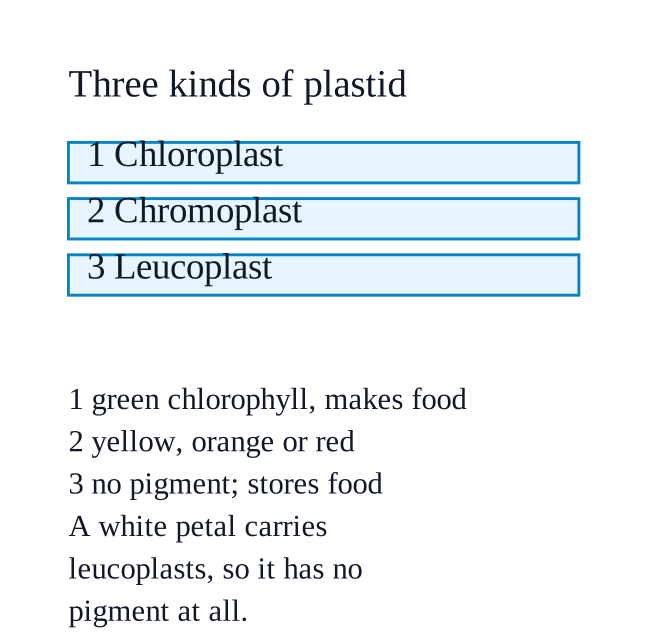
Chloroplasts (clue iii): three or four rod-shaped bodies with a double boundary, a few small discs drawn inside them, and the space around the discs labelled stroma.
Golgi apparatus: a stack of four or five flattened, slightly curved sacs, with tiny circles budding off the ends as vesicles.
Ribosomes: scatter a few free dots in the cytoplasm as well as the ones sitting on the rough ER.
Label the remaining space cytoplasm, run a ruled label line from every single part to its name written outside the cell, and title the figure "A typical plant cell".
If you pick the animal cell instead: no cell wall and no chloroplasts, an irregular rounded outline, only small scattered vacuoles, and add lysosomes as small single-membrane sacs.