Exercise 9.9
The atomic number of fluorine is 9. Explain the formation of the fluorine molecule (). Just as atoms share electrons to form covalent bonds, we too, can share and care to build strong relationships with people around us. This sharing brings unity and stability, laying the foundation for a stronger community, and ultimately, a strong nation. Exploration|Grade
Not cross-checked
NCERT prints no numerical answer for this exercise, so this working has not been cross-checked against the book.
Two fluorine atoms share one pair of electrons, forming a single covalent bond: F—F.
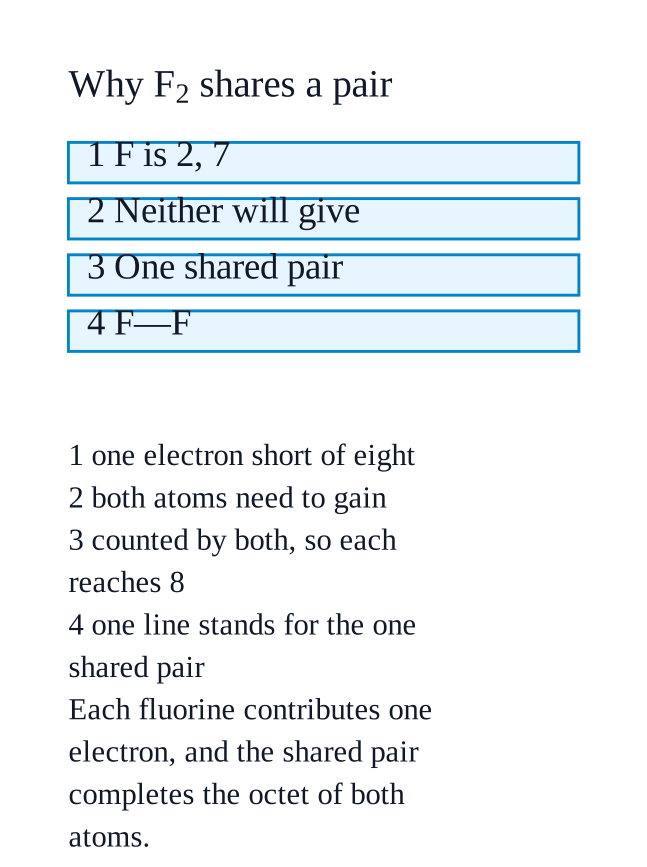
Fluorine (\(\displaystyle Z = 9\)) has the configuration $\displaystyle 2$, $\displaystyle 7$ — seven valence electrons, one short of an octet.
Both atoms need to gain an electron, so neither will donate one; the only way for both to become stable is to share.
Each atom puts in one electron, and the shared pair is counted by both atoms, so each fluorine now has $\displaystyle 8$ valence electrons.
The shared pair attracts both nuclei and holds the atoms together; each atom also keeps three lone pairs.
The molecule is written \(\displaystyle F_2\), or F—F, one line for the one shared pair.