SolveItClass 9 · NCERT

NCERT Solutions · Class 9 Science Atomic Foundations of Matter

39 questions · 21 still being checked

Pause and Ponder 9.6–9.7 (part 8 of 22)

  1. Exercise 9.6

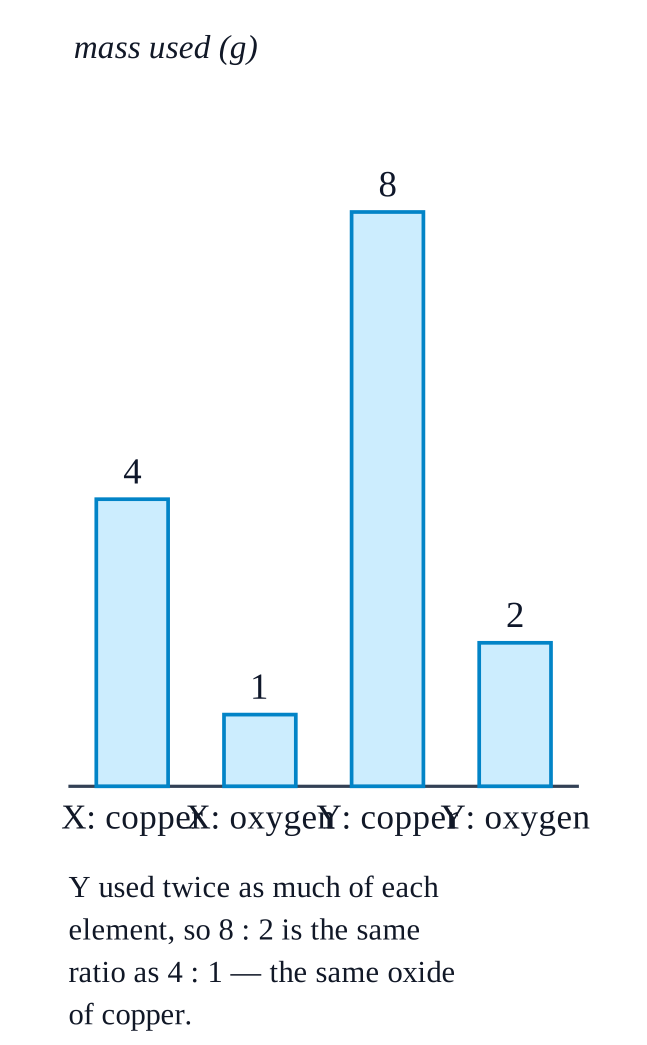
    Students X and Y, both prepared an oxide of copper by combining copper and oxygen in the ratios of 4\displaystyle 4:1\displaystyle 1 and 8\displaystyle 8:2\displaystyle 2, respectively. Do their results justify the Law of Constant Proportions? Explain.

    Not cross-checked

    NCERT prints no numerical answer for this exercise, so this working has not been cross-checked against the book.

    Yes — the results do justify the Law of Constant Proportions.
    NCERT_Solution_Class9_Science_Ch9_PP_Q9-6
    Student X obtained copper : oxygen \(\displaystyle = 4 : 1\).
    Student Y obtained \(\displaystyle 8 : 2\), which reduces to \(\displaystyle \dfrac{8}{2} : \dfrac{2}{2} = 4 : 1\).
    The two ratios are identical, so both students made the same oxide of copper — Y simply used twice as much of each element.
    That is exactly what the law says: however it is prepared, a compound contains its elements in the same fixed ratio by mass.
  2. Exercise 9.7

    Assertion (A): 2\displaystyle 2 g of hydrogen combines with 16\displaystyle 16 g of oxygen to form 18\displaystyle 18 g of water. Reason (R): According to Dalton’s Atomic Theory, atoms combine in a simple whole number ratio by mass to form compounds. Choose the correct option: (i) Both A and R are true, and R is the correct explanation of A. (ii) Both A and R are true, but R is not the correct explanation of A. (iii) A is true, but R is false. (iv) A is false, but R is true. Exploration|Grade 9\displaystyle 9

    Not cross-checked

    NCERT prints no numerical answer for this exercise, so this working has not been cross-checked against the book.

    NCERT’s answer
    (iii)
    -; one; two
    (iii) A is true, but R is false.
    NCERT_Solution_Class9_Science_Ch9_PP_Q9-7
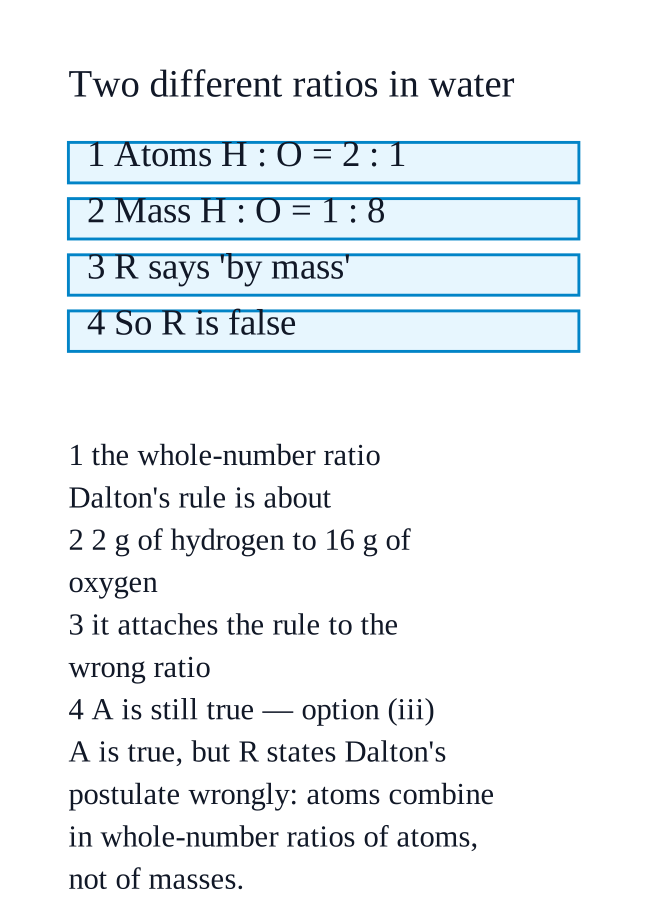
    A is true. \(\displaystyle 2 + 16 = 18\) g, and \(\displaystyle 2 : 16 = 1 : 8\), the fixed hydrogen : oxygen mass ratio of water given in the chapter.
    R is false as worded. Dalton's postulate is that atoms combine in the ratio of simple whole numbers — that is a ratio of the numbers of atoms, not a ratio by mass.
    The two ratios are different quantities. In water the atoms combine as \(\displaystyle H : O = 2 : 1\) (the formula \(\displaystyle H_{2}O\) means two hydrogen atoms to one oxygen atom), while the masses combine as \(\displaystyle 1 : 8\). Dalton's whole-number rule speaks about the first, and R attaches it to the second.
    Nor is a mass ratio obliged to be whole numbers at all — sodium chloride combines in the mass ratio \(\displaystyle 23 : 35.5\).
    So R states the postulate wrongly and cannot explain A.