Exercise 1
Find the total surface area of a cone, if its slant height is m and diameter of its base is m.
Not cross-checked
This solution has not been cross-checked against the answer printed in NCERT.
Radius is half the diameter.\[r = \frac{24}{2} = 12\ \text{m}, \qquad l = 21\ \text{m} \]\[\text{TSA} = \pi r l + \pi r^2 = \pi r (l + r) \]\[\text{TSA} = \frac{22}{7} \times 12 \times (21 + 12) \]\[\text{TSA} = \frac{22}{7} \times 12 \times 33 = \frac{8712}{7} \approx 1244.57 \]Answer: \(\displaystyle \approx 1244.57\ \text{m}^2\) (\(\displaystyle \pi = \tfrac{22}{7}\))
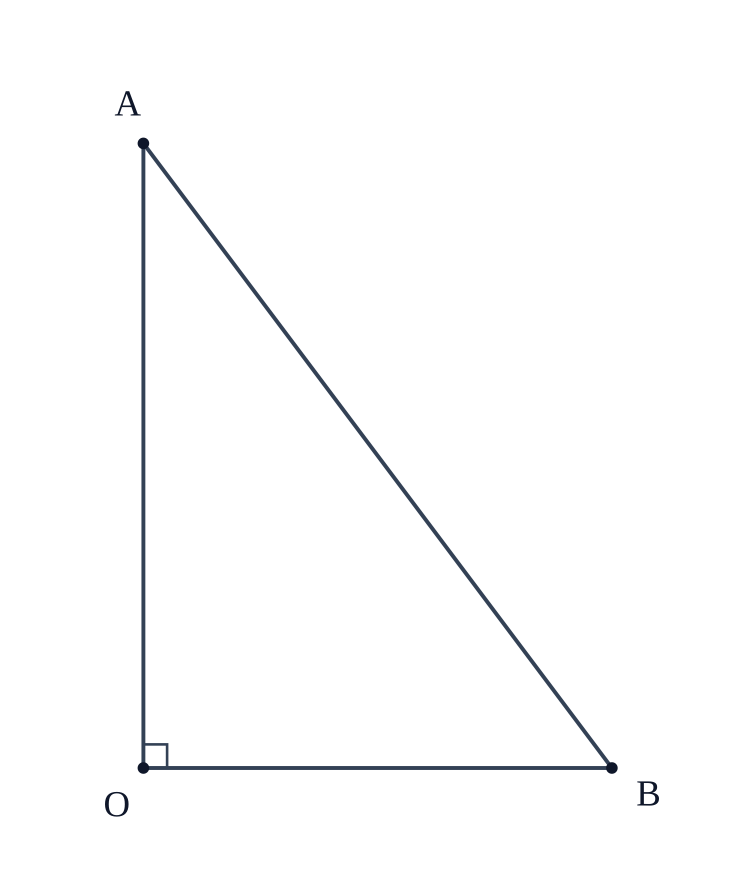 \[l^2 = h^2 + r^2 = 16^2 + 12^2 = 256 + 144 = 400 \Rightarrow l = 20 \]\[\text{CSA} = \pi r l = 3.14 \times 12 \times 20 = 753.6 \]\[\text{TSA} = \pi r (l + r) = 3.14 \times 12 \times (20 + 12) = 1205.76 \]Answer: CSA \(\displaystyle = 753.6\ \text{cm}^2\), TSA \(\displaystyle = 1205.76\ \text{cm}^2\) (\(\displaystyle \pi = 3.14\))
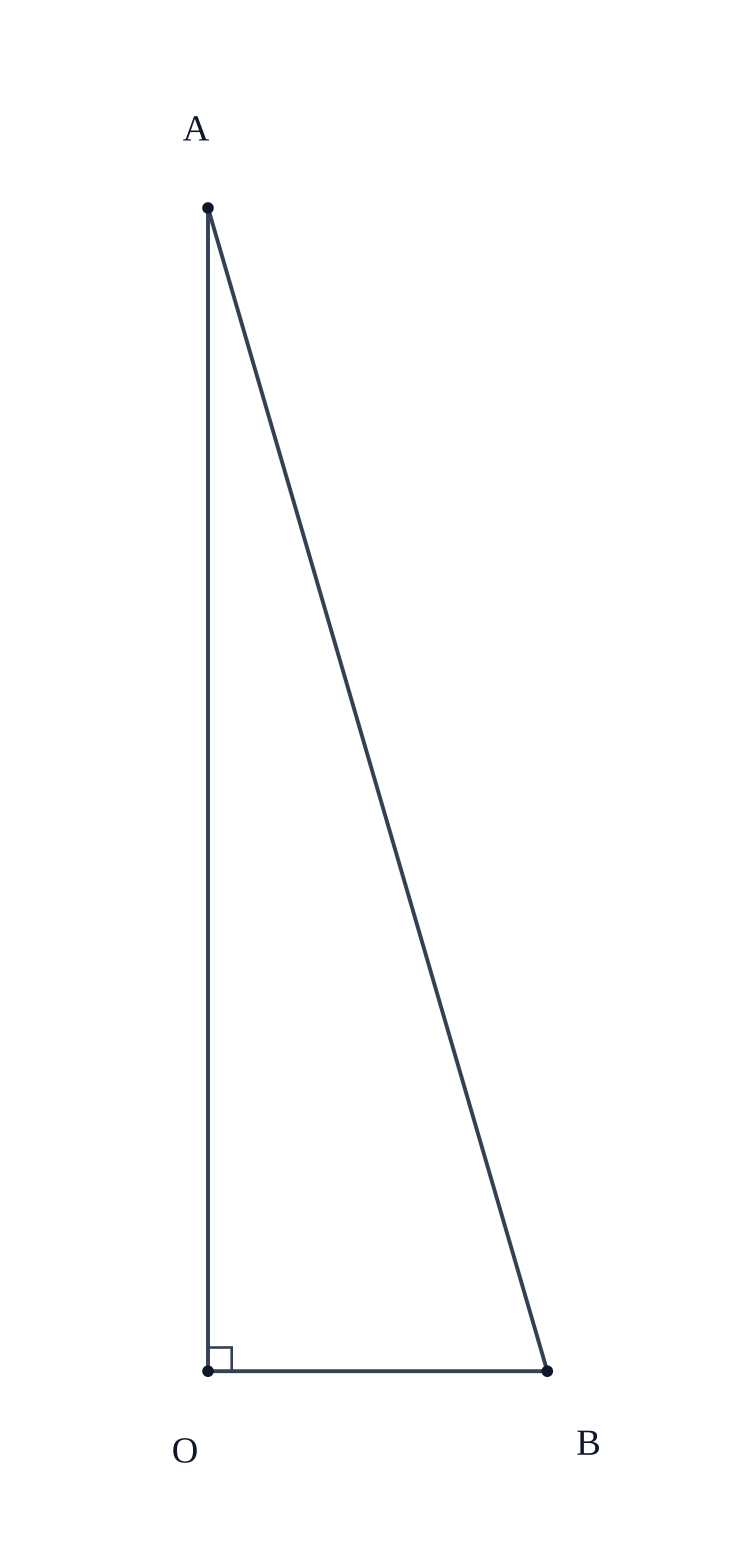 \[l^2 = 7^2 + 24^2 = 49 + 576 = 625 \Rightarrow l = 25 \]\[\text{CSA of one cap} = \pi r l = \frac{22}{7} \times 7 \times 25 = 550 \]\[\text{sheet for 10 caps} = 10 \times 550 = 5500 \]Answer: \(\displaystyle 5500\ \text{cm}^2\) (\(\displaystyle \pi = \tfrac{22}{7}\))
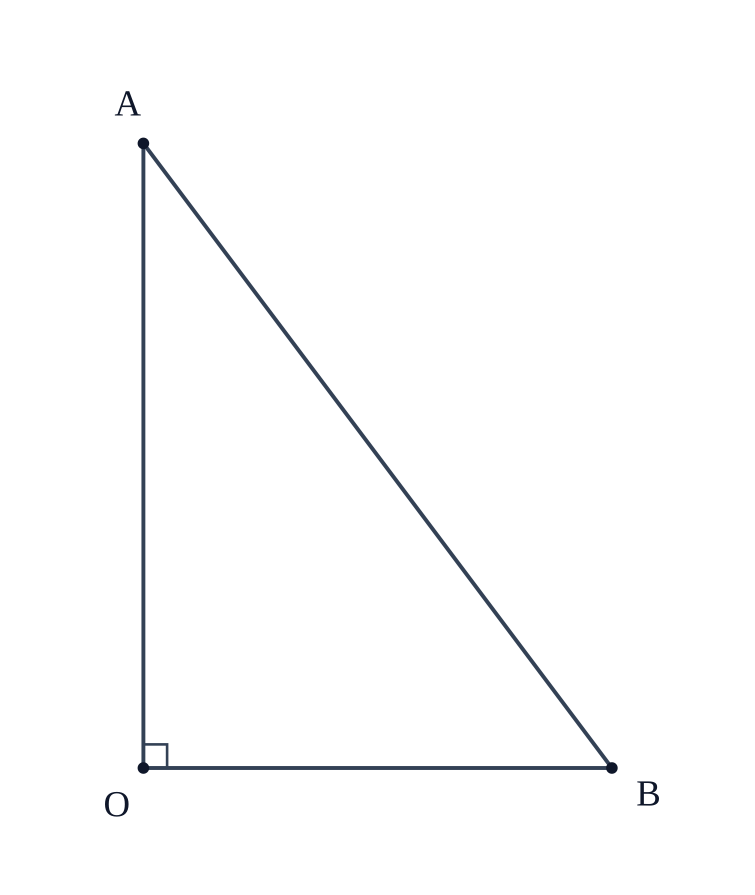 \[l^2 = 8^2 + 6^2 = 100 \Rightarrow l = 10\ \text{m} \]\[\text{CSA} = \pi r l = 3.14 \times 6 \times 10 = 188.4\ \text{m}^2 \]\[\text{length} = \frac{\text{area}}{\text{width}} = \frac{188.4}{3} = 62.8\ \text{m} \]Add the $\displaystyle 20$ cm ($\displaystyle 0.2$ m) allowance.\[62.8 + 0.2 = 63 \]Answer: \(\displaystyle 63\ \text{m}\) (\(\displaystyle \pi = 3.14\))
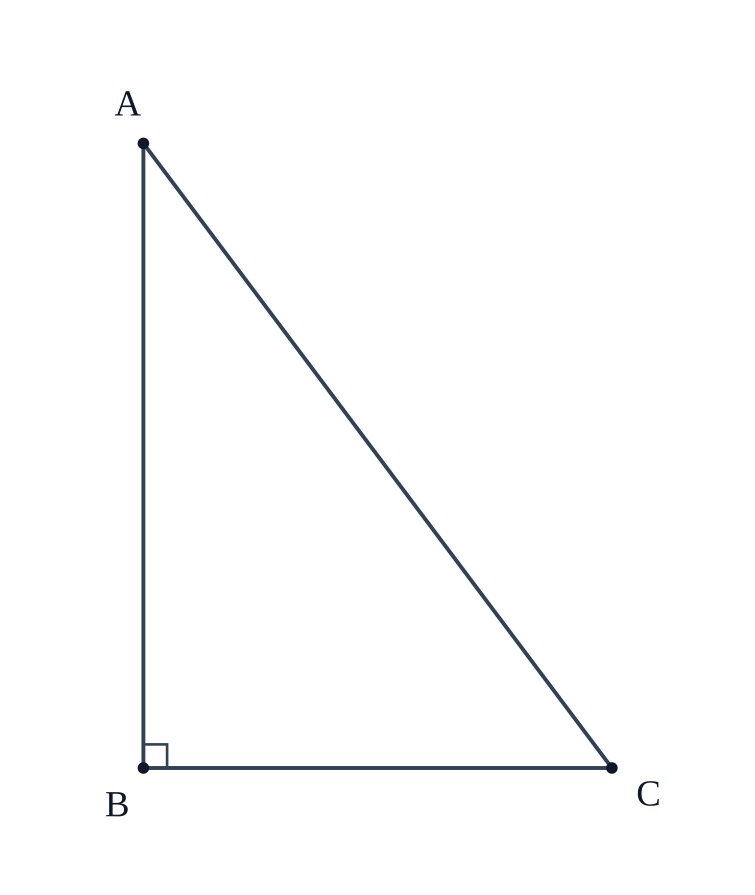 \[h = AB = 8,\qquad r = BC = 6,\qquad l = AC = 10 \]\[V = \frac{1}{3}\pi r^2 h = \frac{1}{3} \times 3.14 \times 6^2 \times 8 = 301.44 \]\[\text{CSA} = \pi r l = 3.14 \times 6 \times 10 = 188.4 \]Answer: volume \(\displaystyle = 301.44\ \text{cm}^3\), CSA \(\displaystyle = 188.4\ \text{cm}^2\) (\(\displaystyle \pi = 3.14\); exactly \(\displaystyle 96\pi\) and \(\displaystyle 60\pi\))
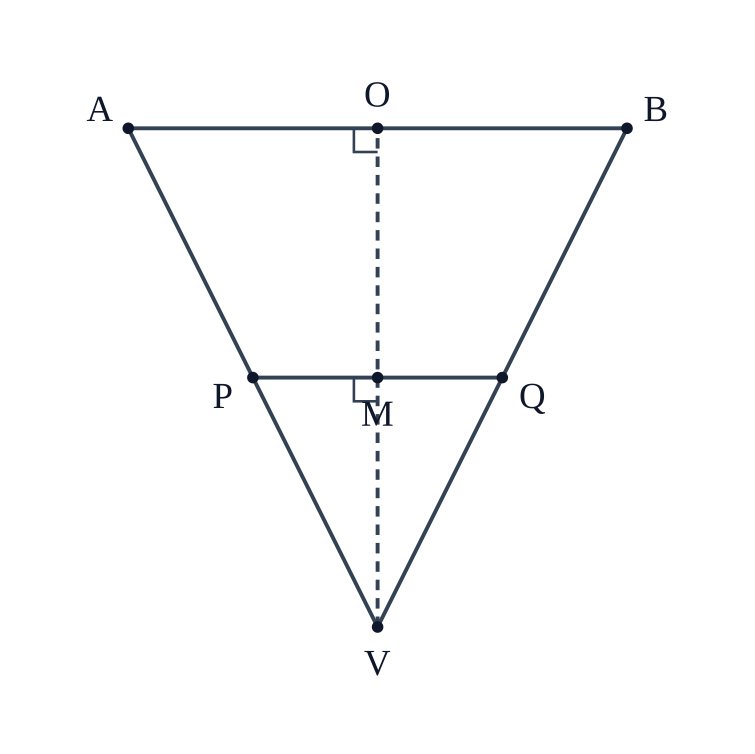 In the axial section \(\displaystyle PM \parallel AO\), so \(\displaystyle \triangle VPM \sim \triangle VAO\).
\[\frac{r}{R} = \frac{VM}{VO} = \frac{H/2}{H} = \frac12 \quad \Rightarrow \quad r = \frac{R}{2} \]
The water is itself a cone of radius \(\displaystyle r\) and height \(\displaystyle \tfrac{H}{2}\).
\[V_{\text{water}} = \frac13 \pi r^2 h = \frac13 \pi \left(\frac{R}{2}\right)^2 \left(\frac{H}{2}\right) = \frac18 \cdot \frac13 \pi R^2 H \]
\[V_{\text{cup}} = \frac13 \pi R^2 H \]
\[\frac{V_{\text{water}}}{V_{\text{cup}}} = \frac18 \]
Answer: \(\displaystyle \dfrac18\) of the cup's volume.
In the axial section \(\displaystyle PM \parallel AO\), so \(\displaystyle \triangle VPM \sim \triangle VAO\).
\[\frac{r}{R} = \frac{VM}{VO} = \frac{H/2}{H} = \frac12 \quad \Rightarrow \quad r = \frac{R}{2} \]
The water is itself a cone of radius \(\displaystyle r\) and height \(\displaystyle \tfrac{H}{2}\).
\[V_{\text{water}} = \frac13 \pi r^2 h = \frac13 \pi \left(\frac{R}{2}\right)^2 \left(\frac{H}{2}\right) = \frac18 \cdot \frac13 \pi R^2 H \]
\[V_{\text{cup}} = \frac13 \pi R^2 H \]
\[\frac{V_{\text{water}}}{V_{\text{cup}}} = \frac18 \]
Answer: \(\displaystyle \dfrac18\) of the cup's volume.