SolveIt is under development
SolveItClass 9 · NCERT

NCERT Solutions · Class 9 Mathematics Math of Space: Surface Area and Volume

52 questions · 52 still being checked

End-of-Chapter Exercises 1–10 (part 5 of 6)

  1. For guesstimate problems, make a guess first before solving.

    Exercise 1

    Estimate how many scoops of ice cream can be obtained from a cuboidal container of dimensions 10 cm×15 cm×20 cm\displaystyle 10 \mathrm{~cm} \times 15 \mathrm{~cm} \times 20 \mathrm{~cm}.

    Not cross-checked

    This solution has not been cross-checked against the answer printed in NCERT.

    Guess: about $\displaystyle 40$ scoops.Assume a scoop is a ball of radius $\displaystyle 2.5$ cm (diameter $\displaystyle 5$ cm) and the whole block can be scooped out.\[V_{\text{container}} = 10 \times 15 \times 20 = 3000 \ \text{cm}^3 \] \[V_{\text{scoop}} = \tfrac{4}{3}\pi (2.5)^3 \approx 65.4 \ \text{cm}^3 \] \[\text{number of scoops} \approx \frac{3000}{65.4} \approx 45.8 \]Only whole scoops count, so 45. A different scoop size gives a different count; any reasonable assumption is valid.Answer: about $\displaystyle 45$ scoops (scoop of radius $\displaystyle 2.5$ cm).
  2. Exercise 2

    A cube of integer side length a\displaystyle a is made of unit cubes. Write an expression giving the number of unit cubes to be added to make a cube of side length a+1\displaystyle a+1.

    Not cross-checked

    This solution has not been cross-checked against the answer printed in NCERT.

    A cube of side \(\displaystyle a\) has \(\displaystyle a^3\) unit cubes and a cube of side \(\displaystyle a+1\) has \(\displaystyle (a+1)^3\).\[(a+1)^3 - a^3 = (a^3 + 3a^2 + 3a + 1) - a^3 \] \[= 3a^2 + 3a + 1 \]The added layer is $\displaystyle 3$ slabs \(\displaystyle a \times a \times 1\), $\displaystyle 3$ rods \(\displaystyle a \times 1 \times 1\) and $\displaystyle 1$ corner cube:\[3(a^2) + 3(a) + 1 = 3a^2 + 3a + 1 \]Check for \(\displaystyle a = 2\):\[3^3 - 2^3 = 19 = 3(4) + 3(2) + 1 \]Answer: \(\displaystyle 3a^2 + 3a + 1\) unit cubes.
  3. Exercise 3

    Solve the following:
    (i)
    Could a person drink enough water in a lifetime to fill an entire room the size of your classroom?
    (ii)
    Estimate the number of bricks used to build the walls of your classroom.

    Not cross-checked

    This solution has not been cross-checked against the answer printed in NCERT.

    Assume a classroom \(\displaystyle 8\ \text{m} \times 6\ \text{m} \times 3\ \text{m}\); other classrooms give different numbers.(i) Guess: yes. Take $\displaystyle 2$ L of water a day for $\displaystyle 70$ years, and \(\displaystyle 1\ \text{m}^3 = 1000\ \text{L}\).\[V_{\text{room}} = 8 \times 6 \times 3 = 144\ \text{m}^3 = 144\,000\ \text{L} \] \[\text{water drunk} \approx 2 \times 365 \times 70 = 51\,100\ \text{L} \] \[51\,100 < 144\,000 \]Even $\displaystyle 3$ L a day for $\displaystyle 80$ years gives only $\displaystyle 87$ $\displaystyle 600$ L.(ii) Walls $\displaystyle 3$ m high and $\displaystyle 20$ cm thick, doors and windows about $\displaystyle 10$ m\(\displaystyle ^2\), brick \(\displaystyle 20 \times 10 \times 10\) cm.\[\text{wall area} = 2(8 + 6) \times 3 - 10 = 74\ \text{m}^2 \] \[\text{wall volume} = 74 \times 0.2 = 14.8\ \text{m}^3 \] \[\text{number of bricks} = \frac{14.8}{0.2 \times 0.1 \times 0.1} = 7400 \]Answer: (i) No; about $\displaystyle 51$ $\displaystyle 000$ L against $\displaystyle 144$ $\displaystyle 000$ L. (ii) About $\displaystyle 7400$ bricks.
  4. Exercise 4

    You are given two options: (A) one chocolate cube of side 50\displaystyle 50 mm, (B) hundred chocolate cubes of side 10\displaystyle 10 mm. Which option gives you more chocolate?

    Not cross-checked

    This solution has not been cross-checked against the answer printed in NCERT.

    A quick guess may favour B, since $\displaystyle 100$ pieces sounds like more. Compare the volumes (same chocolate).\[V_A = 50^3 = 125\,000\ \text{mm}^3 \] \[V_B = 100 \times 10^3 = 100\,000\ \text{mm}^3 \] \[V_A - V_B = 25\,000\ \text{mm}^3 > 0 \] \[\frac{V_A}{V_B} = 1.25 \]Answer: Option A gives more, $\displaystyle 25$% more than B.
  5. Exercise 5

    If all the people in the world are crowded together in one location, how much area would it cover?

    Not cross-checked

    This solution has not been cross-checked against the answer printed in NCERT.

    Guess: about the area of a large city.Assume $\displaystyle 8$ billion people, each standing in a \(\displaystyle 0.5\ \text{m} \times 0.5\ \text{m}\) space (a tight crowd), and \(\displaystyle 1\ \text{km}^2 = 10^6\ \text{m}^2\).\[\text{area per person} = 0.5 \times 0.5 = 0.25\ \text{m}^2 \] \[A = 8 \times 10^{9} \times 0.25 = 2 \times 10^{9}\ \text{m}^2 = 2000\ \text{km}^2 \] \[\text{side of a square of this area} = \sqrt{2000} \approx 45\ \text{km} \]Allowing \(\displaystyle 0.5\ \text{m}^2\) each doubles this to $\displaystyle 4000$ km\(\displaystyle ^2\); other assumptions are valid.Answer: about $\displaystyle 2000$ km\(\displaystyle ^2\), a square roughly $\displaystyle 45$ km on a side.
  6. Exercise 6

    A school provides milk to its students in cylindrical glasses, each with a diameter of 7\displaystyle 7 cm . If each glass is filled with milk to a height of 12\displaystyle 12 cm, how many litres of milk are needed to serve 1600\displaystyle 1600 students? Use 1000 cm3=1\displaystyle 1000 \mathrm{~cm}^3=1 litre.

    Not cross-checked

    This solution has not been cross-checked against the answer printed in NCERT.

    Diameter $\displaystyle 7$ cm gives radius \(\displaystyle r = 3.5\) cm. Take \(\displaystyle \pi = \tfrac{22}{7}\).\[V_{\text{glass}} = \pi r^2 h = \tfrac{22}{7} \times (3.5)^2 \times 12 = 462\ \text{cm}^3 \] \[V_{\text{total}} = 1600 \times 462 = 739\,200\ \text{cm}^3 \] \[\frac{739\,200}{1000} = 739.2\ \text{litres} \]Answer: $\displaystyle 739.2$ litres.
  7. Exercise 7

    The surface area of a sphere of radius 5\displaystyle 5 cm is five times the area of the curved surface of a cone of radius 4\displaystyle 4 cm. Find the height and the volume of the cone.

    Not cross-checked

    This solution has not been cross-checked against the answer printed in NCERT.

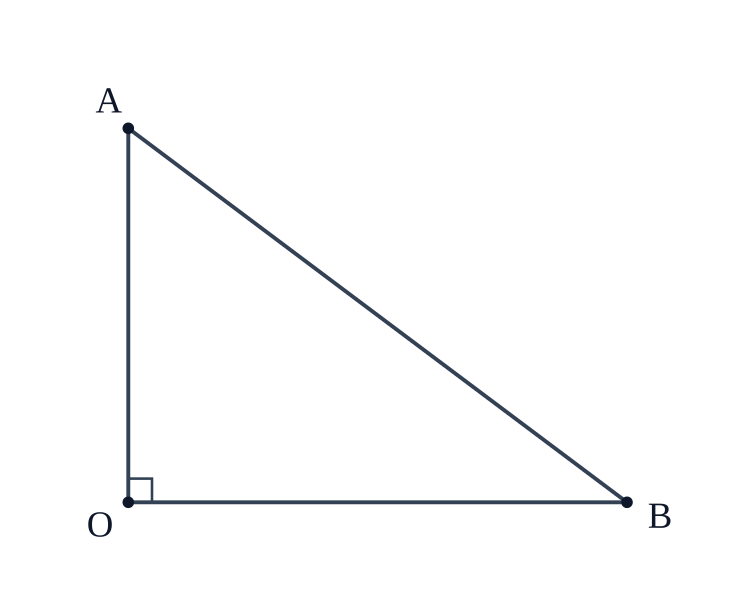
    \[\text{sphere: } 4\pi r^2 = 4\pi (5)^2 = 100\pi\ \text{cm}^2 \] \[\text{cone: } \pi r l = \pi (4)\, l = 4\pi l \] \[100\pi = 5 \times 4\pi l \] \[l = 5\ \text{cm} \]In the right triangle \(\displaystyle AOB\), with \(\displaystyle AO = h\), \(\displaystyle OB = r\), \(\displaystyle AB = l\):NCERT_Solution_Class9_Maths_Ch14_EoC_Q7\[h = \sqrt{l^2 - r^2} = \sqrt{25 - 16} = 3\ \text{cm} \] \[V = \tfrac{1}{3}\pi r^2 h = \tfrac{1}{3}\pi (16)(3) = 16\pi\ \text{cm}^3 \approx 50.3\ \text{cm}^3 \]Answer: \(\displaystyle h = 3\) cm and \(\displaystyle V = 16\pi \approx 50.3\ \text{cm}^3\).
  8. Exercise 8

    Take Earth to be a perfect sphere with radius 6370\displaystyle 6370 km. Take Jupiter to be a perfect sphere with radius 69,900\displaystyle 69,900 km. Take the Sun to be a perfect sphere with radius 6,95,700\displaystyle 6,95,700 km. Compute approximately:
    (i)
    the ratio of the volume of Jupiter to the volume of the Earth;
    (ii)
    the ratio of the volume of the Sun to the volume of the Earth. (Calculator can be used.)

    Not cross-checked

    This solution has not been cross-checked against the answer printed in NCERT.

    Both are spheres, so \(\displaystyle V = \tfrac{4}{3}\pi r^3\) and the \(\displaystyle \tfrac43\pi\) cancels in a ratio:\[\frac{V_1}{V_2} = \frac{\tfrac{4}{3}\pi r_1^3}{\tfrac{4}{3}\pi r_2^3} = \left(\frac{r_1}{r_2}\right)^3 \](i) \[\frac{V_{\text{Jupiter}}}{V_{\text{Earth}}} = \left(\frac{69\,900}{6370}\right)^3 \approx (10.97)^3 \approx 1321 \](ii) \[\frac{V_{\text{Sun}}}{V_{\text{Earth}}} = \left(\frac{695\,700}{6370}\right)^3 \approx (109.2)^3 \approx 1.30 \times 10^{6} \]Answer: (i) about $\displaystyle 1300$ ($\displaystyle 1321$); (ii) about \(\displaystyle 1.3 \times 10^{6}\).
  9. Exercise 9

    Show that the volume of a sphere is equal to 23\displaystyle \frac{2}{3} of the volume of the smallest cylinder which encloses it.

    Not cross-checked

    This solution has not been cross-checked against the answer printed in NCERT.

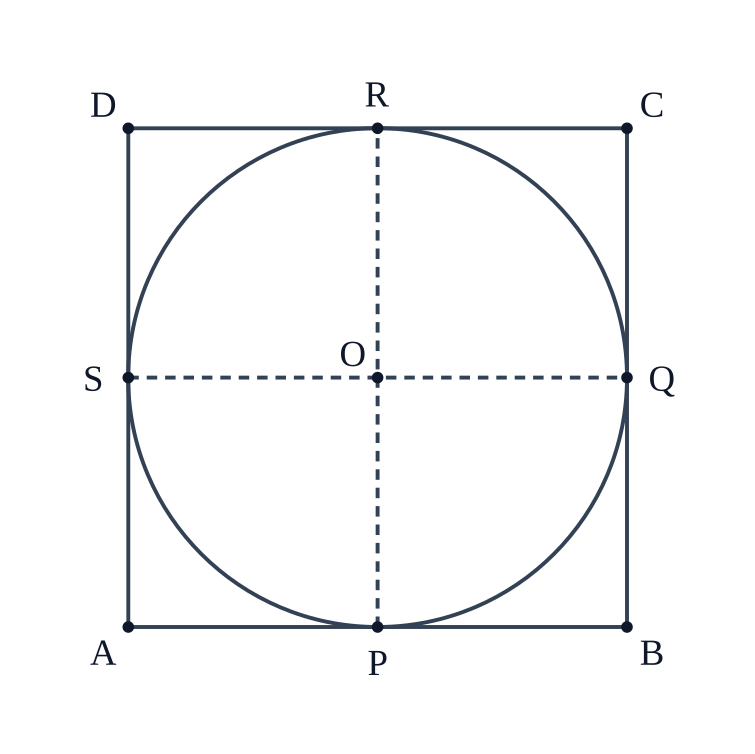
    The smallest enclosing cylinder touches the sphere at its base, top and curved surface. So its base radius is \(\displaystyle r\) and its height is the diameter, \(\displaystyle PR = 2r\) (see figure).NCERT_Solution_Class9_Maths_Ch14_EoC_Q9\[V_{\text{sphere}} = \tfrac{4}{3}\pi r^3 \] \[V_{\text{cylinder}} = \pi r^2 \cdot 2r = 2\pi r^3 \] \[\frac{V_{\text{sphere}}}{V_{\text{cylinder}}} = \frac{\tfrac{4}{3}\pi r^3}{2\pi r^3} = \frac{2}{3} \]Answer: \(\displaystyle V_{\text{sphere}} = \tfrac{2}{3}\,V_{\text{cylinder}}\).
  10. Exercise 10

    Suppose the Earth is perfectly spherical. A string is wrapped tightly around the equator of the Earth. Another string, 1\displaystyle 1 metre longer, is placed around the Earth so that it forms a larger circle, staying the same distance above the ground everywhere. How high above the ground is the second string? Repeat this for:
    (i)
    the Moon
    (ii)
    Jupiter
    (iii)
    a volleyball. Are you surprised by the three answers? Why or why not?

    Not cross-checked

    This solution has not been cross-checked against the answer printed in NCERT.

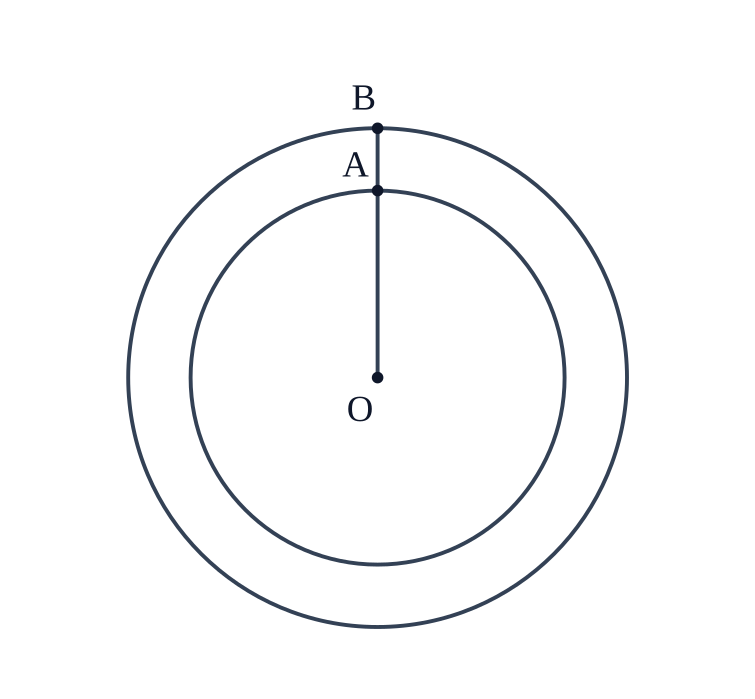
    Guess: the bigger the sphere, the smaller the gap.Let \(\displaystyle R\) be the radius and \(\displaystyle h\) the height of the second string; each string's length is the circumference of its circle (\(\displaystyle OA = R\), \(\displaystyle AB = h\) in the figure).NCERT_Solution_Class9_Maths_Ch14_EoC_Q10\[2\pi R = C \quad \text{(tight string)} \] \[2\pi (R + h) = C + 1 \quad \text{(longer string)} \] \[2\pi h = 1 \ \Rightarrow\ h = \frac{1}{2\pi} \approx 0.159\ \text{m} \]\(\displaystyle R\) has cancelled, so the height is the same for every sphere. For the Earth, \(\displaystyle R \approx 6.37\times10^{6}\) m and \(\displaystyle C \approx 4.00\times10^{7}\) m.(i) Moon. \(\displaystyle R \approx 1.74\times10^{6}\) m: \[C \approx 1.09\times10^{7}\ \text{m}, \qquad h = \frac{(C+1) - C}{2\pi} \approx 0.159\ \text{m} \](ii) Jupiter. \(\displaystyle R \approx 6.99\times10^{7}\) m: \[C \approx 4.39\times10^{8}\ \text{m}, \qquad h = \frac{(C+1) - C}{2\pi} \approx 0.159\ \text{m} \](iii) Volleyball. \(\displaystyle R \approx 0.105\) m: \[C \approx 0.66\ \text{m}, \qquad h = \frac{(C+1) - C}{2\pi} \approx 0.159\ \text{m} \]Surprised? Yes at first: one extra metre on a string $\displaystyle 40,000$ km long lifts it $\displaystyle 16$ cm, exactly as it does on a volleyball. The extra length alone fixes \(\displaystyle h\).Answer: \(\displaystyle h = \dfrac{1}{2\pi}\ \text{m} \approx 16\) cm for the Earth, the Moon, Jupiter and the volleyball alike.