SolveIt is under development
SolveItClass 9 · NCERT

NCERT Solutions · Class 9 Mathematics Math of Space: Surface Area and Volume

52 questions · 52 still being checked

Exercise Set 14.1 1–8 (part 1 of 6)

  1. Exercise 1

    The volume of a cube is 64 cm3\displaystyle 64 \mathrm{~cm}^3. What is its total surface area?

    Not cross-checked

    This solution has not been cross-checked against the answer printed in NCERT.

    Let the side be \(\displaystyle a\) cm.\[a^3 = 64 \Rightarrow a = \sqrt[3]{64} = 4 \]\[\text{TSA} = 6a^2 = 6 \times 4^2 = 96 \]Answer: \(\displaystyle 96\ \text{cm}^2\)
  2. Exercise 2

    How many small cubes with side 20\displaystyle 20 cm can be packed tight in a cubical box with side 2\displaystyle 2 m?

    Not cross-checked

    This solution has not been cross-checked against the answer printed in NCERT.

    \[2\ \text{m} = 200\ \text{cm} \]\[\text{cubes along one edge} = \frac{200}{20} = 10 \]\[\text{cubes in the box} = 10 \times 10 \times 10 = 1000 \]Check by volumes:\[\frac{200^3}{20^3} = \frac{8\,000\,000}{8000} = 1000 \]Answer: \(\displaystyle 1000\) cubes
  3. Exercise 3

    The dimensions of a godown are 40 m×25 m×10 m\displaystyle 40 \mathrm{~m} \times 25 \mathrm{~m} \times 10 \mathrm{~m}. If it is filled with cuboidal boxes, each of dimensions 2 m×1.25 m×1 m\displaystyle 2 \mathrm{~m} \times 1.25 \mathrm{~m} \times 1 \mathrm{~m}, then find the number of boxes.

    Not cross-checked

    This solution has not been cross-checked against the answer printed in NCERT.

    The boxes fit exactly along each edge of the godown:\[\frac{40}{2} = 20, \qquad \frac{25}{1.25} = 20, \qquad \frac{10}{1} = 10 \]\[\text{number of boxes} = 20 \times 20 \times 10 = 4000 \]Check by volumes:\[\frac{40 \times 25 \times 10}{2 \times 1.25 \times 1} = \frac{10\,000}{2.5} = 4000 \]Answer: \(\displaystyle 4000\) boxes
  4. Exercise 4

    Two cubes each of volume 125 cm3\displaystyle 125 \mathrm{~cm}^3 are joined end to end. Find the surface area of the resulting cuboid.

    Not cross-checked

    This solution has not been cross-checked against the answer printed in NCERT.

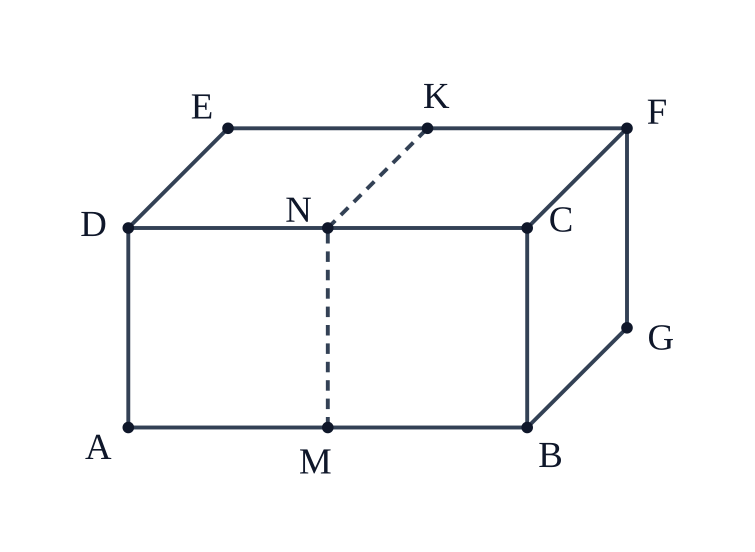
    Each cube has side \(\displaystyle a\) cm.\[a^3 = 125 \Rightarrow a = 5 \]Joined end to end, the cubes form the cuboid in the figure:NCERT_Solution_Class9_Maths_Ch14_Ex14-1_Q4\[l = 10,\quad w = 5,\quad h = 5 \]\[\text{TSA} = 2(lw + wh + hl) = 2(10 \cdot 5 + 5 \cdot 5 + 5 \cdot 10) = 2 \times 125 = 250 \]Check: $\displaystyle 12$ faces of area \(\displaystyle 25\), two of them hidden where the cubes touch:\[(12 - 2) \times 25 = 250 \]Answer: \(\displaystyle 250\ \text{cm}^2\)
  5. Exercise 5

    A cube of side 4\displaystyle 4 cm is cut into cubes of side 1\displaystyle 1 cm. What is the ratio of the surface areas of the original cube and all the cut-out cubes? (Note that there is no change in volume but a big change in the surface area. This property has major consequences in the biological world.)

    Not cross-checked

    This solution has not been cross-checked against the answer printed in NCERT.

    \[\text{TSA of the original cube} = 6 \times 4^2 = 96 \]\[\text{number of small cubes} = \frac{4^3}{1^3} = 64 \]\[\text{TSA of one small cube} = 6 \times 1^2 = 6 \]\[\text{TSA of all small cubes} = 64 \times 6 = 384 \]\[\text{ratio} = 96 : 384 = 1 : 4 \]Answer: \(\displaystyle 1 : 4\)
  6. Exercise 6

    The surface areas of the three faces of a cuboid that meet at one of the corners of the cuboid are 6 cm2,15 cm2\displaystyle 6 \mathrm{~cm}^2, 15 \mathrm{~cm}^2, and 10 cm2\displaystyle 10 \mathrm{~cm}^2 respectively. What is the volume of the cuboid?

    Not cross-checked

    This solution has not been cross-checked against the answer printed in NCERT.

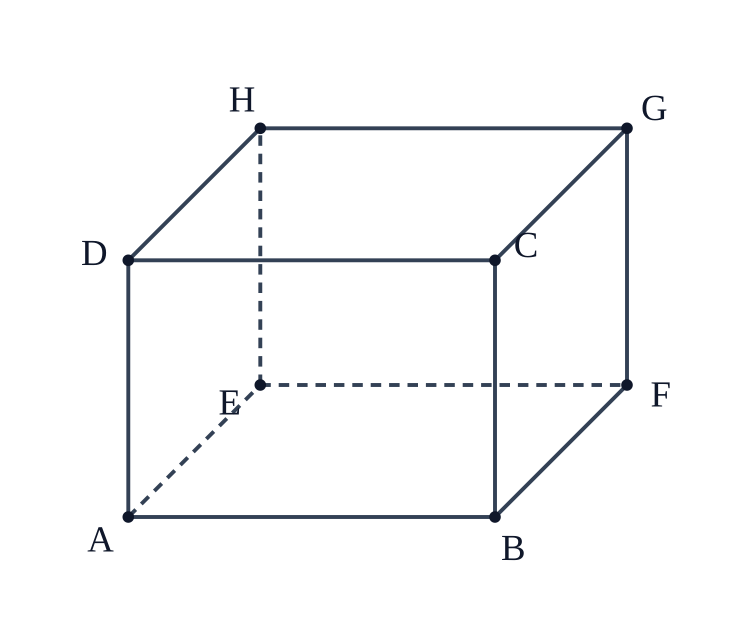
    Let the edges of the cuboid in the figure be \(\displaystyle l = AB,\ w = BF,\ h = BC\). The three faces at \(\displaystyle C\) have areas \(\displaystyle lw,\ wh,\ lh\) (which is which does not affect the volume).NCERT_Solution_Class9_Maths_Ch14_Ex14-1_Q6\[lw = 6, \qquad wh = 15, \qquad lh = 10 \]\[(lw)(wh)(lh) = (lwh)^2 = 6 \times 15 \times 10 = 900 \]\[V = lwh = \sqrt{900} = 30 \]Check: \(\displaystyle l = \dfrac{30}{15} = 2,\ w = \dfrac{30}{10} = 3,\ h = \dfrac{30}{6} = 5\), and\[lw = 6, \qquad wh = 15, \qquad lh = 10, \qquad lwh = 30 \]Answer: \(\displaystyle 30\ \text{cm}^3\)
  7. Exercise 7

    A cube of side 5\displaystyle 5 cm is painted on all its faces. If it is sliced into 1 cm3\displaystyle 1 \mathrm{~cm}^3 cubes, how many of these 1 cm3\displaystyle 1 \mathrm{~cm}^3 cubes have
    (i)
    exactly three faces painted?
    (ii)
    exactly two faces painted?
    (iii)
    exactly one face painted?
    (iv)
    no face painted?

    Not cross-checked

    This solution has not been cross-checked against the answer printed in NCERT.

    (i) Only the corner cubes have three faces on the outside; a cube has $\displaystyle 8$ corners.\[8 \](ii) Each of the $\displaystyle 12$ edges has \(\displaystyle 5 - 2 = 3\) cubes that are not corners.\[12 \times (5 - 2) = 36 \](iii) Each of the $\displaystyle 6$ faces has a \(\displaystyle (5-2) \times (5-2)\) block of cubes clear of its edges.\[6 \times (5 - 2)^2 = 54 \](iv) The unpainted cubes form the inner \(\displaystyle 3 \times 3 \times 3\) cuboid.\[(5 - 2)^3 = 27 \]Check:\[8 + 36 + 54 + 27 = 125 = 5^3 \]Answer: (i) $\displaystyle 8$, (ii) $\displaystyle 36$, (iii) $\displaystyle 54$, (iv) $\displaystyle 27$
  8. Exercise 8

    Find a cuboid with edges whose lengths are integers (in cm), given that it has a total surface area of exactly 100 cm2\displaystyle 100 \mathrm{~cm}^2.
    (i)
    Is there more than one such cuboid?
    (ii)
    Can you find them all?
    (iii)
    Show that you have found them all.

    Not cross-checked

    This solution has not been cross-checked against the answer printed in NCERT.

    With integer edges \(\displaystyle l \le w \le h\):\[2(lw + wh + hl) = 100 \Rightarrow lw + wh + hl = 50 \](i) Yes. Two examples:\[1 \times 2 \times 16: \quad 2(2 + 32 + 16) = 100 \]\[2 \times 4 \times 7: \quad 2(8 + 28 + 14) = 100 \](ii) Yes, these are the only two; (iii) shows why.(iii) Adding \(\displaystyle l^2\) to both sides factorises the equation:\[(l + w)(l + h) = 50 + l^2 \]Since \(\displaystyle l \le w \le h\), both factors are at least \(\displaystyle 2l\):\[2l \le l + w \le l + h \]Also \(\displaystyle 50 = lw + wh + hl \ge 3l^2\), so \(\displaystyle l \le 4\). Check each \(\displaystyle l\):\[\begin{array}{|c|c|l|c|} \hline l & 50 + l^2 & \text{pairs } p \times q \text{ with } 2l \le p \le q & (w, h) \\ \hline 1 & 51 & 3 \times 17 & (2, 16) \\ \hline 2 & 54 & 6 \times 9 & (4, 7) \\ \hline 3 & 59 & \text{none (59 is prime)} & - \\ \hline 4 & 66 & \text{none (66 = } 6 \times 11 \text{ but } 6 < 8) & - \\ \hline \end{array} \]Answer: (i) yes; (ii), (iii) exactly two cuboids: \(\displaystyle 1 \times 2 \times 16\) and \(\displaystyle 2 \times 4 \times 7\) (cm)