SolveIt is under development
SolveItClass 9 · NCERT

NCERT Solutions · Class 9 Mathematics Math of Space: Surface Area and Volume

52 questions · 52 still being checked

Exercise Set 14.2 1–5 (part 2 of 6)

  1. Exercise 1

    Two cylinders, A and B, are given. The radius of cylinder B is twice that of cylinder A, and the height of cylinder B is half that of cylinder A. Find the ratio of the curved surface area of A to the curved surface area of B. Also find the ratio of the volume of A to the volume of B.

    Not cross-checked

    This solution has not been cross-checked against the answer printed in NCERT.

    Let cylinder A have radius \(\displaystyle r\) and height \(\displaystyle h\). Then B has radius \(\displaystyle 2r\) and height \(\displaystyle \tfrac{h}{2}\).\[\text{CSA}_A = 2\pi r h \] \[\text{CSA}_B = 2\pi (2r)\left(\tfrac{h}{2}\right) = 2\pi r h \] \[\text{CSA}_A : \text{CSA}_B = 1 : 1 \]\[V_A = \pi r^2 h \] \[V_B = \pi (2r)^2 \left(\tfrac{h}{2}\right) = 2\pi r^2 h \] \[V_A : V_B = 1 : 2 \]Answer: curved surface areas \(\displaystyle 1:1\); volumes \(\displaystyle 1:2\).
  2. Exercise 2

    The radii of two cylinders are in the ratio 2\displaystyle 2:3\displaystyle 3, and their heights are in the ratio 3\displaystyle 3:2. Find
    (a)
    the ratio of their volumes, and
    (b)
    the ratio of their curved surface areas.

    Not cross-checked

    This solution has not been cross-checked against the answer printed in NCERT.

    Take radii \(\displaystyle 2k,\ 3k\) and heights \(\displaystyle 3m,\ 2m\).(a) Volume ratio:\[\frac{V_1}{V_2} = \frac{\pi (2k)^2 (3m)}{\pi (3k)^2 (2m)} = \frac{12}{18} = \frac{2}{3} \](b) Curved surface area ratio:\[\frac{S_1}{S_2} = \frac{2\pi (2k)(3m)}{2\pi (3k)(2m)} = \frac{12}{12} = 1 \]Answer: (a) \(\displaystyle 2:3\); (b) \(\displaystyle 1:1\).
  3. Exercise 3

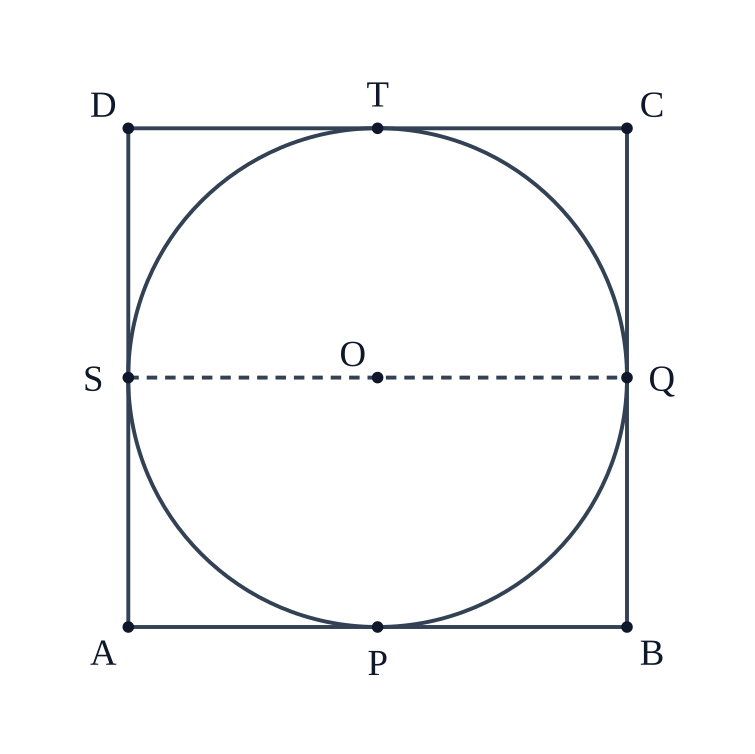
    The edge of a cube measures r cm\displaystyle r \mathrm{~cm}. The largest possible right circular cylinder is cut out of the cube. What do you think is the volume of the cylinder (in cm3\displaystyle \mathrm{cm}^3 )?

    Not cross-checked

    This solution has not been cross-checked against the answer printed in NCERT.

    The cylinder must fit inside the cube. Its height is at most \(\displaystyle r\), and its base circle must fit inside a square face of side \(\displaystyle r\). Both are largest when the base circle touches all four sides of the face.NCERT_Solution_Class9_Maths_Ch14_Ex14-2_Q3\[h = r, \qquad 2R = r \ \Rightarrow\ R = \tfrac{r}{2} \] \[V = \pi R^2 h = \pi \left(\tfrac{r}{2}\right)^2 r = \tfrac{\pi r^3}{4} \]Answer: \(\displaystyle \dfrac{\pi r^3}{4}\ \text{cm}^3\).
  4. Exercise 4

    The radius of the base of a cylinder is increased by 10\displaystyle 10%. At the same time, the height of the cylinder is decreased by x%\displaystyle x \%. Given that the volume of the cylinder remains unchanged, find the value of x\displaystyle x.

    Not cross-checked

    This solution has not been cross-checked against the answer printed in NCERT.

    Let the original radius be \(\displaystyle r\) and height \(\displaystyle h\). The new radius is \(\displaystyle 1.1\,r\) and the new height is \(\displaystyle h\left(1 - \tfrac{x}{100}\right)\). The volume is unchanged, so:\[\pi (1.1r)^2 \, h\left(1 - \tfrac{x}{100}\right) = \pi r^2 h \] \[1.21\left(1 - \tfrac{x}{100}\right) = 1 \] \[1 - \tfrac{x}{100} = \tfrac{100}{121} \] \[\tfrac{x}{100} = \tfrac{21}{121} \] \[x = \tfrac{2100}{121} \approx 17.36 \]Answer: \(\displaystyle x = \tfrac{2100}{121} \approx 17.36\).
  5. Exercise 5

    A solid metallic cube of side 12\displaystyle 12 cm is melted and recast into solid cylindrical rods, each having radius 2\displaystyle 2 cm and height 12\displaystyle 12 cm. Find:
    (i)
    the volume of the cube,
    (ii)
    the volume of one cylindrical rod,
    (iii)
    the approximate number of complete cylindrical rods that can be formed. (π≈227)\displaystyle \left(\pi \approx \frac{22}{7}\right)

    Not cross-checked

    This solution has not been cross-checked against the answer printed in NCERT.

    (i)\[V_{\text{cube}} = 12^3 = 1728\ \text{cm}^3 \](ii)\[V_{\text{rod}} = \pi r^2 h = \tfrac{22}{7} \times 2^2 \times 12 = \tfrac{1056}{7} \approx 150.86\ \text{cm}^3 \](iii) Recasting keeps the volume the same, so the number of rods is:\[n = \frac{1728}{1056/7} = \frac{12096}{1056} \approx 11.45 \]Only complete rods count, so \(\displaystyle n = 11\).Answer: (i) \(\displaystyle 1728\ \text{cm}^3\); (ii) \(\displaystyle \tfrac{1056}{7} \approx 150.86\ \text{cm}^3\); (iii) \(\displaystyle 11\) rods.