SolveIt is under development
SolveItClass 9 · NCERT

NCERT Solutions · Class 9 Mathematics Math of Space: Surface Area and Volume

52 questions · 52 still being checked

End-of-Chapter Exercises 11–22 (part 6 of 6)

  1. For guesstimate problems, make a guess first before solving.

    Exercise 11

    We have a cylinder with a base radius of r cm\displaystyle r \mathrm{~cm} and height h cm\displaystyle h \mathrm{~cm}. A square pyramid is fitted inside it. The square base of the pyramid lies on the base of the cylinder, its corners on the boundary of the cylinder. The apex of the pyramid lies on the top of the cylinder. Find the ratio of the volume of this pyramid to the volume of the cylinder.

    Not cross-checked

    This solution has not been cross-checked against the answer printed in NCERT.

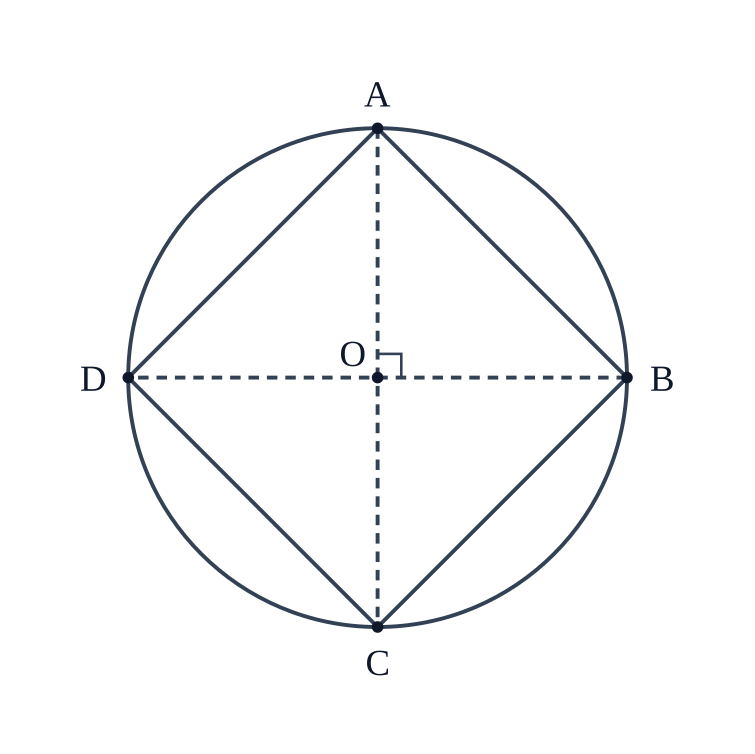
    The pyramid's square base \(\displaystyle ABCD\) has its corners on the base circle of the cylinder (top view). Its apex is on the top face, so its height is \(\displaystyle h\).NCERT_Solution_Class9_Maths_Ch14_EoC_Q11The diagonals are diameters, \(\displaystyle OA = OB = r\), and they meet at right angles at \(\displaystyle O\).\[AB^2 = OA^2 + OB^2 = r^2 + r^2 = 2r^2 \] \[\text{base area} = AB^2 = 2r^2 \] \[V_{\text{pyramid}} = \tfrac{1}{3} \times 2r^2 \times h = \tfrac{2}{3} r^2 h \] \[V_{\text{cylinder}} = \pi r^2 h \] \[\frac{V_{\text{pyramid}}}{V_{\text{cylinder}}} = \frac{\tfrac{2}{3} r^2 h}{\pi r^2 h} = \frac{2}{3\pi} \approx 0.21 \]Answer: \(\displaystyle V_{\text{pyramid}} : V_{\text{cylinder}} = 2 : 3\pi\).
  2. Exercise 12

    What is the change in volume when:
    (i)
    the length of a cuboid with dimensions l,w,h\displaystyle l, w, h is increased by 1\displaystyle 1 unit?
    (a)
    1\displaystyle 1 cubic unit
    (b)
    (lwh + 1\displaystyle 1) cubic unit
    (c)
    wh cubic units
    (d)
    lw\displaystyle l w cubic units
    (e)
    lh\displaystyle l h cubic units
    (ii)
    the radius of a cylinder with dimensions r,h\displaystyle r, h is increased by 1\displaystyle 1 unit?
    (a)
    1\displaystyle 1 cubic unit
    (b)
    πr2h\displaystyle \pi r^2 h cubic units
    (c)
    πr2\displaystyle \pi r^2 cubic units
    (d)
    2πrh+2πh\displaystyle 2 \pi r h+2 \pi h cubic units
    (e)
    2πrh+πh\displaystyle 2 \pi r h+\pi h cubic units *(iii) the radius of a sphere is decreased by 1\displaystyle 1 unit?

    Not cross-checked

    This solution has not been cross-checked against the answer printed in NCERT.

    (i) New volume minus old volume: \[(l+1)\,wh - lwh = wh \] The volume increases by \(\displaystyle wh\) cubic units: option (c).(ii) \[\pi (r+1)^2 h - \pi r^2 h = \pi h\,(2r + 1) = 2\pi r h + \pi h \] The volume increases by \(\displaystyle 2\pi r h + \pi h\) cubic units: option (e).(iii) The radius \(\displaystyle r\) becomes \(\displaystyle r - 1\) (with \(\displaystyle r \ge 1\)): \[\tfrac{4}{3}\pi (r-1)^3 - \tfrac{4}{3}\pi r^3 = \tfrac{4}{3}\pi\,(-3r^2 + 3r - 1) \] \[= -\left(4\pi r^2 - 4\pi r + \tfrac{4\pi}{3}\right) \] The volume decreases by \(\displaystyle 4\pi r^2 - 4\pi r + \tfrac{4\pi}{3}\) cubic units.Answer: (i) (c) \(\displaystyle wh\); (ii) (e) \(\displaystyle 2\pi r h + \pi h\); (iii) a decrease of \(\displaystyle 4\pi r^2 - 4\pi r + \tfrac{4\pi}{3}\) cubic units.
  3. Exercise 13

    Given a cube with volume V\displaystyle V, express its total surface area S\displaystyle S in terms of V\displaystyle V.

    Not cross-checked

    This solution has not been cross-checked against the answer printed in NCERT.

    Let the edge of the cube be \(\displaystyle a\).\[V = a^3 \ \Rightarrow\ a = V^{1/3} \] \[S = 6a^2 = 6\left(V^{1/3}\right)^2 = 6V^{2/3} \]Check with \(\displaystyle a = 2\): \(\displaystyle V = 8\) and \(\displaystyle 6\cdot 8^{2/3} = 6 \cdot 4 = 24 = 6 \cdot 2^2\).Answer: \(\displaystyle S = 6V^{2/3}\).
  4. Exercise 14

    Given a cube with total surface area S\displaystyle S, express its volume V\displaystyle V in terms of S\displaystyle S.

    Not cross-checked

    This solution has not been cross-checked against the answer printed in NCERT.

    Let the edge of the cube be \(\displaystyle a\).\[S = 6a^2 \ \Rightarrow\ a = \sqrt{\frac{S}{6}} \] \[V = a^3 = \left(\frac{S}{6}\right)^{3/2} = \frac{S\sqrt{S}}{6\sqrt{6}} \]Check with \(\displaystyle S = 24\): \(\displaystyle \left(\tfrac{24}{6}\right)^{3/2} = 4^{3/2} = 8 = 2^3\).Answer: \(\displaystyle V = \left(\dfrac{S}{6}\right)^{3/2}\).
  5. Exercise 15

    A cylindrical glass of height 25\displaystyle 25 cm and radius 4\displaystyle 4 cm has water up to a height of 16\displaystyle 16 cm. A crow wants to drink water from this glass. The water must be at a height of 20\displaystyle 20 cm for the crow to reach it. There are some marbles lying around. How many marbles of radius 1\displaystyle 1 cm should the crow drop into the glass to make the water reach the required height?

    Not cross-checked

    This solution has not been cross-checked against the answer printed in NCERT.

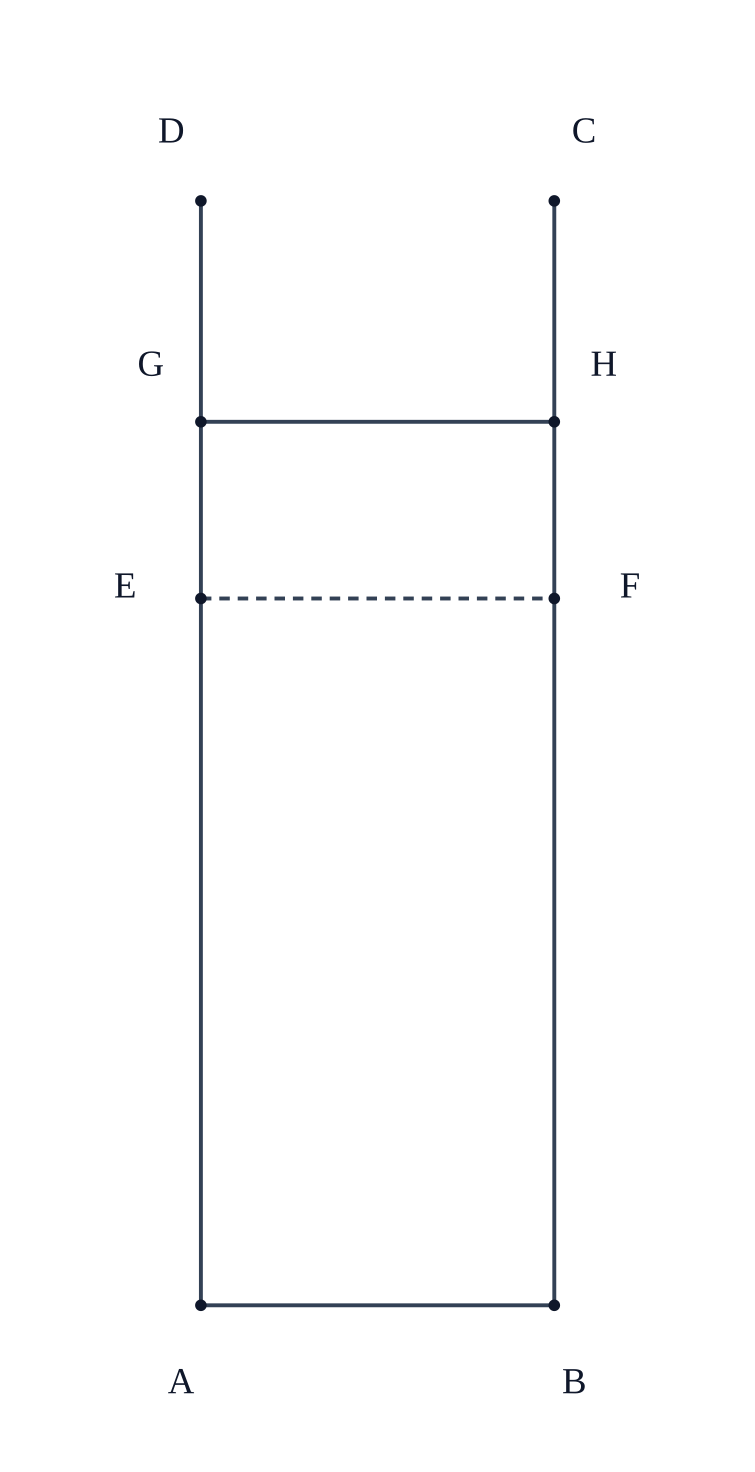
    Guess: a few dozen marbles.The marbles sink, so the water rises from \(\displaystyle EF\) to \(\displaystyle GH\), a rise of \(\displaystyle 20 - 16 = 4\) cm. The volume of this extra layer equals the volume of the marbles.NCERT_Solution_Class9_Maths_Ch14_EoC_Q15\[V_{\text{rise}} = \pi (4)^2 (4) = 64\pi\ \text{cm}^3 \] \[V_{\text{marble}} = \tfrac{4}{3}\pi (1)^3 = \tfrac{4\pi}{3}\ \text{cm}^3 \] \[n = \frac{64\pi}{4\pi/3} = 48 \]The water at $\displaystyle 20$ cm stays below the rim at $\displaystyle 25$ cm.Answer: $\displaystyle 48$ marbles.
  6. Exercise 16

    Find the volume of ink in a new ball point pen. Take the necessary measurements and make approximations, as needed.

    Not cross-checked

    This solution has not been cross-checked against the answer printed in NCERT.

    Guess: well under $\displaystyle 1$ mL.Treat the ink in the refill as a thin cylinder. Measured with a ruler on a transparent refill: ink column length \(\displaystyle h \approx 10\) cm, inner diameter \(\displaystyle \approx 2\) mm, so \(\displaystyle r \approx 0.1\) cm.\[V = \pi r^2 h \] \[V \approx 3.14 \times (0.1)^2 \times 10 = 0.314\ \text{cm}^3 \] \[0.314\ \text{cm}^3 \approx 0.3\ \text{mL} \quad (1000\ \text{cm}^3 = 1\ \text{litre}) \]The ball at the tip is ignored. Other pens and measurements give somewhat different values; any estimate from measured \(\displaystyle r\) and \(\displaystyle h\) is valid.Answer: about \(\displaystyle 0.3\ \text{cm}^3\) ($\displaystyle 0.3$ mL) from \(\displaystyle V = \pi r^2 h\), as one worked example.
  7. Exercise 17

    Solve: (i) A ball of chapati dough of radius 6\displaystyle 6 cm is prepared. Estimate how many chapatis can be made from it? *(ii) Cut a coconut/muskmelon in half and find out the approximate volume of edible coconut flesh/fruit by taking the necessary measurements.

    Not cross-checked

    This solution has not been cross-checked against the answer printed in NCERT.

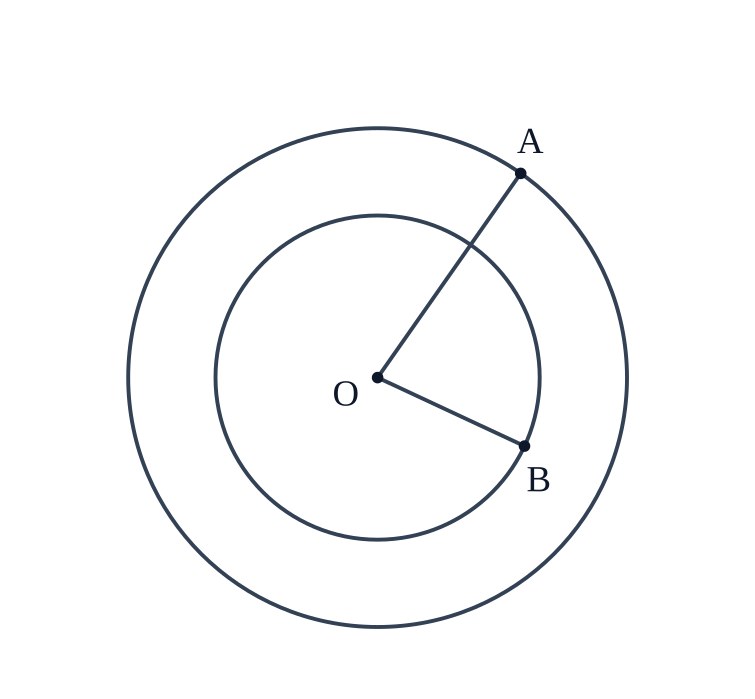
    (i) Guess: about 20. Model the ball as a sphere and a chapati as a thin disc, diameter $\displaystyle 15$ cm and thickness $\displaystyle 2$ mm.\[V_{\text{ball}} = \tfrac{4}{3}\pi (6)^3 = 288\pi \ \text{cm}^3 \] \[V_{\text{chapati}} = \pi (7.5)^2 (0.2) = 11.25\pi \ \text{cm}^3 \] \[\frac{288\pi}{11.25\pi} = 25.6 \]Round down: a 26th chapati would fall short.(ii) Guess: about $\displaystyle 400$ cm\(\displaystyle ^3\). Suppose the cut face of a coconut shows outer radius \(\displaystyle R = 6\) cm and flesh $\displaystyle 1$ cm thick, so \(\displaystyle r = 5\) cm. Each half's flesh is a hemispherical shell.NCERT_Solution_Class9_Maths_Ch14_EoC_Q17\[V_{\text{half}} = \tfrac{2}{3}\pi R^3 - \tfrac{2}{3}\pi r^3 = \tfrac{2}{3}\pi (216 - 125) = \tfrac{182\pi}{3} \approx 190.6 \ \text{cm}^3 \] \[V_{\text{coconut}} = 2 \times 190.6 \approx 381 \ \text{cm}^3 \]Other measurements give other valid answers. For a muskmelon, \(\displaystyle r\) is the seed cavity's radius.Answer: (i) about $\displaystyle 25$ chapatis; (ii) about $\displaystyle 380$ cm\(\displaystyle ^3\) of flesh for the coconut measured above.
  8. Exercise 18

    Looking at the Ganita Manjari, Grade 9\displaystyle 9, Part 2\displaystyle 2 textbook, Sheela wonders:
    (i)
    If all the pages of this textbook were laid out side-by-side on the floor would they cover the entire classroom floor?
    (ii)
    What is the maximum number of textbooks that can fit in an empty storeroom of dimensions 15\displaystyle 15 ft × 20\displaystyle 20 ft × 30\displaystyle 30 ft?

    Not cross-checked

    This solution has not been cross-checked against the answer printed in NCERT.

    (i) Guess: no. Take $\displaystyle 100$ sheets ($\displaystyle 200$ pages) of $\displaystyle 20$ cm \(\displaystyle \times\) $\displaystyle 27$ cm and a classroom $\displaystyle 8$ m \(\displaystyle \times\) $\displaystyle 6$ m.\[A_{\text{sheets}} = 100 \times 20 \times 27 = 54\,000 \ \text{cm}^2 = 5.4 \ \text{m}^2 \] \[A_{\text{floor}} = 8 \times 6 = 48 \ \text{m}^2 \] \[\frac{5.4}{48} \approx \frac{1}{9} \]Counting each of the $\displaystyle 200$ pages separately:\[200 \times 540 = 108\,000 \ \text{cm}^2 = 10.8 \ \text{m}^2 < 48 \ \text{m}^2 \]Other page sizes give other values, but nowhere near 48.(ii) Guess: about $\displaystyle 5$ lakh. Book: $\displaystyle 20$ \(\displaystyle \times\) $\displaystyle 27$ \(\displaystyle \times\) $\displaystyle 1$ cm; with $\displaystyle 1$ ft \(\displaystyle \approx\) $\displaystyle 30$ cm the room is $\displaystyle 450$ \(\displaystyle \times\) $\displaystyle 600$ \(\displaystyle \times\) $\displaystyle 900$ cm. Volume bound:\[\frac{450 \times 600 \times 900}{20 \times 27 \times 1} = \frac{2.43 \times 10^{8}}{540} = 450\,000 \]Stack the $\displaystyle 1$, $\displaystyle 20$, $\displaystyle 27$ cm edges along $\displaystyle 450$, $\displaystyle 600$, $\displaystyle 900$ cm:\[\frac{450}{1} = 450, \qquad \frac{600}{20} = 30, \qquad \left\lfloor \frac{900}{27} \right\rfloor = 33 \] \[450 \times 30 \times 33 = 445\,500 \]Other book sizes give other values.Answer: (i) No: $\displaystyle 5.4$ m\(\displaystyle ^2\) of paper ($\displaystyle 10.8$ m\(\displaystyle ^2\) even counting each page separately) against a $\displaystyle 48$ m\(\displaystyle ^2\) floor. (ii) About $\displaystyle 4.5$ lakh books ($\displaystyle 445,500$ stacked; never more than $\displaystyle 450,000$).
  9. Exercise 19

    If the entire human population decided to climb into one giant cube, how long would the side have to be?

    Not cross-checked

    This solution has not been cross-checked against the answer printed in NCERT.

    Guess: about $\displaystyle 1$ km. Take \(\displaystyle 8 \times 10^{9}\) people, each of mass $\displaystyle 60$ kg and about the density of water (\(\displaystyle 1000\ \text{kg/m}^3\)), packed without gaps.\[v = \frac{60}{1000} = 0.06 \ \text{m}^3 \] \[V = 8 \times 10^{9} \times 0.06 = 4.8 \times 10^{8} \ \text{m}^3 \] \[s = \sqrt[3]{4.8 \times 10^{8}} \approx 783 \ \text{m} \]With standing room of \(\displaystyle 0.5\ \text{m}^3\) each:\[s = \sqrt[3]{8 \times 10^{9} \times 0.5} \approx 1587 \ \text{m} \]Answer: about $\displaystyle 0.8$ km; about $\displaystyle 1.6$ km with standing room.
  10. Exercise 20

    The Earth's surface has an estimated volume of 1.38\displaystyle 1.38 billion km3\displaystyle \mathrm{km}^3 of water. Suppose the Earth is a perfect sphere and all this water forms a uniform layer completely covering the Earth's surface, like a thin water bubble. Estimate the thickness of this water layer. The Earth's radius is ~6371\displaystyle 6371 km.
    (i)
    Write an expression that gives the thickness of this water layer.
    (ii)
    Simplify the expression in (i) using a calculator.

    Not cross-checked

    This solution has not been cross-checked against the answer printed in NCERT.

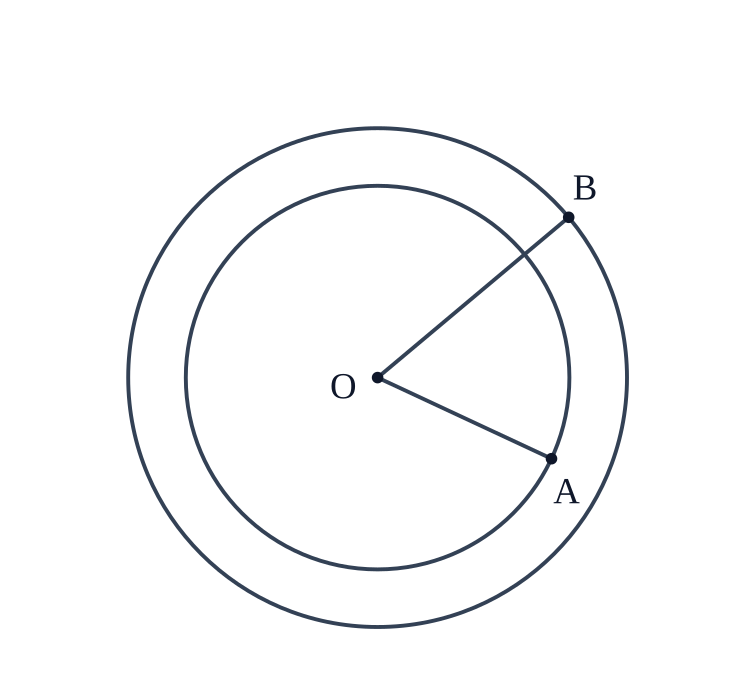
    (i) Guess: a few km. The water is a shell between spheres of radius \(\displaystyle R\) and \(\displaystyle R + t\), with \(\displaystyle V = 1.38 \times 10^{9}\ \text{km}^3\).NCERT_Solution_Class9_Maths_Ch14_EoC_Q20\[V = \tfrac{4}{3}\pi (R + t)^3 - \tfrac{4}{3}\pi R^3 \] \[(R + t)^3 = R^3 + \frac{3V}{4\pi} \] \[t = \sqrt[3]{R^3 + \frac{3V}{4\pi}} - R \](ii) With \(\displaystyle R = 6371\) km:\[R^3 \approx 2.5860 \times 10^{11}, \qquad \frac{3V}{4\pi} \approx 3.2945 \times 10^{8} \] \[t = \sqrt[3]{2.58926 \times 10^{11}} - 6371 \approx 6373.70 - 6371 \approx 2.7 \ \text{km} \]Check: \(\displaystyle t\) is tiny beside \(\displaystyle R\), so \(\displaystyle t \approx \dfrac{V}{4\pi R^2} = \dfrac{1.38 \times 10^{9}}{5.101 \times 10^{8}} \approx 2.7\ \text{km}\).Answer: (i) \(\displaystyle t = \sqrt[3]{R^3 + \tfrac{3V}{4\pi}} - R\); (ii) about $\displaystyle 2.7$ km.
  11. Exercise 21

    Give the dimension of a cuboid whose volume is halved when its surface area is doubled.

    Not cross-checked

    This solution has not been cross-checked against the answer printed in NCERT.

    Guess: a thick block reshaped into a flat slab, since a slab has much surface for little volume. Take block A and slab B (in cm):\[V_A = 8 \times 14 \times 14 = 1568, \qquad S_A = 2(112 + 196 + 112) = 840 \] \[V_B = 1 \times 28 \times 28 = 784, \qquad S_B = 2(28 + 784 + 28) = 1680 \] \[V_B = \tfrac{1}{2} V_A, \qquad S_B = 2 S_A \]Other pairs work, e.g. \(\displaystyle 8 \times 12 \times 16\) and \(\displaystyle 1 \times 16 \times 48\); multiplying every edge of both by the same \(\displaystyle k\) keeps the ratios.Answer: \(\displaystyle 8 \times 14 \times 14\) cm, reshaped to \(\displaystyle 1 \times 28 \times 28\) cm.
  12. Exercise 22

    Project: Find the volume of your house making necessary approximations. Present how you solved it.

    Not cross-checked

    This solution has not been cross-checked against the answer printed in NCERT.

    Treat each room as a cuboid, take the ceiling height as $\displaystyle 3$ m and ignore wall thickness. Measure each room's floor and add the volumes. Sample plan (metres):\[\begin{array}{|l|c|c|c|c|} \hline \text{Room} & l & w & h & V = lwh \ (\text{m}^3) \\ \hline \text{Living room} & 5 & 4 & 3 & 60 \\ \text{Bedroom 1} & 4 & 4 & 3 & 48 \\ \text{Bedroom 2} & 3.5 & 3 & 3 & 31.5 \\ \text{Kitchen} & 3 & 3 & 3 & 27 \\ \text{Baths and passage} & 2.5 & 3 & 3 & 22.5 \\ \hline & & & \text{Total} & 189 \\ \hline \end{array} \]Check with the whole house as one box:\[9 \times 7 \times 3 = 189 \ \text{m}^3 = 1\,89\,000 \ \text{litres} \]Another house gives other numbers; the method is the same.Answer: for the sample house, about \(\displaystyle 189\ \text{m}^3\) ($\displaystyle 1,89,000$ litres).