Exercise 1
Find the area under the given curves and given lines:
(i)
and -axis
(ii)
and -axis
Not cross-checked
This solution has not been cross-checked against the answer printed in NCERT.
NCERT’s answer
(i)
\(\displaystyle \frac{7}{3}\) (ii) $\displaystyle 624.8$
The area of the region bounded by a curve \(\displaystyle y=f(x)\), the \(\displaystyle x\)-axis and the ordinates \(\displaystyle x=a,\;x=b\) is \(\displaystyle \int_{a}^{b}|y|\,dx\); when \(\displaystyle f(x)\ge 0\) throughout \(\displaystyle [a,b]\) the modulus may be dropped and the area is simply \(\displaystyle \int_{a}^{b}y\,dx\).
(i)
On \(\displaystyle [1,2]\) we have \(\displaystyle y=x^{2}>0\), so the whole strip lies above the \(\displaystyle x\)-axis:
\[\text{Area}=\int_{1}^{2}x^{2}\,dx=\left[\frac{x^{3}}{3}\right]_{1}^{2}=\frac{8}{3}-\frac{1}{3}=\frac{7}{3}.\]
Area \(\displaystyle =\dfrac{7}{3}\) square units.
(ii)
On \(\displaystyle [1,5]\) we have \(\displaystyle y=x^{4}>0\), so again no splitting is needed:
\[\text{Area}=\int_{1}^{5}x^{4}\,dx=\left[\frac{x^{5}}{5}\right]_{1}^{5}=\frac{3125}{5}-\frac{1}{5}=\frac{3124}{5}.\]
Area \(\displaystyle =\dfrac{3124}{5}=624.8\) square units.
 By the definition of the modulus,
\[|x+3|=\begin{cases}-(x+3), & x<-3,\\[2pt] x+3, & x\ge -3.\end{cases}\]
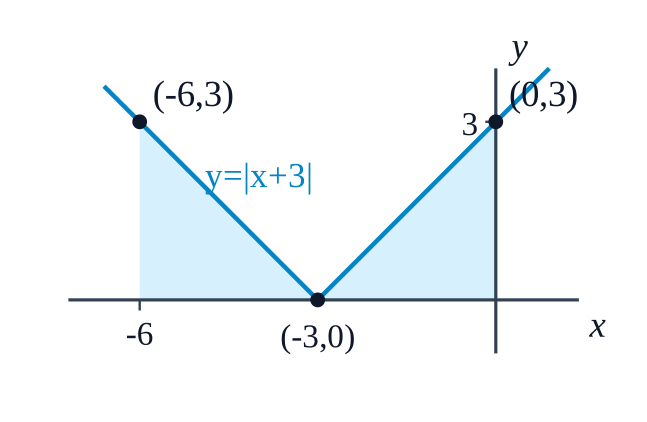
So the graph is two straight half-lines meeting at the vertex \(\displaystyle (-3,0)\): the line \(\displaystyle y=-(x+3)\) of slope \(\displaystyle -1\) to the left of \(\displaystyle x=-3\) (through \(\displaystyle (-6,3)\)), and the line \(\displaystyle y=x+3\) of slope \(\displaystyle +1\) to the right (through \(\displaystyle (0,3)\)). The graph never dips below the \(\displaystyle x\)-axis.Because the integrand changes formula at \(\displaystyle x=-3\), the integral must be split there (this is the step to get right \(\displaystyle -\) integrating \(\displaystyle x+3\) straight through from \(\displaystyle -6\) to \(\displaystyle 0\) would give \(\displaystyle 0\)):
\[\int_{-6}^{0}|x+3|\,dx=\int_{-6}^{-3}-(x+3)\,dx+\int_{-3}^{0}(x+3)\,dx.\]
First piece:
\[\int_{-6}^{-3}-(x+3)\,dx=-\left[\frac{x^{2}}{2}+3x\right]_{-6}^{-3}=-\left[\left(\frac{9}{2}-9\right)-\left(18-18\right)\right]=-\left(-\frac{9}{2}\right)=\frac{9}{2}.\]
Second piece:
\[\int_{-3}^{0}(x+3)\,dx=\left[\frac{x^{2}}{2}+3x\right]_{-3}^{0}=0-\left(\frac{9}{2}-9\right)=\frac{9}{2}.\]
Adding,
\[\int_{-6}^{0}|x+3|\,dx=\frac{9}{2}+\frac{9}{2}=9.\]
(Check against the sketch: two right triangles of legs \(\displaystyle 3\) and \(\displaystyle 3\), total area \(\displaystyle 2\times\tfrac12\times3\times3=9\).)\(\displaystyle \displaystyle\int_{-6}^{0}|x+3|\,dx=9\).
By the definition of the modulus,
\[|x+3|=\begin{cases}-(x+3), & x<-3,\\[2pt] x+3, & x\ge -3.\end{cases}\]
So the graph is two straight half-lines meeting at the vertex \(\displaystyle (-3,0)\): the line \(\displaystyle y=-(x+3)\) of slope \(\displaystyle -1\) to the left of \(\displaystyle x=-3\) (through \(\displaystyle (-6,3)\)), and the line \(\displaystyle y=x+3\) of slope \(\displaystyle +1\) to the right (through \(\displaystyle (0,3)\)). The graph never dips below the \(\displaystyle x\)-axis.Because the integrand changes formula at \(\displaystyle x=-3\), the integral must be split there (this is the step to get right \(\displaystyle -\) integrating \(\displaystyle x+3\) straight through from \(\displaystyle -6\) to \(\displaystyle 0\) would give \(\displaystyle 0\)):
\[\int_{-6}^{0}|x+3|\,dx=\int_{-6}^{-3}-(x+3)\,dx+\int_{-3}^{0}(x+3)\,dx.\]
First piece:
\[\int_{-6}^{-3}-(x+3)\,dx=-\left[\frac{x^{2}}{2}+3x\right]_{-6}^{-3}=-\left[\left(\frac{9}{2}-9\right)-\left(18-18\right)\right]=-\left(-\frac{9}{2}\right)=\frac{9}{2}.\]
Second piece:
\[\int_{-3}^{0}(x+3)\,dx=\left[\frac{x^{2}}{2}+3x\right]_{-3}^{0}=0-\left(\frac{9}{2}-9\right)=\frac{9}{2}.\]
Adding,
\[\int_{-6}^{0}|x+3|\,dx=\frac{9}{2}+\frac{9}{2}=9.\]
(Check against the sketch: two right triangles of legs \(\displaystyle 3\) and \(\displaystyle 3\), total area \(\displaystyle 2\times\tfrac12\times3\times3=9\).)\(\displaystyle \displaystyle\int_{-6}^{0}|x+3|\,dx=9\).