Exercise 1
Find the area of the region bounded by the ellipse .
Not cross-checked
This solution has not been cross-checked against the answer printed in NCERT.
NCERT’s answer
\(\displaystyle 12 \pi\)
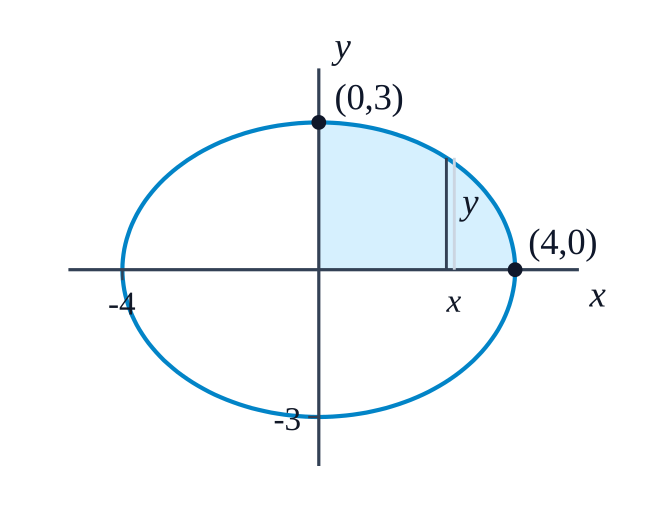 The region is the whole ellipse \(\displaystyle \frac{x^{2}}{16}+\frac{y^{2}}{9}=1\), i.e. \(\displaystyle \frac{x^{2}}{4^{2}}+\frac{y^{2}}{3^{2}}=1\), so \(\displaystyle a=4\) along the \(\displaystyle x\)-axis and \(\displaystyle b=3\) along the \(\displaystyle y\)-axis.The equation contains only \(\displaystyle x^{2}\) and \(\displaystyle y^{2}\), so the curve is symmetric about both axes. Hence the required area is four times the area of the part lying in the first quadrant.In the first quadrant \(\displaystyle y\ge 0\), so solving the equation of the ellipse for \(\displaystyle y\),
\[\frac{y^{2}}{9}=1-\frac{x^{2}}{16}\quad\Rightarrow\quad y=\frac{3}{4}\sqrt{16-x^{2}},\qquad 0\le x\le 4 \]Taking vertical strips of height \(\displaystyle y\) and width \(\displaystyle dx\) from \(\displaystyle x=0\) to \(\displaystyle x=4\),
\[\text{Area}=4\int_{0}^{4}y\,dx=4\int_{0}^{4}\frac{3}{4}\sqrt{16-x^{2}}\,dx=3\int_{0}^{4}\sqrt{16-x^{2}}\,dx \]Applying the standard integral \(\displaystyle \int\sqrt{a^{2}-x^{2}}\,dx=\frac{x}{2}\sqrt{a^{2}-x^{2}}+\frac{a^{2}}{2}\sin^{-1}\frac{x}{a}+C\) with \(\displaystyle a=4\),
\[\text{Area}=3\left[\frac{x}{2}\sqrt{16-x^{2}}+8\sin^{-1}\frac{x}{4}\right]_{0}^{4} \]At \(\displaystyle x=4\) the first term vanishes because \(\displaystyle \sqrt{16-16}=0\), and \(\displaystyle \sin^{-1}1=\frac{\pi}{2}\); at \(\displaystyle x=0\) both terms are \(\displaystyle 0\). So
\[\text{Area}=3\left[\left(0+8\cdot\frac{\pi}{2}\right)-0\right]=3(4\pi)=12\pi \](This agrees with the general formula \(\displaystyle \pi ab=\pi(4)(3)=12\pi\).)The area of the region bounded by the ellipse is \(\displaystyle 12\pi\) square units.
The region is the whole ellipse \(\displaystyle \frac{x^{2}}{16}+\frac{y^{2}}{9}=1\), i.e. \(\displaystyle \frac{x^{2}}{4^{2}}+\frac{y^{2}}{3^{2}}=1\), so \(\displaystyle a=4\) along the \(\displaystyle x\)-axis and \(\displaystyle b=3\) along the \(\displaystyle y\)-axis.The equation contains only \(\displaystyle x^{2}\) and \(\displaystyle y^{2}\), so the curve is symmetric about both axes. Hence the required area is four times the area of the part lying in the first quadrant.In the first quadrant \(\displaystyle y\ge 0\), so solving the equation of the ellipse for \(\displaystyle y\),
\[\frac{y^{2}}{9}=1-\frac{x^{2}}{16}\quad\Rightarrow\quad y=\frac{3}{4}\sqrt{16-x^{2}},\qquad 0\le x\le 4 \]Taking vertical strips of height \(\displaystyle y\) and width \(\displaystyle dx\) from \(\displaystyle x=0\) to \(\displaystyle x=4\),
\[\text{Area}=4\int_{0}^{4}y\,dx=4\int_{0}^{4}\frac{3}{4}\sqrt{16-x^{2}}\,dx=3\int_{0}^{4}\sqrt{16-x^{2}}\,dx \]Applying the standard integral \(\displaystyle \int\sqrt{a^{2}-x^{2}}\,dx=\frac{x}{2}\sqrt{a^{2}-x^{2}}+\frac{a^{2}}{2}\sin^{-1}\frac{x}{a}+C\) with \(\displaystyle a=4\),
\[\text{Area}=3\left[\frac{x}{2}\sqrt{16-x^{2}}+8\sin^{-1}\frac{x}{4}\right]_{0}^{4} \]At \(\displaystyle x=4\) the first term vanishes because \(\displaystyle \sqrt{16-16}=0\), and \(\displaystyle \sin^{-1}1=\frac{\pi}{2}\); at \(\displaystyle x=0\) both terms are \(\displaystyle 0\). So
\[\text{Area}=3\left[\left(0+8\cdot\frac{\pi}{2}\right)-0\right]=3(4\pi)=12\pi \](This agrees with the general formula \(\displaystyle \pi ab=\pi(4)(3)=12\pi\).)The area of the region bounded by the ellipse is \(\displaystyle 12\pi\) square units.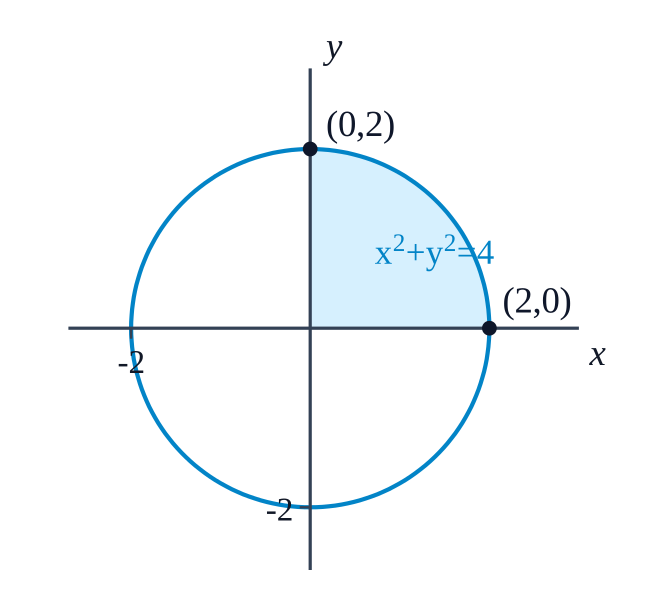 The circle \(\displaystyle x^{2}+y^{2}=4\) has centre at the origin and radius \(\displaystyle 2\). In the first quadrant both \(\displaystyle x\ge 0\) and \(\displaystyle y\ge 0\), and the lines \(\displaystyle x=0\) and \(\displaystyle x=2\) are exactly the two extreme ordinates of the circle there, so the region is the whole first-quadrant quarter of the disc.In the first quadrant \(\displaystyle y=\sqrt{4-x^{2}}\) (positive square root, since \(\displaystyle y\ge 0\)), so
\[\text{Area}=\int_{0}^{2}y\,dx=\int_{0}^{2}\sqrt{4-x^{2}}\,dx \]Using \(\displaystyle \int\sqrt{a^{2}-x^{2}}\,dx=\frac{x}{2}\sqrt{a^{2}-x^{2}}+\frac{a^{2}}{2}\sin^{-1}\frac{x}{a}+C\) with \(\displaystyle a=2\),
\[\text{Area}=\left[\frac{x}{2}\sqrt{4-x^{2}}+2\sin^{-1}\frac{x}{2}\right]_{0}^{2}=\left(0+2\sin^{-1}1\right)-\left(0+0\right)=2\cdot\frac{\pi}{2}=\pi \](Check: a quarter of the disc is \(\displaystyle \frac{1}{4}\pi r^{2}=\frac{1}{4}\pi(2)^{2}=\pi\).)The area is \(\displaystyle \pi\) square units, so the correct answer is (A).
The circle \(\displaystyle x^{2}+y^{2}=4\) has centre at the origin and radius \(\displaystyle 2\). In the first quadrant both \(\displaystyle x\ge 0\) and \(\displaystyle y\ge 0\), and the lines \(\displaystyle x=0\) and \(\displaystyle x=2\) are exactly the two extreme ordinates of the circle there, so the region is the whole first-quadrant quarter of the disc.In the first quadrant \(\displaystyle y=\sqrt{4-x^{2}}\) (positive square root, since \(\displaystyle y\ge 0\)), so
\[\text{Area}=\int_{0}^{2}y\,dx=\int_{0}^{2}\sqrt{4-x^{2}}\,dx \]Using \(\displaystyle \int\sqrt{a^{2}-x^{2}}\,dx=\frac{x}{2}\sqrt{a^{2}-x^{2}}+\frac{a^{2}}{2}\sin^{-1}\frac{x}{a}+C\) with \(\displaystyle a=2\),
\[\text{Area}=\left[\frac{x}{2}\sqrt{4-x^{2}}+2\sin^{-1}\frac{x}{2}\right]_{0}^{2}=\left(0+2\sin^{-1}1\right)-\left(0+0\right)=2\cdot\frac{\pi}{2}=\pi \](Check: a quarter of the disc is \(\displaystyle \frac{1}{4}\pi r^{2}=\frac{1}{4}\pi(2)^{2}=\pi\).)The area is \(\displaystyle \pi\) square units, so the correct answer is (A).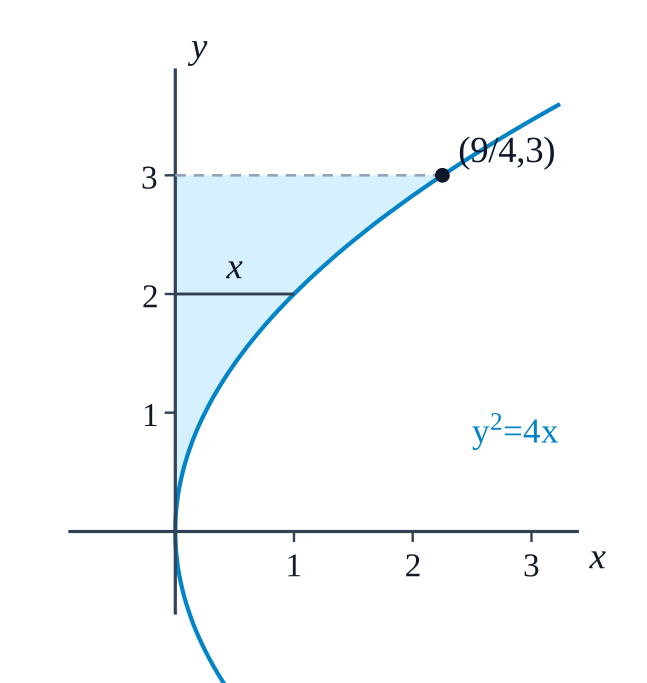 The boundaries are the parabola \(\displaystyle y^{2}=4x\), the \(\displaystyle y\)-axis \(\displaystyle (x=0)\) and the horizontal line \(\displaystyle y=3\). Since the region is bounded by two horizontal lines of the picture (\(\displaystyle y=0\) at the vertex and \(\displaystyle y=3\) at the top) and lies between the \(\displaystyle y\)-axis and the parabola, integrate with respect to \(\displaystyle y\) using horizontal strips — this is the step to get right; integrating \(\displaystyle y\,dx\) would describe a different region.From \(\displaystyle y^{2}=4x\), the length of a horizontal strip measured from the \(\displaystyle y\)-axis to the curve is
\[x=\frac{y^{2}}{4} \]
and \(\displaystyle y\) runs from \(\displaystyle 0\) (the vertex, where the parabola meets the \(\displaystyle y\)-axis) to \(\displaystyle 3\).\[\text{Area}=\int_{0}^{3}x\,dy=\int_{0}^{3}\frac{y^{2}}{4}\,dy=\frac{1}{4}\left[\frac{y^{3}}{3}\right]_{0}^{3}=\frac{1}{4}\cdot\frac{27}{3}=\frac{9}{4} \]The area is \(\displaystyle \frac{9}{4}\) square units, so the correct answer is (B).
The boundaries are the parabola \(\displaystyle y^{2}=4x\), the \(\displaystyle y\)-axis \(\displaystyle (x=0)\) and the horizontal line \(\displaystyle y=3\). Since the region is bounded by two horizontal lines of the picture (\(\displaystyle y=0\) at the vertex and \(\displaystyle y=3\) at the top) and lies between the \(\displaystyle y\)-axis and the parabola, integrate with respect to \(\displaystyle y\) using horizontal strips — this is the step to get right; integrating \(\displaystyle y\,dx\) would describe a different region.From \(\displaystyle y^{2}=4x\), the length of a horizontal strip measured from the \(\displaystyle y\)-axis to the curve is
\[x=\frac{y^{2}}{4} \]
and \(\displaystyle y\) runs from \(\displaystyle 0\) (the vertex, where the parabola meets the \(\displaystyle y\)-axis) to \(\displaystyle 3\).\[\text{Area}=\int_{0}^{3}x\,dy=\int_{0}^{3}\frac{y^{2}}{4}\,dy=\frac{1}{4}\left[\frac{y^{3}}{3}\right]_{0}^{3}=\frac{1}{4}\cdot\frac{27}{3}=\frac{9}{4} \]The area is \(\displaystyle \frac{9}{4}\) square units, so the correct answer is (B).