SolveIt is under development
SolveItClass 12 · Exemplar

NCERT Exemplar · Class 12 Physics Wave Optics

23 questions

Very Short Answer Questions 10–15 (part 3 of 5)

  1. Exercise 10

    Is Huygen's principle valid for longitudunal sound waves?
    NCERT’s answer
    Yes.
    Each point of a sound wavefront emits secondary wavelets; their forward envelope is the next wavefront.\[\text{wavelet radius after time } t:\quad r = vt,\qquad v_{\text{air}}\approx 340\ \mathrm{m\,s^{-1}} \]The construction needs only a finite wave speed, not transverse vibrations.Answer: Yes.
  2. Exercise 11

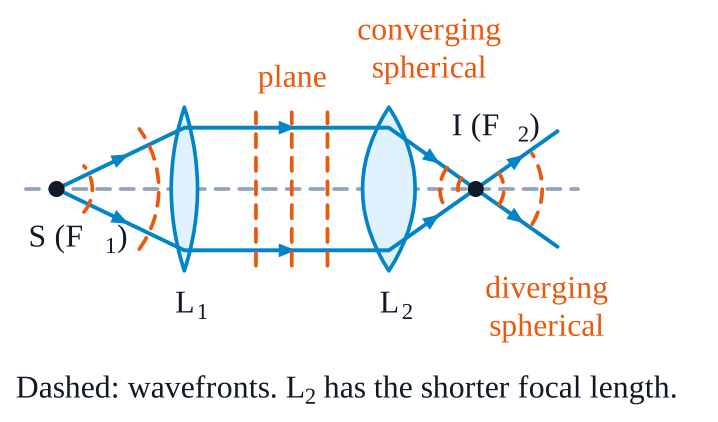
    Consider a point at the focal point of a convergent lens. Another convergent lens of short focal length is placed on the other side. What is the nature of the wavefronts emerging from the final image?
    NCERT’s answer
    Spherical.
    \[S\ \text{at}\ F_1 \;\Rightarrow\; \text{parallel rays} \;\Rightarrow\; \text{plane wavefront between } L_1 \text{ and } L_2 \]\[\text{plane wavefront}\ \xrightarrow{\ L_2\ }\ \text{converging spherical wavefront, centre } I\ \text{at}\ F_2 \]NCERT_Solution_Class12_Physics_Exemplar_Ch10_Q11Beyond \(\displaystyle I\) the wavefront spreads out again as a diverging sphere.Answer: Spherical, converging to the image point and diverging beyond it.
  3. Exercise 12

    What is the shape of the wavefront on earth for sunlight?
    NCERT’s answer
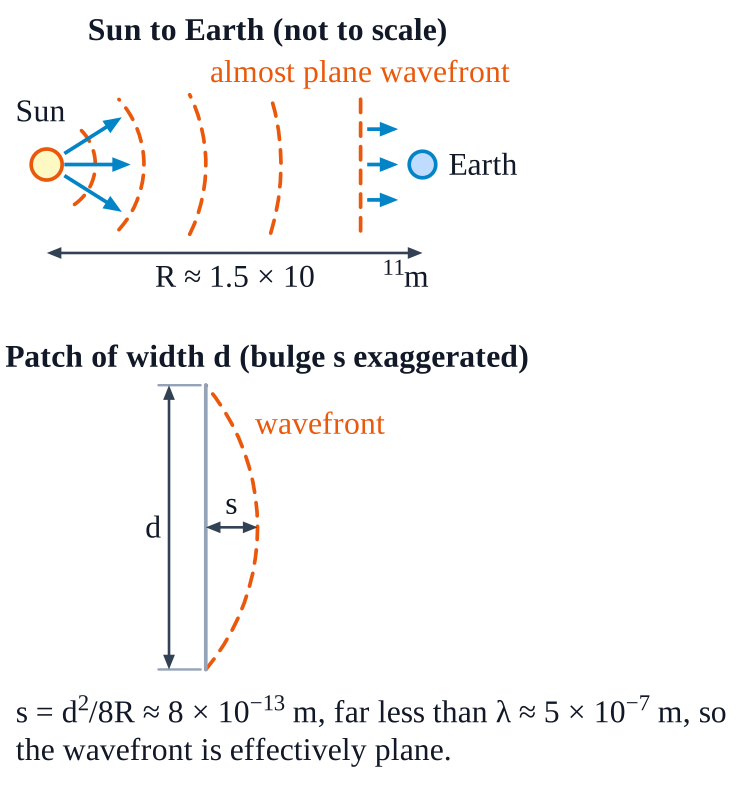
    Spherical with huge radius as compared to the earth's radius so that it is almost a plane.
    Bulge of the sphere over a patch of width \(\displaystyle d\):\[R\approx 1.5\times10^{11}\ \mathrm{m},\qquad d = 1\ \mathrm{m} \]\[s=\frac{d^{2}}{8R}=\frac{(1\ \mathrm{m})^{2}}{8\times1.5\times10^{11}\ \mathrm{m}}\approx 8\times10^{-13}\ \mathrm{m}\ \ll\ \lambda\approx 5\times10^{-7}\ \mathrm{m} \]NCERT_Solution_Class12_Physics_Exemplar_Ch10_Q12Curvature is far below one wavelength, so the wavefront is effectively plane.Answer: Spherical, radius \(\displaystyle R\approx1.5\times10^{11}\ \mathrm{m}\), so effectively plane.
  4. Exercise 13

    Why is the diffraction of sound waves more evident in daily experience than that of light wave?
    NCERT’s answer
    Sound wave have frequencies $\displaystyle 20$ Hz to $\displaystyle 20$ kHz. The corresponding wavelengths are 15m and 15mm, respectively. Diffraction effects are seen if there are slits of width \(\displaystyle a\) such that. \[\alpha \sim \lambda . \] For light waves, wavelengths \(\displaystyle \sim 10^{-7} \mathrm{~m}\). Thus diffraction effects will show when \[a \sim 10^{-7} \mathrm{~m} . \] whereas for sound they will show for \[15 \mathrm{~mm}<a<15 \mathrm{~m} . \]
    Diffraction is marked only when the obstacle or opening is comparable to \(\displaystyle \lambda\).\[\lambda_{\text{sound}}=\frac{v}{f}=\frac{340\ \mathrm{m\,s^{-1}}}{1000\ \mathrm{Hz}}=0.34\ \mathrm{m},\qquad \lambda_{\text{light}}\approx 5\times10^{-7}\ \mathrm{m} \]\[\text{door or wall, } a\sim 1\ \mathrm{m}:\qquad \frac{\lambda_{\text{sound}}}{a}\sim 0.3,\qquad \frac{\lambda_{\text{light}}}{a}\sim 5\times10^{-7} \]Answer: Sound's wavelength is comparable to everyday obstacles; light's is far smaller.
  5. Exercise 14

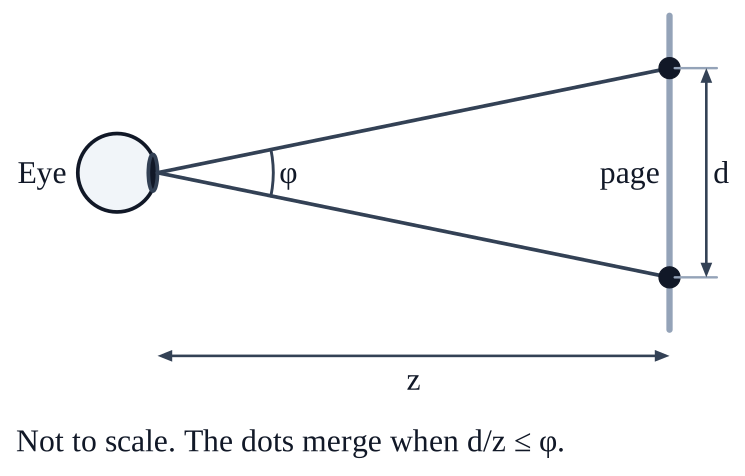
    The human eye has an approximate angular resolution of ϕ=5.8×10⁻⁴\displaystyle \phi=5.8 \times 10^{-4} rad and a typical photoprinter prints a minimum of 300\displaystyle 300 dpi (dots per inch, 1\displaystyle 1 inch = 2.54\displaystyle 2.54 cm). At what minimal distance z should a printed page be held so that one does not see the individual dots.
    NCERT’s answer
    The linear distance between two dots is \(\displaystyle l=\frac{2.54}{300} \mathrm{~cm} \simeq 0.84 \times 10^{-2} \mathrm{~cm}\). At a distance of \(\displaystyle Z \mathrm{~cm}\) this subtends an angle. \[\phi \sim l / z \therefore z=\frac{l}{\phi}=\frac{0.84 \times 10^{-2} \mathrm{~cm}}{5.8 \times 10^{-4}} \sim 14.5 \mathrm{~cm} . \]
    Dot spacing:\[d=\frac{2.54\ \mathrm{cm}}{300}=8.47\times10^{-3}\ \mathrm{cm}=8.47\times10^{-5}\ \mathrm{m} \]NCERT_Solution_Class12_Physics_Exemplar_Ch10_Q14Dots stay unresolved when their spacing subtends at most \(\displaystyle \phi\) at the eye:\[\frac{d}{z}\le\phi \;\Rightarrow\; z\ \ge\ \frac{d}{\phi}=\frac{8.47\times10^{-5}\ \mathrm{m}}{5.8\times10^{-4}\ \mathrm{rad}}\approx 0.146\ \mathrm{m} \]Answer: \(\displaystyle z\approx 0.146\ \mathrm{m}\) (about $\displaystyle 15$ cm); hold the page no closer.
  6. Exercise 15

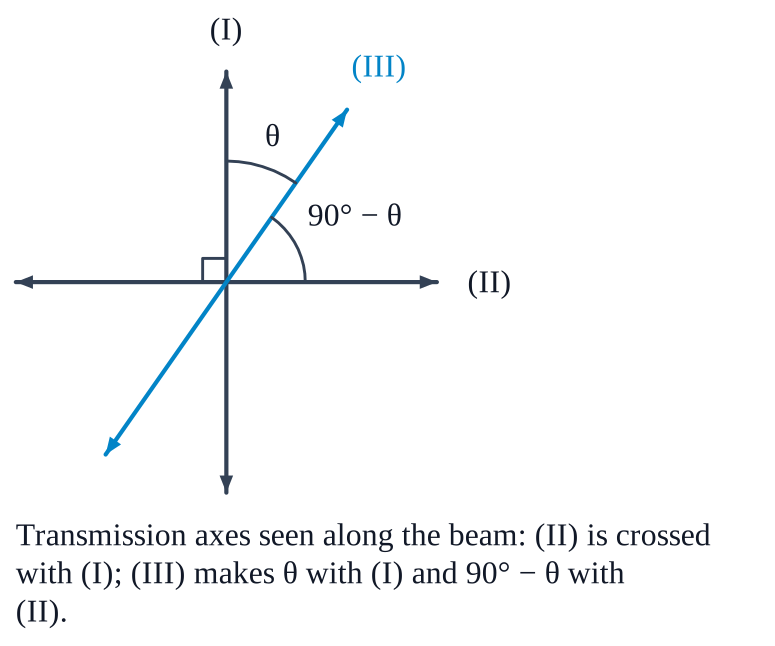
    A polariod (I) is placed in front of a monochromatic source. Another polatiod (II) is placed in front of this polaroid (I) and rotated till no light passes. A third polaroid (III) is now placed in between (I) and (II). In this case, will light emerge from (II). Explain.
    NCERT’s answer
    Only in the special cases when the pass axis of (III) is parollel to (I) or (II) there shall be no light emerging. In all other cases there shall be light emerging because the pass axis of (II) is no longer perpendicular to the pass axis of (III).
    \(\displaystyle I_0\) leaves (I); axis of (III) at \(\displaystyle \theta\) to (I); (II) crossed to (I).NCERT_Solution_Class12_Physics_Exemplar_Ch10_Q15\[I'=I_0\cos^2\theta \quad\text{(after III)} \]\[I''=I'\cos^2(90^\circ-\theta)=I_0\cos^2\theta\,\sin^2\theta=\tfrac14 I_0\sin^2 2\theta \quad\text{(after II)} \]\[\theta\neq0^\circ,\,90^\circ\ \Rightarrow\ I''\neq0,\qquad \theta=45^\circ:\ I''=\tfrac14 I_0 \]Answer: Yes; at most \(\displaystyle I_0/4\) at \(\displaystyle \theta=45^\circ\).