SolveIt is under development
SolveItClass 12 · Exemplar

NCERT Exemplar · Class 12 Physics Wave Optics

23 questions

Long Answer Questions 20–23 (part 5 of 5)

  1. Exercise 20

    AC=CO=D, S1C=S2C=d≪D\mathrm{AC}=\mathrm{CO}=D, \mathrm{~S}_1 \mathrm{C}=\mathrm{S}_2 \mathrm{C}=d \ll D A small transparent slab containing material of μ=1.5\displaystyle \mu=1.5 is placed along AS2\displaystyle \mathrm{AS}_2 (Fig.10.6). What will be the distance from O of the principal maxima and of the first minima on either side of the principal maxima obtained in the absence of the glass slab. . NCERT_Question_Class12_Physics_Exemplar_Ch10_Q20
    NCERT’s answer
    Path difference \(\displaystyle =2 d \sin \theta+(\mu-1) l\) ∴ For principal maxima, \[\begin{aligned} & 2 d \sin \theta+0.5 l=0 \\ & \sin \theta_0=\frac{-l}{4 d}=\frac{-1}{16} \quad\left(\because l=\frac{d}{4}\right) \\ & \therefore \mathrm{OP}=D \tan \theta_0 \approx-\frac{D}{16} \end{aligned} \] For the first minima: \[\therefore 2 d \sin \theta_1+0.5 l= \pm \frac{\lambda}{2} \] \[\sin \theta_1=\frac{ \pm \lambda / 2-0.5 l}{2 d}=\frac{ \pm \lambda / 2-\lambda / 8}{2 \lambda}= \pm \frac{1}{4}-\frac{1}{16} \] On the positive side: \(\displaystyle \sin \theta^{+}=\frac{3}{16}\) On the negative side: \(\displaystyle \sin \theta^{-}=-\frac{5}{16}\) The first principal maxima on the positive side is at distance \(\displaystyle D \tan \theta^{+}=D \frac{\sin \theta^{+}}{\sqrt{1-\sin ^2 \theta}}=D \frac{3}{\sqrt{16^2-3^2}}\) above O. In the -ve side, the distance will be \(\displaystyle D \tan \theta^{-}=\frac{5}{\sqrt{16^2-5^2}}\) below O.
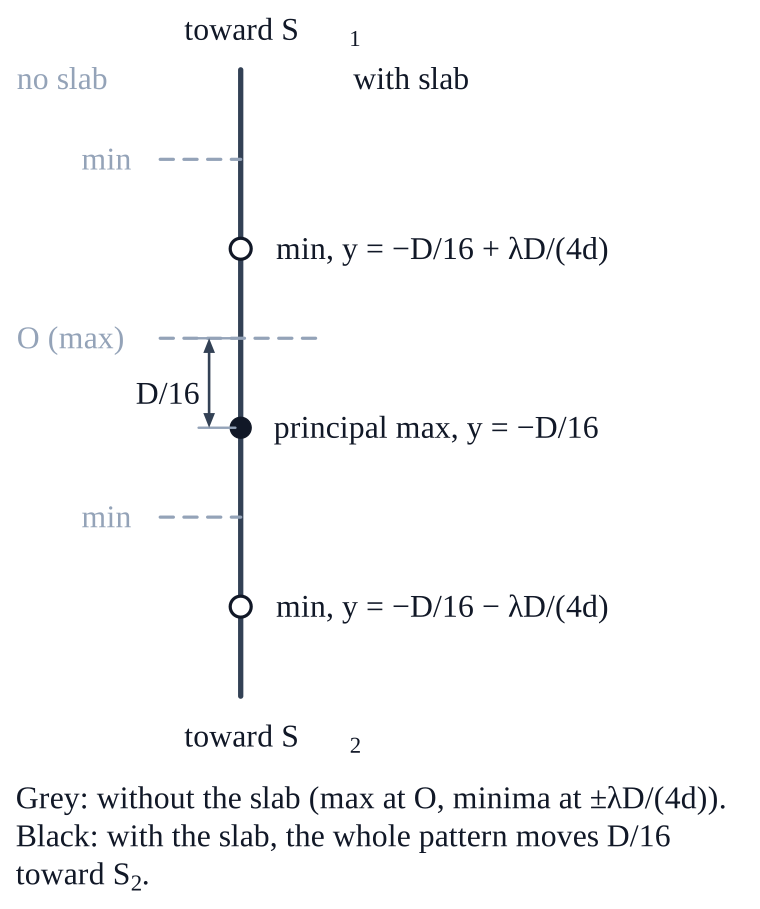
    Slit separation \(\displaystyle S_1S_2=2d\); \(\displaystyle AS_1=AS_2\). For a point \(\displaystyle P\) at height \(\displaystyle y\) above \(\displaystyle O\): \[S_2P-S_1P=2d\sin\theta\approx\frac{2d\,y}{D} \] Only the extra optical path of the slab counts, since it replaces air of the same length: \[\Delta_{\text{slab}}=(\mu-1)L=(1.5-1)\,\frac d4=\frac d8 \] Net path difference (via \(\displaystyle S_2\) minus via \(\displaystyle S_1\)): \[\Delta=\frac{2d\,y}{D}+\frac d8 \] Principal maximum, \(\displaystyle \Delta=0\): \[y_0=-\frac{D}{16} \] First minima, \(\displaystyle \Delta=\pm\dfrac{\lambda}{2}\): \[\frac{2d\,y}{D}+\frac d8=\pm\frac{\lambda}{2}\;\Rightarrow\; y=-\frac{D}{16}\pm\frac{\lambda D}{4d} \] NCERT_Solution_Class12_Physics_Exemplar_Ch10_Q20 Without the slab: maximum at \(\displaystyle O\), minima at \(\displaystyle \pm\dfrac{\lambda D}{4d}\); the slab shifts the whole pattern by \(\displaystyle D/16\) toward \(\displaystyle S_2\). Answer: principal maximum at \(\displaystyle D/16\) below \(\displaystyle O\) (toward \(\displaystyle S_2\)); first minima at \(\displaystyle y=-\dfrac{D}{16}\pm\dfrac{\lambda D}{4d}\) from \(\displaystyle O\).
  2. Exercise 21

    Four identical monochromatic sources A,B,C,D as shown in the (Fig.10.7) produce waves of the same wavelength λ\displaystyle \lambda and are coherent. Two receiver R1\displaystyle \mathrm{R}_1 and R2\displaystyle \mathrm{R}_2 are at great but equal distaces from B.
    (i)
    Which of the two receivers picks up the larger signal?
    (ii)
    Which of the two receivers picks up the larger signal when B is turned off?
    (iii)
    Which of the two receivers picks up the larger signal when D is turned off?
    (iv)
    Which of the two receivers can distinguish which of the sources B or D has been turned off?
    NCERT_Question_Class12_Physics_Exemplar_Ch10_Q21
    Take \(\displaystyle d\gg\lambda\): every source gives the same amplitude \(\displaystyle a\) at a receiver, so only phase matters. Phase relative to B:
    \[\phi=-\frac{2\pi}{\lambda}\,(r-r_B) \]
    A sideways offset of \(\displaystyle \lambda/2\) changes the distance only by \(\displaystyle \sim\lambda^2/8d\approx0\), so it is ignored.
    \(\displaystyle R_1\) (on line CBA, beyond A): A is nearer by \(\displaystyle \lambda/2\), C farther by \(\displaystyle \lambda/2\), D\(\displaystyle \approx\) same as B:
    \[\phi_A=+\pi,\quad \phi_B=0,\quad \phi_C=-\pi,\quad \phi_D=0 \]
    \(\displaystyle R_2\) (perpendicular to AC, on the side opposite D): D is farther by \(\displaystyle \lambda/2\), A, B, C equal:
    \[\phi_A=\phi_B=\phi_C=0,\quad \phi_D=-\pi \]
    Resultant (terms in the order A, B, C, D):
    (i)
    all on:
    \[E_1=a(-1+1-1+1)=0,\qquad E_2=a(1+1+1-1)=2a \]
    (ii)
    B off:
    \[E_1=a(-1-1+1)=-a,\qquad E_2=a(1+1-1)=a \]
    (iii)
    D off:
    \[E_1=a(-1+1-1)=-a,\qquad E_2=a(1+1+1)=3a \]
    (iv)
    \(\displaystyle |E_1|=a\) whether B or D is off; \(\displaystyle |E_2|=a\) for B off but \(\displaystyle 3a\) for D off.
    Answer: (i) \(\displaystyle R_2\) (\(\displaystyle I=4a^2\) against $\displaystyle 0$); (ii) equal (\(\displaystyle a^2\) each); (iii) \(\displaystyle R_2\) (\(\displaystyle 9a^2\) against \(\displaystyle a^2\)); (iv) \(\displaystyle R_2\).
  3. Exercise 22

    The optical properties of a medium are governed by the relative permitivity (εr\displaystyle \varepsilon_r) and relative permeability (μr\displaystyle \mu_r). The refractive index is defined as μrεr=n\displaystyle \sqrt{\mu_r \varepsilon_r}=n. For ordinary material εr>0\displaystyle \varepsilon_r>0 and μr>0\displaystyle \mu_{\mathrm{r}}>0 and the positive sign is taken for the square root. In 1964\displaystyle 1964, a Russian scientist V. Veselago postulated the existence of material with εr\displaystyle \varepsilon_r <0\displaystyle <0 and μr<0\displaystyle \mu_{\mathrm{r}}<0. Since then such 'metamaterials' have been produced in the laboratories and their optical properties studied. For such materials n=−μrεr\displaystyle n=-\sqrt{\mu_r \varepsilon_r}. As light enters a medium of such refractive index the phases travel away from the direction of propagation.
    (i)
    According to the description above show that if rays of light enter such a medium from air (refractive index =1\displaystyle =1) at an angle θ\displaystyle \theta in 2nd \displaystyle 2^{\text {nd }} quadrant, them the refracted beam is in the 3rd \displaystyle 3^{\text {rd }} quadrant.
    (ii)
    Prove that Snell's law holds for such a medium.
    NCERT’s answer
    (i)
    Suppose the postulate is true, then two parallel rays would proceed as shown in Fig. 1. Assuming ED shows a wave front then all points on this must have the same phase. All points with the same optical path length must have the same phase.
    Thus \(\displaystyle -\sqrt{\varepsilon_r \mu_r} A E=\mathrm{BC}-\sqrt{\varepsilon_r \mu_r} \mathrm{CD}\)
    or \(\displaystyle B C=\sqrt{\varepsilon_r \mu_r}(C D-A E)\)
    \(\displaystyle \mathrm{BC}>0, \mathrm{CD}>\mathrm{AE}\)
    As showing that the postulate is reasonable. If however, the light proceeded in the sense it does for ordinary material (viz. in the fourth quadrant, Fig. $\displaystyle 2$)
    Then \(\displaystyle -\sqrt{\varepsilon_r \mu_r} A E=\mathrm{BC}-\sqrt{\varepsilon_r \mu_r} \mathrm{CD}\)
    or, \(\displaystyle B C=\sqrt{\varepsilon_r \mu_r}(C D-A E)\)
    As AE > CD, BC < O
    showing that this is not possible. Hence the postalate is correct.
    (ii)
    From Fig. 1.
    \(\displaystyle \mathrm{BC}=\mathrm{AC} \sin \theta_{\mathrm{i}}\) and \(\displaystyle \mathrm{CD}-\mathrm{AE}=\mathrm{AC} \sin \theta_{\mathrm{r}}\):
    Since \(\displaystyle -\sqrt{\varepsilon_r \mu_r}(A E-C D)=B C\)
    \(\displaystyle -n \sin \theta_{\mathrm{r}}=\sin \theta_i\).
    NCERT_Solution_Class12_Physics_Exemplar_Ch10_Q22_ncert
    NCERT_Solution_Class12_Physics_Exemplar_Ch10_Q22_ncert_2
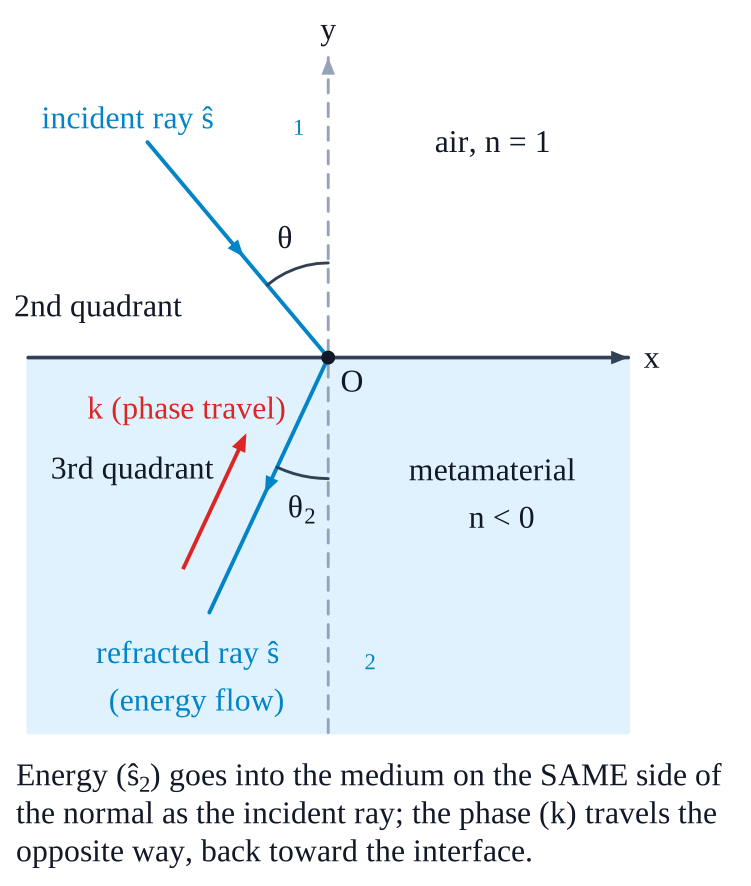
    Interface along the \(\displaystyle x\)-axis, normal along \(\displaystyle y\), air above. Incident ray comes from the 2nd quadrant to \(\displaystyle O\) with unit direction \(\displaystyle \hat{\mathbf{s}}_1=(\sin\theta,\,-\cos\theta)\), \(\displaystyle \theta>0\). Wave vector in a medium of index \(\displaystyle n\) (phase moves opposite to the ray when \(\displaystyle n<0\)): \[\mathbf{k}=n\,\frac{\omega}{c}\,\hat{\mathbf{s}} \] NCERT_Solution_Class12_Physics_Exemplar_Ch10_Q22 The phase must match along the interface at every \(\displaystyle x\), so \(\displaystyle k_x\) is the same on both sides, with \(\displaystyle \hat{\mathbf{s}}_2=(\sin\theta_2,\,-\cos\theta_2)\) the ray direction in the medium: \[\frac{\omega}{c}\,(1)\sin\theta=\frac{\omega}{c}\,n\sin\theta_2 \] \[\sin\theta_2=\frac{\sin\theta}{n}<0\quad(n=-\sqrt{\mu_r\varepsilon_r}<0) \] Energy flows into the medium, so \(\displaystyle s_{2y}=-\cos\theta_2<0\), and \(\displaystyle s_{2x}=\sin\theta_2<0\): \[s_{2x}<0,\quad s_{2y}<0 \;\Rightarrow\; \text{refracted ray in the 3rd quadrant} \] Part (ii): with \(\displaystyle n_1=1,\ n_2=n\) the matching condition is \[n_1\sin\theta_1=n_2\sin\theta_2,\qquad |\theta_2|=\sin^{-1}\frac{\sin\theta}{|n|} \] Answer: (i) \(\displaystyle \sin\theta_2=\sin\theta/n<0\) puts the refracted ray in the 3rd quadrant; (ii) \(\displaystyle n_1\sin\theta_1=n_2\sin\theta_2\) holds with \(\displaystyle n_2<0\).
  4. Exercise 23

    To ensure almost 100\displaystyle 100 per cent transmittivity, photographic lenses are often coated with a thin layer of dielectric material. The refractive index of this material is intermediated between that of air and glass (which makes the optical element of the lens). A typically used dielectric film is MgF2\displaystyle \mathrm{MgF}_2 (n=1.38)\displaystyle (n=1.38). What should the thickness of the film be so that at the center of the visible speetrum (5500A˚)\displaystyle (5500 \AA) there is maximum transmission.
    NCERT’s answer
    Consider a ray incident at an angle \(\displaystyle i\). A part of this ray is reflected from the air-film interface and a part refracted inside. This is partly reflected at the film-glass interface and a part transmitted. A part of the reflected ray is reflected at the film-air interface and a part transmitted as \(\displaystyle r_2\) parallel to \(\displaystyle r_1\). Of course succesive reflections and transmissions will keep on decreasing the amplitude of the wave. Hence rays \(\displaystyle r_1\) and \(\displaystyle r_2\) shall dominate the behavior. If incident light is to be transmitted through the lens, \(\displaystyle r_1\) and \(\displaystyle r_2\) should interfere destructively. Both the reflections at A and D are from lower to higher refractive index and hence there is no phase change on reflection. The optical path difference between \(\displaystyle r_2\) and \(\displaystyle r_1\) is \(\displaystyle n(\mathrm{AD}+\mathrm{CD})-\mathrm{AB}\). If \(\displaystyle d\) is the thickness of the film, then \[\begin{aligned} & A D=C D=\frac{d}{\cos r} \\ & A B=A C \sin i \\ & \frac{A C}{2}=d \tan r \\ & \therefore A C=2 d \tan r \end{aligned} \] Hence, \(\displaystyle \mathrm{AB}=2 \mathrm{~d} \tan r \sin i\) Thus the optical path difference is \[\begin{aligned} & 2 n \frac{d}{\cos r}-2 d \tan r \sin i \\ & =2 . \frac{\sin i}{\sin r} \frac{d}{\cos r}-2 d \frac{\sin r}{\cos r} \sin i \\ & =2 d \sin \left[\frac{1-\sin ^2 r}{\sin r \cos r}\right] \\ & =2 n d \cos r \end{aligned} \] For these waves to interefere destructively this must be \(\displaystyle \lambda / 2\). \[\Rightarrow 2 n d \cos r=\frac{\lambda}{2} \] or \(\displaystyle n d \cos r=\lambda / 4\) For a camera lens, the sources are in the vertical plane and hence \[\begin{aligned} & i \simeq r \simeq 0 \\ & \therefore n d \simeq \frac{\lambda}{4} . \\ & \Rightarrow d=\frac{5500 \AA}{1.38 \times 4} \simeq 1000 \AA \end{aligned} \] NCERT_Solution_Class12_Physics_Exemplar_Ch10_Q23_ncert
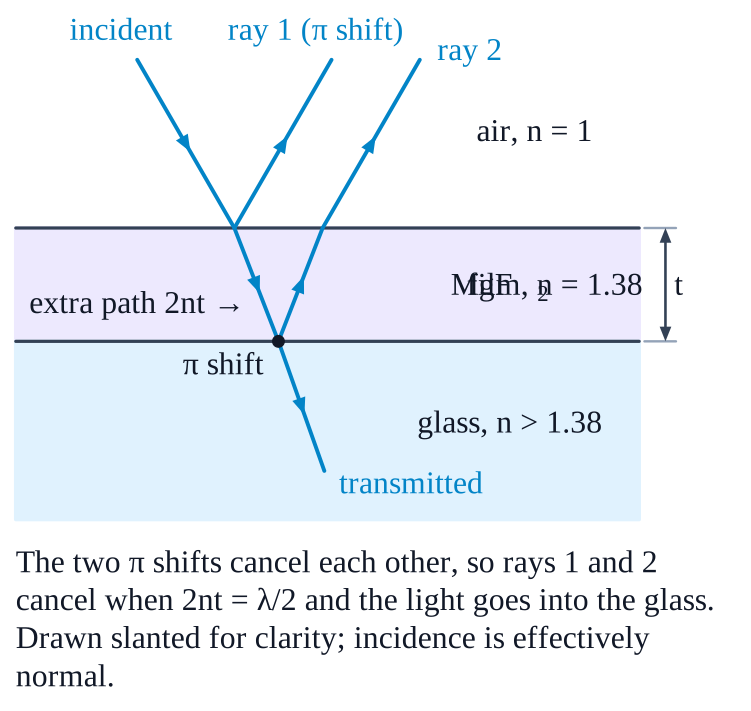
    Air \(\displaystyle <\) film \(\displaystyle <\) glass in refractive index, so each reflection (air–film and film–glass) gives a \(\displaystyle \pi\) shift and the two cancel. The reflected rays then cancel, which maximises transmission, when the extra path \(\displaystyle 2nt\) is a half wavelength: NCERT_Solution_Class12_Physics_Exemplar_Ch10_Q23 \[2nt=\left(m+\tfrac12\right)\lambda,\qquad m=0\ \text{for the least thickness} \] \[t=\frac{\lambda}{4n}=\frac{550\ \mathrm{nm}}{4\times1.38} \] \[t\approx 99.6\ \mathrm{nm}\approx 1.0\times10^{-7}\ \mathrm{m} \] Do not use \(\displaystyle 2nt=m\lambda\) here; that holds when only one reflection has a \(\displaystyle \pi\) shift. Answer: \(\displaystyle t\approx 99.6\ \mathrm{nm}\) (about $\displaystyle 996$ Å).